FS7: 100 or 109 IRE gamma ?

Hello,

I read quite a lot of stuff relating to video levels, but here I am, still confused.

I shoot for TV, where I need legal broadcast levels, and for Youtube, which apparently clips highlights above 100 IRE.

I always grade, in Speedgrade.

Should I use a hypergamma that goes to 100 IRE or one that goes to 109 IRE ?

If I use a 100 IRE gamma and shoot in 10 bits, do I still get the 10 bits of information ?

Out of curiosity... If the answer is that I should shoot in a 100 IRE gamma, then who needs to shoot in a 109 IRE gamma ? People that shoot for the web but are not going through the Youtube pipeline ? People that shoot for cinema where, I assume, projectors can display the signal above 100 IRE ?

Thanks a lot.

Fred
 
Yep, Ben's right, you're confused between acquisition and delivery. With acquisition, more (dynamic range/exposure latitude) is always better.
 
Thanks for answering. I agree that more dynamic range is better. But when I read the FS7 manual, it states that Hypergamma 1 and 3 have the same dynamic range, but not the same white limit. So, in this case, which one is the better for me ? And what is the use of the latter ?

Quote from the manual :

HG1 3250G36 325% dynamic range 100% white limit

HG3 3259G40 325% dynamic range 109% white limit.
 
Actually, if you are going to shoot with Hypergamma you don't want either one of those. You want HG7 or HG8. Both of them will give you 800% dynamic range and 109% white limit. The use of any other HG besides those two is dumbing down the camera unnecessarily. As others have already said, acquisition has different needs than delivery.
 
HG2 and HG3 seems to be hypergammacurves that are useful for lowlight. Will not be the most typical situation maybe but could be important in such situations for you? To get most of the dynamic range HG7 and HG8 will be better, but shooting for tv you will have to reduce the liminance below IRE100.
 
Thanks.

I agree and I know that HG7 and 8 will be better in terms of dynamic range and for most shooting situations for me.

Let's state my problem another way : What is puzzling me is I don't understand why they do not make HG7 and HG8 equivalents with 100% white limit, given that most users want some "legal" delivery signal, either because they distribute via Youtube or TV or because they just don't want to take any risks. It seems to me it is a waste of time to "legalize" every one of your clips all the time.

So, I assume there must be some "advantage" of some sorts of having an illegal signal ; this is why the questions from my first post still stand :

"If I use a 100 IRE gamma and shoot in 10 bits, do I still get the 10 bits of information ?

Out of curiosity... If the answer is that I should shoot in a 100 IRE gamma, then who needs to shoot in a 109 IRE gamma ? People that shoot for the web but are not going through the Youtube pipeline ? People that shoot for cinema where, I assume, projectors can display the signal above 100 IRE ?"

Have a nice day.
 
Out of curiosity... If the answer is that I should shoot in a 100 IRE gamma, then who needs to shoot in a 109 IRE gamma ?

Well, I certainly do.

As it has already been said a few times already in this thread, the needs of acquistion and delivery are different. I want that extra 9% of headroom. Why would I want to have my my highlights clip right at 100% if I didn't have to? Even if my delivery destination is limited to 100%, that doesn't mean I have to shoot my footage with that artificial ceiling.

Also, the difference between a 109% limit HG and a 100% limit HG wouldn't affect how I expose at all. In other words, my exposure would be exactly the same for both, but one of them gives me some margin of safety. If highlights happen to go beyond 100%, but still don't clip, they could be easily be brought down in post where I have more control and flexibility. It really is shortsighted to hobble your camera for no reason, and you never know how you might want to use that footage later on down the road. In fact, that is exactly the reason why I shoot S-LOG almost all of the time.

https://vimeo.com/ondemand/resolve
 
Hi vilrockerdefer,


a big reason for 109% gammas is to keep everything within legal range (0-100%) reasonably close to basic Rec709 - so that things look good on a monitor or TV - whilst expanding the dynamic range of what is recorded.


Basic Rec709 only has 2 1/3 stops of headroom. Conventionally video cameras increase this by splitting from the base curve with a 'knee' in the top five or ten percent. That gives a bit of detail to smooth off he highlights, but tends to be rather harsh, particularly if you want to reach a great deal of highlight range. By recording into the 'extended' range from 100% to 109%, the rolloff can be gentler, and potentially cover a greater range.


For wide gammas keeping within 100%, something has to give. In the case of LC709 and LC709A, they cover six stops of headroom before clipping at 100%. Pushing that much range into a conventional knee above 90% IRE would be pretty pointless, so instead the rolloff is smooth and diverges from the base Rec709 curve much lower down. The visual upshot is that skin tones and 90% white reflectance end up at much lower levels (65%-70% zebras on a conventional video camera come in around 55%-58% on LC709A on Sony Cameras and similar levels with ARRI 709 on Amira, a 90% white target comes in around 71%).


For the Sony hypergammas, the 109% ones - particularly HG7 and HG8 - mean that you can get a nice, bright client, director and viewer friendly picture within legal range with a bit more available tucked away in extended range where an editor or colourist may find use for it.

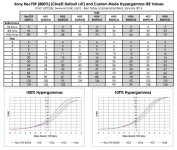
HypergammasChart.jpg
This is a table I made up a while ago including all the Sony Hypergammas, plus Rec709(800%) which gives an idea of how different dynamic ranges are squeezed into the limited 0-100% pot. You can see that the 109% Hypergamma midtones are rather closer to the brightness of Rec709(800%) (which is itself a 109% curve with a soft knee) than the 100% ones,

Ben
 
I want that extra 9% of headroom. Why would I want to have my my highlights clip right at 100% if I didn't have to? Even if my delivery destination is limited to 100%, that doesn't mean I have to shoot my footage with that artificial ceiling.

Also, the difference between a 109% limit HG and a 100% limit HG wouldn't affect how I expose at all. In other words, my exposure would be exactly the same for both, but one of them gives me some margin of safety. If highlights happen to go beyond 100%, but still don't clip, they could be easily be brought down in post where I have more control and flexibility.

Thank you. Your position is exactly the same as mine was until I checked something last friday... I switched from (virtually identical except for white limit) HG1 and HG3 on my FS7 and saw that the brightness of the scene changes in the viewfinder.

I therefore conclude that if you shoot 100 vs 109 IRE, you are going to, whether you want it or not, change the way you expose, unless, of course 1) you strictly always expose through scopes and only through scopes 2) you apply a 109% adjustment to your desired levels ie grey for instance.

I was, on purpose, shooting something that was partly overexposed to check if I would get some more highlights information with the 109 IRE profile. But I did not notice any additional details. No more information at all.

It seems to me so far, that when you switch from a 100 IRE profile to an "identical" 109 IRE profile, you are not "gaining" any information, you are just changing the scale. It looks as if it would be strictly equivalent, for instance, to shoot with 90% zebra in a 100 IRE profile, and to shoot with 100% zebra in the same but 109 IRE profile. You would then get the same "headroom", qualitatively and quantitatively speaking.

So again, I don't see how an HG7 equivalent that would only go up to 100% would be detrimental to the final delivery quality.

a big reason for 109% gammas is to keep everything within legal range (0-100%) reasonably close to basic Rec709 - so that things look good on a monitor or TV - whilst expanding the dynamic range of what is recorded.

Now that makes perfect sense and it was the only thing I could so far suspect as the rational reason behind all of this 109 IRE story ! Thank you.

The thing that surprises me is that in your chart, hypergammas that are supposed to have only a 325% DR are still able to capture light at -6 and +5 stops, the same way that 800% gammas do. How come ? I guess there's (still) something I am missing.
 
Your results and conclusions differ markedly from my own, so I will let you figure what works best for you. I already know how the Hypergammas work for me after having used them for over 10 years now.
 
Hi vilrockerdefer,

the percentage values which Sony includes in their Hypergamma titles are 'linear IRE' values. In linear IRE, an 18% gray target equates to 20% linear IRE. Being linear, one stop over is 40%, two stops is 80% three stops 160% and 325% is around four stops over (as you can see on the chart). 460% is around 4 1/2 stops over and 800% around 5 1/3 stops - the headroom of cameras such as the F3 and F35, and consequently the defined spec of S-Log1.

The idea of linear IRE is that 100% linear IRE = 100% Rec709, which is around 2 1/3 stops over.

The percentages in the Hypergammas titles work best as a guide to the headroom available above 18% or mid gray rather than a hard-and-fast definition of the whole dynamic range. Looking against stops, the limit in the shadows is determined by sensor noise and the point at which the difference between each stop is less than the bit-depth (usually 8 or 10) being recorded can distinguish. After all, in terms of stops, an ideal closed iris with lens cap on is minus infinity stops! ;-)

The current generation of Sony cameras claim around 14 potential stops of dynamic range with 6 stops of headroom. That's why I drew the charts to go to 8 stops down, but clearly there won't be much worthwhile going on down there. :)

I initially obtained the data for the curves from examining LUTs generated by Sony software, then checked against any other sources I could find plus playing with my own camera ;-) . As such, I'm confident to say that they are an accurate reflection of the Hypergamma response curves,

Ben
 
Last edited:
Thanks for these enlightening posts.

I'll try to sum up what this means to me in terms of workflow :

Given that I record on the FS7 in HG7 or HG8, the factory viewfinder will show the whole 109% range of brightness, and this means that the middle grey will look a bit underexposed if I shoot a scene with a total contrast corresponding the dynamic range of the selected gamma with the brightest spot in the scene set to give 109 IRE.

After importing in Premiere, the image will look different, as if 9% gain was added, because it displays 100% white as pure white instead of displaying 109% white as pure white as in the viewfinder. Middle grey will look more proper, and of course I'll have the benefit of being able to bring down the superwhites under 100% if I want them displayed.
 
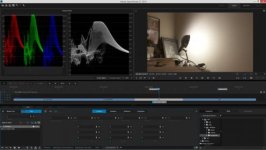
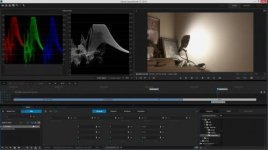
To validate my claims, I tried ingesting my HG1 and HG3 (same scene, same exposure) into Speedgrade. I must say that the readings seem to match those of your chart.

What is surprising is that, contrarily to what one might expect, the 100 IRE HG1 seems to have more dynamic range as 109 IRE HG3. It appears to be the same in your chart, where HG3 can't go as far as 5 stops up, whereas HG1 can.

For the sake of easy visual comparison, I subtracted 0.13 gain to the HG3 shot, so that both scopes would match (at least below highlights clipping).

Here are the captures :

- HG1 : hg1.jpg

- HG3 : hg3.jpg

Here are the original files in full resolution, where you can properly see the clipping.

I am curious about what Doug Jensen thinks about this as well.
 
Last edited:
I am curious about what Doug Jensen thinks about this as well.

I think you are wasting time fooling around two Hypergammas that shouldn't be used at all, so with that said, I have no interest in the comparison. As I already said, HG7 and HG8 are the only two worth using. :)

Also, I don't really care too much about what scopes show in post. Who knows what is happening to the footage in post. If you really want to see what is going on with the CAMERA you need to get a real waveform monitor and connect it to the "live" SDI output with a professional chart and then do your comparison.
 
Last edited:
Well, I am interested in "not too high" DR gammas because, especially when shooting in 8-bit, I suspect high DR tends to cause banding in gradients, as discussed in this post.

I personaly had very disappointing experiences when shooting Slog, as shown by these dpx.

This article states that you should not use high DR gammas if possible (when the scene itself for example has not too much contrast).

For all these reasons, I am interested in "low" DR gammas, especially given that I don't always have access to 10 bit and never to 12 bit.
 
As I said before, I strongly disagree with your conclusions and your fears about banding and your poor experiences with S-LOG, so I will let you figure what works best for you. I already know how the Hypergammas work for me after having used them for over 10 years now, and S-LOG for about four years. But with that said, I think you are wasting time going down the wrong path. If you can't get good results with HG7, HG8, or S-LOG then I would say you are doing something wrong in-camera or in post.
 
The shot I took that is in the dpx above was taken in HFR mode so I guess maybe indeed that explains the banding.

Apart from that, the more I search, the more I feel that 109 IRE vs 100 has absolutely nothing to do with headroom. For example, I just read that Slog3 only goes up to 92 IRE.
 
To be honest this betrays a lack of understanding of what slog is and does and we go back to (again) discussing the difference between acquisition and delivery specs.

All other things being equal shooting with log allows you to cram more information into the image than any other way. When you prep that for a rec709 delivery you can then choose how much of that pint of log information to squeeze into that half pint rec709 delivery container.
 
All other things being equal shooting with log allows you to cram more information into the image than any other way.
If, by information, you mean in the shadows, or if, by information, you mean dynamic range, I think you are correct.

If you mean sheer bits, I think you are wrong. I am no expert on that but I can quote some of them if you wish.


I am curious about what people think the best gamma would be in a shooting situation similar to news shooting ie no time to pull out gray cards, no time for zebraying skin tones, etc, but where you would have all the time you need to color correct in post. For example if you would do a documentary on some war front, or covering some riots, or whatever.

Given that shooting hypergammas forces you to double think before pushing rec, especially to avoid skin tones being exposed too much on the right.
 
Back
Top