1/4" Connector On Cameras Please?

adamr316

Well-known member
Can I get an amen? Please camera makers put 1/4" TRS connectors on cameras from now on not 1/8". The little connectors are fine on CONSUMER cameras but professional gear is no place for such tiny, unsecure connections. Are there any newer cameras that have them on am I crazy?
 
The little connectors are fine on CONSUMER cameras but professional gear is no place for such tiny, unsecure connections.

And if you have a camera with a 1/8" audio input, you have a consumer-grade (or, at best, "pro-sumer") camera.

1/4" is, in a way, just as unstable (read: non-locking) as 1/8". Plus, you're talking about cameras that have terribly cheap, mic-level inputs that are wired for 2-channel, unbalanced signal. The last camera I know of that actually had 1/4" ins was the Sony CCD-V5000 Hi8 camcorder. It was a beast in the "pro-sumer" category as it had tons of manual control, 3 chips, and actual VU meters. No time code, though, and a fixed lens.

Professional gear has XLR inputs for balanced mic- and line- level input.

Edit: Of course, depending on what you're doing, it may not really matter anyway. For ENG and "magazine"-style EFP, yes, you want professional audio in-camera. But if your main gig is narrative (features, docs, indie films), then picture is what matters as far as the camera is concerned. The best sound comes from a dedicated team and gear package.
 
Last edited:
1/4" TRS is not a particularly secure connector. What most folks would want is XLR. It locks and is very robust and is a field standard.

Darn Alex beat me to it.
 
Last edited:
I would concur with Alex. In addition, a 1/4" connector may be even more prone to damage ( to itself or the device) since the barrel protrudes out more than a 1/8" mini.
Are we talking about HPs or audio inputs? For audio inputs, the (Switchcraft mini-XLR) TA series are small, fairly robust and locking.
 
A 1/4" connector is very long and is a bigger hole for contaminant intrusion into your camera. XLR's can be sealed, take up less depth and very little more diameter. 1/8" connectors are used because of the very small footprint and universal availability. If manufacturers would spend the extra few cents, there are high quality locking 1/8" connectors available with threaded shafts on the jacks and screw collars on the plugs.
 
Yes, XLR connectors could be sealed, but I've never seen one that was. (Except for the covers over them when unused.) XLRs actually extend back as far as 1/4 inch connectors and are physically larger, as well. So for purely space conservation, 1/4 inch phone would be more efficient than XLR. But 1/4 inch are NOT the standard for ANYTHING and would require adapters to/from industry standard connections.

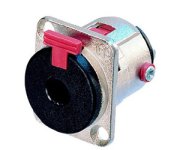
There ARE locking 1/4 inch phone jacks (in the same physical form-factor as panel-mount XLR, see photo below.)

102.jpg

But if you are going to take that much space, just use the industry-standard XLR and get on with your life. 1/4 inch phone is slowly dying in the connector species, replaced by more specific (and generally smaller) connectors.
 
What about the mini-XLR connector ?

I used to own a boundary mic that had a mini XLR connector that never gave me any troubles.
 
What about the mini-XLR connector ?

I used to own a boundary mic that had a mini XLR connector that never gave me any troubles.
Red put mini-XLRs on the original Red One, and they were pretty much universally despised. Tiny non-standard connector that meant having to get an adapter cable for every time you wanted to use it...

XLR is the standard, everything has XLR, even a cheapo $199 Zoom H4N recorder has XLRs. Why go with anything else? If you really, really wanted 1/4", how about a combo quarter-inch & XLR port like the Zoom has... at least you'd still have the standard XLR connector too...
 
Red put mini-XLRs on the original Red One, and they were pretty much universally despised. Tiny non-standard connector that meant having to get an adapter cable for every time you wanted to use it..
The 'new' RED Epic has two 1/8". Go figure. It's non-locking, balanced, (or TS unbalanced). In any case the RED's audio STILL ain't up to Par.. 24 bit or not, a little better than a DSRL maybe.
 
No video camera will ever have really good audio. The priority is ALWAYS the video and NEVER the audio.
The low-end consumer cameras have only enough to keep the customer happy. No mic input. No headphone monitor, etc.
The middle-range pro-sumer, and "professional" cameras have audio good enough for the 11pm news. If you want any better, you are probably doing double-system.
The high-end cameras just assume you are doing double system and have audio only good enough for a scratch/sync/time-code track. And some have no audio at all.

Of course, there are odd-ball things like the Zoom Q3 models which are essentially little portable audio recorders with a camera.
 
Back
Top