“Netflix Image Enhancement Rules Take Cinematographers by Surprise”

That makes a lot of sense!

And the contrast is painful, while Netflix pushes filmmakers into quality broadcast probably still insists on providing interlaced content.
 
Netflix should be more concerned about their streaming image quality. I have a standard HD subscription and The Big Bang Theory looked like a chekerboard.
 
Netflix should be more concerned about their streaming image quality. I have a standard HD subscription and The Big Bang Theory looked like a chekerboard.
It is about the legacy of the source material.
Streaming quality does not solely depend on Netflix but on the network infrastructure between Netflix and people's homes.

But network speed will drastically improve over the next few years.
 
Next on "Netflix: Executive Notes"... (the show that nobody watches because it's mind numbingly boring)

Netflix Exec (to crew): Sorry, guys. New tech requirements. No lenses wider than 35mm, it makes the talent look fat.

DP: But, this is a dream sequence. We're going for a certain look. Things are supposed to look a little weird and distorted.

Netflix Exec: Can't you do that with an 80. When I'm taking video of my dog and my kid an 80 looks great. I think you should go with an 80...

DP: I don't think an 80 works in this situation --

Netflix Exec: Look, I don't care. These are the new tech specs. Follow them. I don't see any Steven Spielbergs or Martin Scorseses here. (to DP)... And you're not Roger Deakins... Look, guys. Sorry, but these are the new rules. Follow them or there could be some consequences for the production...
(leaving)
Have a great shooting day, guys!
 
It seems most other people are somehow living in a magical Nirvana where they are achieving these amazing Internet speeds of 400Mbps or 500 Mbps. I wonder if anyone who claims to be receiving these
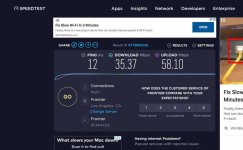
speeds actually CHECKs what they are getting. I pay Frontier for FIOS fiber optic and supposedly am getting 150Mbps up and down.
I go to speedtest.net and on a good day, I can get 35up and around 50Mbps down. That's why I laugh when people start talking reliable 4K, 6K or 8K streaming. And my connection is unreliable as hell,
it's constantly buffering a simple 1080 signal. The damn pipes are not reliable or large enough to do any of this bleeding edge stuff. And I have the supposedly beelding edge fiber. It's a joke.

From 5 minutes ago on my "blazing fast", supposedly 150Mbps connection

Screen Shot 2019-11-18 at 6.36.04 AM  November 18.jpg
 
That's weird, Dan. Your upload is faster than your download? But I agree. I'm on Spectrum in NYC and it's supposed to be 200MB and I'm getting 68 down and 11 up :/
 
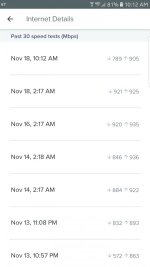
Yeah, these numbers are usually appear only on flyers and the contract. My package says 500 Mbps download speed, 100 Mbps guaranteed. But I've checked my speedtest history, so sometimes 400 Mpbs is a possibility.

speedtest.jpg
 
The problem is that the pipe to your house can handle the speed. But the uplink to the next element in the network cannot. It's been a problem from day one. The box that aggregates the neighborhood traffic never has a big enough link to the backbone or internal switch to deliver the goods for everyone on the box. They also purposely choke traffic from the next box in the network to ease congestion issues. When this stuff was designed, no one imagined the bandwidth needs. They do a full network upgrade to the tune of billions of dollars and it's only good for a few years. The companies that design the boxes (there's only 3 majors left and none of them are North American) have long development cycles.
That's why 5G is so attractive. They can get rid of this other layer of network completely and have one unified wireless network delivering mobile and stationary internet. No need to maintain cables to the house.
 
I just don't trust a 100% wireless network/data solution. Not that our current cable and fiber systems are bullet proof or cutting edge compared to some places in the world, but I know what it's like in a congested cell area and you're dead in the water. I was in FL yesterday covering a major sporting event and as the people started crowding in cell service went away. Not just that the service was bogged down and slow, your phone actually did not have service, as in NO BARS. (*sidebar rant*)With my new iPhone 11 Pro, I generally get at least two days out of a charge and still have around 25%-30% when I put it on charge the second night when I go to bed. Sometimes I will go to bed that first night with it still at at least 80% charge. We were on site almost 16 hours. I was working so it wasn't exactly like I was playing on my phone all day and I only had somewhere in the 30% to maybe 40% max charge left. In 16 hours, because of the weak signal, my phone used as much power as it normally would in two full days of normal use.

So, to make 5G this panacea that everyone things it is going to be, they're going to have to build these wireless networks out to orders of magnitude greater than what we have with 4G.
 
Yes, you're right. One of the problems they've had with cell towers is that a lot of them don't have fiber going to them. So they have the exact same problem I was mentioning; the choke point is the uplink from the aggregator (the tower). 5G will be useless unless they properly engineer the links to the backbone so that it can accommodate the 1G bandwidth being promised. I'm surprised all this stuff works as well as it does. The data rate growths are a real challenge for the operators. People dropping cable and satellite TV and going to 4k streaming is probably a nightmare for them.
 
AT&T claims to have tech that’s faster than 5G, & is delivered over standard telephone lines. This is supposedly why they are not that interested in 5G, but color me skeptical.
 
For a company not interested in 5G, they have it deployed in 21 cities and they are touting something called 5G+.

Regarding faster than 5G over twisted pair, AT&T went through billions to set up their DSL network. I guess they decided extend the life of twisted pair. But that is counter-intuitive to operator's desire to abandon the copper network, which is very expensive to maintain.

AT&T doesn't build or design anything. They're not allowed to by law. It's John Cioffi, the father of DSL that is touting terabit DSL. But the range is much shorter than other DSL technology much like 5G is. He is offering 10G at 500 meters and lower speeds further out. That was in 2017. Give the manufacturers a couple of years to standardize the technology and design new platforms for it and perhaps it's in AT&T's labs by now. Then another year to trial it and two more years to get it out.

The problem is that the current version of DSL goes out to about 5000 feet and Cioffi says terabit DSL won't be practical past 3000' (at what speed he doesn't say). So there's a mismatch there.
 
Wow, you are very privileged to have this available.

For sure. This is Fiber To The Premises (FTTP). My ISP leases the main fiber from AT&T, but then had to run their own lines through the neighborhood, including the hookup to each address as needed. The streets here are a simple grid, so it was probably relatively easy to implement. Once they had enough requests on each block, they would hang the lines and begin installs. After about a year, they pretty much had the whole area covered. I thought my speeds would start dropping after more people got connected to the network, but that hasn't been the case. $62/mo includes taxes, modem/router rental, etc., and that's after they raised the price by $10 in the 3rd year.

I'm very lucky, but I would think this type of network will soon be much more common throughout the country. I know a lot of old DSL networks have been upgraded to Fiber To The Node (FTTN), so many folks are halfway there already.
 
Back
Top