Sony z150 vs z190 colour comparsion

Takumarr

Well-known member
Are 3-sensor cameras superior to single-sensor cameras? Considering the progress of single sensor cameras, do both technologies have the same color result?

in this post, under the pretext of comparing two Sony camera models, in fact, we compare single sensor cameras with prismatic cameras...
 

Attachments

  • 49747-200_fig1.jpg
    49747-200_fig1.jpg
    30.8 KB · Views: 0
There are far more differences between these two cameras than just 3-chip vs. 1-chip. So, it would be virtually impossible to say that any differences you see between the cameras are simply caused by the number of sensors. In other words, there is no way to eliminate all the dozens of other variables that affect image quality.

My advice is to ignore how many sensors a camera has and just evaluate the imagery it produces. If one camera looks better to your eyes than the other, then it is the winner. But then you have to consider all the features and functions one camera offers that may not be found on the other. There are no simple answers.
 
Thanks for your feedback,
190 seems to be a better model than 150 while the sensor size is reduced to 1/3. If 190 doesn't provide a better image than 150, there is no reason to choose it. Although as you mentioned it is the result of the image that is decisive...
 
I don't own a Z150 or Z190 anymore, but they were both very nice cameras for their price and size. The Z190's main problem is that it is terrible in low-light. The Z150's main problem is that it didn't have all the XDCAM ENG bells & whistles.

 
First of all, thank you for the images, as I understand 4k images are 4:2:0 and z150 in 1080 there is a possibility of 4:2:2

Yes, that is correct. But 8-bit 4:2:0 isn't a problem if care is taken to use a picture profile that comes close to a final look, plus making sure exposure and white balance are on the mark. If someone is a sloppy shooter or wants to rely on LOG to fix stuff in post, then the Z150 isn't a good choice for 4K.
 
Thanks, I was just guessing and visually it looks like 420, I wasn't sure, of course sony always has a good balance in movies to the point where it's hard to distinguish between 422 and 420, I'm also interested in smaller formats and 422 xdcam and I am mpeg 35mb. ofcors may I never leave Panasonic cams...
however beuty footage!:thumbup:
 
it's hard to distinguish between 422 and 420:

Yes. I would challenge anyone to tell the difference between 4:2:2 10-bit and 4:2:0 8-bit in a side-by-side comparison of any ungraded footage. The benefits of 4:2:2 only become visible during heavy grading in post. Other than that, they are essentially the same right out of the camera. That's why it is so important to come as close as you can to a final image onboard the camera when shooting 4:2:0 8-bit.
 
But 422 has a color space that is usually recognizable, although I've never found a need for it,
although in some cases a 420 image is better than, or equal to 422. like ex3 35mbps,
 
But 422 has a color space that is usually recognizable, although I've never found a need for it,
although in some cases a 420 image is better than, or equal to 422. like ex3 35mbps,

I'm not saying that 4:2:2 isn't better. It is better. But you can only see the difference if you grade the footage in post. Otherwise the difference (with ungraded footage) is almost never visible to the human eye.
 
If you are agree we turn to topic, beacuse Mr. Chris Young may join the discussion, let's talk about the comparison of single-sensor and 3-sensor camcorders...
 
Last edited:
after 2010, some 3-sensor models continue, and single sensors are upgraded, but the result of the image is similar (or not). We know that 3-sensor cameras are still used. What is their advantage? More realistic color? or accuracy?


sensor-chip.png - Click image for larger version  Name:	sensor-chip.png Views:	0 Size:	59.9 KB ID:	5708133

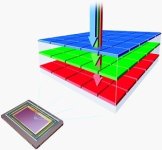
In cameras with 3 sensors, the colors are received on each sensor separately, then they are combined, there will be three colors for each image cell. In single sensors, Bayer filter is used in most cases, a single layer color filter is placed on the cells, in this type of pattern, each pixel is connected with the pixels around it, and the exact color combination is calculated.also additional processing such as anti aliasing may be applied to the image.


FOVEON_X3_BREAKOUT_1_S.jpeg - Click image for larger version  Name:	FOVEON_X3_BREAKOUT_1_S.jpeg Views:	0 Size:	18.7 KB ID:	5708134
There is another type of three-layer color filter, but most cameras use Bayer's single-layer model, which seems to have a certain advantage.

en_zu_09_01.jpg - Click image for larger version  Name:	en_zu_09_01.jpg Views:	0 Size:	16.7 KB ID:	5708135

​​​​​seems that the video results are similar in two sensors, although some videos are more artificial and digitalize colour...
 
Last edited:
If you are agree we turn to topic, beacuse Mr. Chris Young may join the discussion, let's talk about the comparison of single-sensor and 3-sensor camcorders...

You can't compare them unless you know of a camcorder that comes in both single-sensor and three-sensor options. Such a camera doesn't exist. Therefore, when you take any two camcorders and put them side by side it is impossible to say whatever differences you observe are due to there being a different number of sensors.

I wil repeat what I already wrote a few days ago: There are far more differences between two cameras than just 3-chip vs. 1-chip. So, it would be virtually impossible to say that any differences you see between the cameras are simply caused by the number of sensors. In other words, there is no way to eliminate all the dozens of other variables that affect image quality.
 
I htink the closest you could come to comparing a 3-chip camera to a 1-chip camera would be the Sony Z750 (3 chips) and Z450 (1 chip). But even then, ther are deeper differences in signal processing and other paramaters than just counting the number of sensors.
 
You can't compare them unless you know of a camcorder that comes in both single-sensor and three-sensor options. Such a camera doesn't exist. Therefore, when you take any two camcorders and put them side by side it is impossible to say whatever differences you observe are due to there being a different number of sensors.

I wil repeat what I already wrote a few days ago: There are far more differences between two cameras than just 3-chip vs. 1-chip. So, it would be virtually impossible to say that any differences you see between the cameras are simply caused by the number of sensors. In other words, there is no way to eliminate all the dozens of other variables that affect image quality.

You said the result of the image is important, and I have accepted this as an important principle. But if the technology cannot be compared, what is the reason for making new 3chip cameras? What is the justification? Maybe a more natural image! It lies in single sensor cameras, the Bayer pattern uses a computational method for composition, as well as image processing and correction, and anti aliasing and a process that may bring the image closer to a 3-sensor camera, well, that's where our answer .
 
Last edited:
I don't take this discussion too hard, if you see something wrong, I will correct it. I don't have a lot of experience in cames and all the cameras I've handled are less than six cameras! Anyway, it's a good thing that you are very careful.
 
Last edited:
Prism.

There is a prism there that has to be perfectly made and then there are three sensors that have to be perfectly aligned.

Thats what get in the way. It also affects the way lenses have to be designed.

And you may not be able to SEE the difference between 4:2:0 and 4:2:2 but your grading software sure can as soon as you want to start making corrections. That is when you will see the difference.
 
Back
Top