Is this a terrible idea?

SDub

Well-known member
I've recently moved into a new office space which I will film out of. It has a drop ceiling which makes rigging gear to the ceiling challenging, however, I prefer it because it cuts down on cable clutter on the ground a ton.

My plan is to use scissor mounts for drop ceilings, an extension pole, and a ballhead on every piece of gear which would include GH5s, Intellytech LC-160s, other various light fixtures, microphones, and cables. Wherever I add a piece of gear, I plan on adding additional drop ceiling wire for support.

I'm curious if I'm going to regret this in a year for some unforeseen reason like the ceiling drooping over time despite the added support. Anyone have experience in this area?

Gear to be used:
1. Scissor mount: https://www.bhphotovideo.com/c/product/857311-REG/impact_srp_124_scissor_mount_for_drop.html
2. Extension pole: https://www.bhphotovideo.com/c/prod...s_429499_Telescopic_Baby_Stand_Extension.html
3. Ballhead (mostly for lightweight objects): https://www.bhphotovideo.com/c/product/1631590-REG/impact_br_mbh_baby_receiver_with_mini.html
 
It’s not a bad idea but I’m sure it also has its downsides, mainly once setup it’s not easy to change. I hate cable clutter too so good luck and let us know how it turns out.
 
It's quite a novel approach - I've not come across those ceiling mounts before. what does ring a alarm bell (hopefully unnecessarily). The extension is intended for making a floor stand higher - upside down, will the sections remain captive or if loose, let the sliding parts fall out? Looking at the kit I have here, that would be an awful lot of weight to hang off a suspended ceiling - especially if you also have to factor in the cable weight. I didn't know about these fittings, so here the lighting is ground supported. I have 6 vertical scaffolding tubes, and then a grid of scaffolding mounted on top. It's adjusted so that it cannot move laterally - as the tubes have end plates on the walls, preventing sideways movement, but the weight of the whole thing is transferred to the ground. I can place a ladder on the tube if need be, and I just use normal clamps on the lights.
 
I think the listed parts cant carry much load.. as cannot those floatinfg ceilings whose carcass is an aluminium extruded T of about 1mm thick, hing by 2mm wires.

I think a 'grid' of scaffoding or 'bowens high glide' system could be put close to the roof and then many things could be hung and cables tidied

(one way to tidy cables is to punch up the tiles, and throw some leads across above the roof tiles)

S.
 
Drop ceiling metal frames are made out of very thin metal, and I think that the weight and leverage of your gear might bend or warp the metal frame, despite adding support wires.

I once installed a fairly heavy projector in a caddy designed to sit in a ceiling tile slot, as part of a police station training simulator. As far as I know, it's still in place, but
the caddy was suspended by support wires, and the caddy was merely touching the metal frame, not resting on it.
 
I'm no expert but I used such a device to hang lighting for commercial at an office with a drop ceiling. It did the job despite my reservations. It was convenient to hang hair and background lights so they didn't get in a wide shot or if you have limited space to work with. That being said it wasn't permanently installed so I couldn't speak to the long term effects but I was surprised how much weight those type of ceilings can handle.
 
Last edited:
Thank you all for your thoughts and suggestions!

It's quite a novel approach - I've not come across those ceiling mounts before. what does ring a alarm bell (hopefully unnecessarily). The extension is intended for making a floor stand higher - upside down, will the sections remain captive or if loose, let the sliding parts fall out? Looking at the kit I have here, that would be an awful lot of weight to hang off a suspended ceiling - especially if you also have to factor in the cable weight. I didn't know about these fittings, so here the lighting is ground supported. I have 6 vertical scaffolding tubes, and then a grid of scaffolding mounted on top. It's adjusted so that it cannot move laterally - as the tubes have end plates on the walls, preventing sideways movement, but the weight of the whole thing is transferred to the ground. I can place a ladder on the tube if need be, and I just use normal clamps on the lights.

I hadn't thought about using the extensions in a way that wasn't intended - upside down v.s. right side AAup. Is there any way you could take a picture of your setup?

I think a 'grid' of scaffoding or 'bowens high glide' system could be put close to the roof and then many things could be hung and cables tidied
Thanks for giving me a term to search! I'll look into it.
 
If your ceiling has not load support and you are therefore bridging maybe 4m either scaff ot hi glide would need support of some nature..
Neither is ridgid enough to hold a load over a long span.

being attached to a steel H beam or some form of suspension (or upright supports.. doubltless horrid and space ruining)
 
Thank you all for your thoughts and suggestions!


I hadn't thought about using the extensions in a way that wasn't intended - upside down v.s. right side AAup. Is there any way you could take a picture of your setup?


Thanks for giving me a term to search! I'll look into it.

I just saw Andrew Locke(Gaffer and Gear) address this in one of his episodes, telling people to not use things like risers upside down, because the lock-offs are designed for loads pushing down not pulling(if they were upside down).
 
Helped a client set up his office social media studio using some of these... they're fine for light lighting (like LC-160's). I've also used them to hang lighting on other office space shoots. I would not use them for things like camera and microphone... put those on a separate rolling stand or wall mounts.
 
Helped a client set up his office social media studio using some of these... they're fine for light lighting (like LC-160's). I've also used them to hang lighting on other office space shoots. I would not use them for things like camera and microphone... put those on a separate rolling stand or wall mounts.

Hey Mcbob! Why would a light work but not a camera? I feel like the light + ballast is much heavier than the cameras I used (GH5 etc)

A grid would be 'scaffolding' and 'kee klamp' (or kee lite if you have more money)

This is how I currently rig up my space! I drill the klee fittings into floor joists in the ceiling (I'm in a basement) and then rig everything to them. It's been amazing. For a drop ceiling, it's harder because metal H-beams are pretty far up there. How would you attach the klee fittings to the H-beam above? Not sure if there's a cinema standard, or people are just using whatever works for them.

I just saw Andrew Locke(Gaffer and Gear) address this in one of his episodes, telling people to not use things like risers upside down, because the lock-offs are designed for loads pushing down not pulling(if they were upside down).

Thank you so much for mentioning Andrew Locke. I'll go absorb all his rigging content now, haha.
 
Im thinking you need new h beans spanning from wall to wall under the ceiling which you would then attache your system to

maybe an I beam 130mnX80mm (total guess)

clearly that is not cheap or simple

I think these scissor clamps work for a dedo or 60w led (better for heat) but would not work for a camera on a 750mm drop pole- that system would have too much leverage
 
Exactly that, the leverage and flexibility of drop ceiling grid making camera control a nightmare. The less you need to touch and adjust fixtures on scissor clamp hangers, the better. If you put LC’s up there, get the header cable extensions so you can run the cable through the ceiling, down a wall, and control them from the ballast on the ground or a shelf.
 
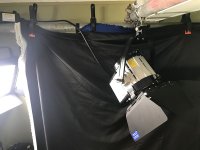
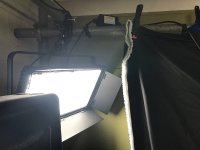
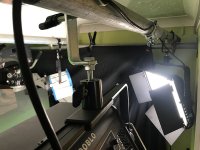
Not sure if these pics help - but you can see how the uprights are attached to the horizontals, and how they are braced against the walls so they cannot move. all the weight is on the upright scaff - in my case quite low - the ceiling is at 3m, but the idea holds good for taller spaces. Scaff is so easy to use, if you need something where you have nothing, drop on a shorter cross piece, or drop arms, or double ended drops. Scaff parts are very cheap and not 'posh'. I actually meant to paint the scaff, but never got around to it.
 

Attachments

  • IMG_0754.jpg
    IMG_0754.jpg
    82.4 KB · Views: 0
  • IMG_0753.jpg
    IMG_0753.jpg
    78.1 KB · Views: 0
  • IMG_0755.jpg
    IMG_0755.jpg
    103.4 KB · Views: 0
Thanks for the image, paulears! How do those pipes interface with the wall? From the image, it looks like they disappear in to the drywall. Are you using some sort of wall spreader?
 
I think that they end at the wall. This is how my shipping contrainer is done for shelves.. but I use jack feet to go from floor to ceiliing which puts a compressive load at both ends - you could not do that on a soft ceiling but you could do wall spanning (there are various vids) .. bacially a foot screws out to put a compressive load between the walls
 
Alright, I've come up with a solution I'm confident in. Here's the plan:

Above the drop ceiling, there are metal H-beams. I'm going to attach some unistrut to the H-beams with u-bolts. Then, with some strut-nuts, I'll attach some standard klee flanges to the unistrut. From here, I'll drop down several lengths of metal conduit so that the cage comes down to a more useable height. It's at this point that the conduit will be actually travelling through the drop ceiling, so I'll have to remove panels and cut holes to accommodate for the diameter of the conduit.

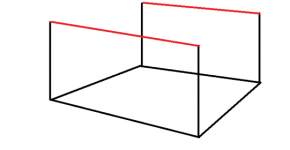
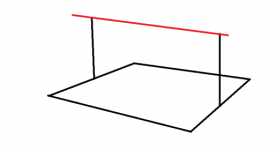
The final question that remains is how exactly to configure the cage. Do I need a length at every corner, or can I get away with only 2 to support my needs. In this simple paint diagram, red is the unistrut, and black is the conduit + klee fittings.

unistrut (1).png - Click image for larger version  Name:	unistrut (1).png Views:	0 Size:	56.1 KB ID:	5687995

unistrut (1).png - Click image for larger version  Name:	unistrut (1).png Views:	0 Size:	56.1 KB ID:	5687995

I like this idea because not only is it rock solid, but it also uses the klee fittings that I already have. Any thoughts about this idea?
 
I cant quite understand the pics and thier releation to the existing H beams.

The panels are probably 600x600mm - I could suggest (if it is a rental property) that you remove and store the panels and then get 600*600 plywood (maybe with a white plastic/formica finish) and drill those our to allow your tube through. (and holes for hiding cables?)

I dont see why the kee joins are not going stright into the H beams.

Screwing into the H beams is destructive (of the lanlords property) I.. aha I see thise is where the unistrut comes in? ("U" bolts attach non destrudivly to the H??)
https://www.orbitalfasteners.co.uk/p...amp-hdg-wscrew

When hanging kee clamp (or rigging it for any tensile loads) one can consider a 10mm hole in the join and 8mm holes in your pipes (25mm from the end?) to create a 'safety' using an m8*80 bolt.

Of course the main load is tensile (mass of the lights under gravity) but there will still be angular loads , especially during rigging.

You may consider some form of triangulation in your design.
 
That's a good point, morgan. There's definitely some room for adding some diagonal conduit to give it resistance against shear forces! You are correct about the unistrut and the u-bolts. This allows me to add the klee fittings without damaging the H-beams as it is a rental space. I'll also look into getting some melamine coated OSB or plywood to replace the drop ceiling tiles as they are pretty fussy to deal with.

To help explain the diagram further, the red lines (the unistrut) runs perpendicular to the above H-beams, which are not diagrammed.
 
Back
Top