Peter C.
Veteran
I can see what you did. I think the best resolutions are made on New Years Eve.I am glad we helped you get your question resolved.

Follow along with the video below to see how to install our site as a web app on your home screen.
Note: This feature may not be available in some browsers.
I can see what you did. I think the best resolutions are made on New Years Eve.I am glad we helped you get your question resolved.

You really can't use this 320 x 240 analogy, because it's not a thing you can do a direct comparison with. !
the horizontal resolution is all we were interested in - the number of lines individually definable before they blend into each other. The picture width was irrelevant - we only had 4:3.

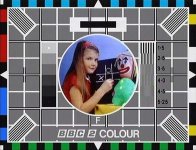
not at all - just different uses of terms - so we have 'horizontal resolution' as in the capability to go from black to white detectably in a single horizontal line - with the digital square and rectangular pixels, and 'horizontal resolution' of each horizontal line from it's vertical neighbour. This is getting more confusing by the second. I do agree though that we normally assume vertical resolution of each horizontal line - but the test charts are clever things - each component designed for a specific purpose. By the way, you were right earlier - you do simply zoom in to these, or bring the camera closer until the corner marks match your display edges. In the US did you have test cards, transmitted out of hours to allow you to set the brightness and colour correctly and check things like circles being circles, not eclipses? Here's an old BBC 1 version
Can analog video be progressive scan?
All of that said, I just want to clarified, when we say something is 400 lines of resolution, we’re talking about the horizontal resolution and not the vertical. The vertical is always 480 or 540 PAL. Or are we saying that it’s only resolving 400 lines out of a potential 480/540? I feel like I still haven’t gotten a straight simple answer regarding this.
Yes. I remember them in the mid '90s mentioned in Videomaker magazine, but I never saw one in person. I think DLD was right, that they were called IDTVs (Improved Definition Televisions). I read that onlookers sometimes thought they were HDTVs, because of the improvement that progressive scanning brought. They were very rare, perhaps more instances on trade show floors than in people's living rooms. Soon, HDTVs took over, which brought both progressive scanning and higher resolution.
Why do you suspect that progressive scanning is incompatible with analog? The two features seem unrelated, in my mind.
Yes, 400 lines of horizontal resolution, per picture height. So to calculate the total number of pixels horizontally, multiply the resolution by the aspect ratio. So, 400 x 1.33 = 532.
know CRT TVs and analog broadcasts were interlaced.
Is there a progressive analog recording format?
Ok so if I understand this right, then SVHS (420 lines) has a (roughly) digital equivalent of of 558 x 420 pixels?
Since 420 x 1.33 = 558.6
Interlacement was entirely to reduce flicker. Cathode ray tubes, if progressive, would have had noticeable flicker.
Not that I know of.
No, 558 x 480.
NTSC video always had 525 horizontal scan lines. That was the standard. As you know, some of them were not used for picture but sync and maybe overscan, so you wind up with about 480 visible on most TV sets (I think 483 or 486 to be exact?). That's the vertical resolution.
Among NTSC formats (VHS, S-VHS, Video 8, Hi-8) the only variation was the horizontal resolution. They always had 525 scan lines, which again was about 480 visible So the horizontal resolution was the only thing that differed.
So VHS and Video 8 were about 320 x 480. And S-VHS and Hi8 were about 560 x 480.
We've answered all these questions over and over now, and we're just covering old ground with little extra bits.
You really cannot compare old and new. Interlaced pictures were also necessary because of phosphor spot decay - the odd or even frame was still glowing as the next frame was painted in the gaps.
The horizontal and vertical resolution is totally different. If you have 525 lines in America, the first thing was that some were off the screen anyway. The TV might have 525 lines, and the scan rate is fixed and we know how many are capable of being seen. So we might be able to say that we have 257 horizontal lines at any one time. Differences between varying quality televisions is going to give varying quality pictures. How wide each of the scan lines is, how sharp the focus is, is the overlay of even and odd frames totally different or a slight overlap? The video recorders with their 240 line resolution is nothing to do with the 257 horizontal lines we're talking about here. If the video can do 240, then that measurement is sort of progressive, as a measurement, but as we've said test charts generally are measuring the frequency response of the chain, buy measuring the capability of a black to white to black vertical grid - a square wave, the scan trace moving horizontally. The little squares of vertical black lines on a white background let you assess the frequency response from about 1.5MHz to 5.5MHz.
The bit about aspect ratios is to do with the frequency response. The distance the scan has to travel alters the ability to display the square wave - more divisions of the same size across the screen. This is not the same as the discussion about 240 vs 400 lines - both of those are not even linked to the PAL or NTSC system, which have different numbers of lines. Two different specifications, depending on what you are talking about - resolution in lines, limited by maximum frequency response, and screen display lines, set by the TV system format
Just a quick side question. Figured I would ask here rather than start a new thread since it’s sort of related.
Can analog video be progressive scan? Put another way is there such a thing as progressive scan analog video?
I suspect the answer is no, but just curious.
Analog CRT computer monitors were progressive scan. Interlace was just a way to maintain resolution while reducing over the air transmission bandwidth of NTSC color TV to match the 6MHZ RF channel bandwidth of progressive scanned black and white. 6MHz RF channels are still used today. With ATSC compressed digital signals we can fit one 1080i 59.94HD interlaced signal or one 720p 29,97 progressive signal plus two SD resolution signals into the same channel bandwidth. Now that can extend to 29.97 progressive scan UHD as the only signal.
The best resolution for Academy format 4-perf 35mm test prints I ever saw was around 800 LPPH, limited by jitter and gate weave of the film as it moved through the projector.
Analog SD programs that were originally shot on videotape have not held up well. Most look pretty bad, which is why they are seldom rerun. Those that were shot on S16mm film or 35mm film still look very good with modern restoration.