Have I been wrong this whole time about resolution?

Video technology has had a very messy and confusing history. It's cool to learn about it and what not, but at some point too much time in life passes by for a lot of the older information to have much value in a current existence and may even cause confusion.

It definitely causes confusion. Because I'm still not sure why the Kell Factor is even a thing. It's supposed to tell us what the real perceived resolution is, but what I still don't understand is why the perceived resolution is different from the actual resolution. Why is 480 lines really only 330 lines? What is causing the loss of those 150 lines?
 
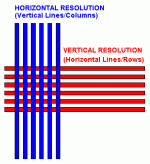
I apologize, but I still don't feel like I've gotten a straight answer on my original question. Are we counting vertical lines (red) or horizontal lines (blue) when we say VHS is 240 lines or Hi8 is 400 lines?
 
Last edited:
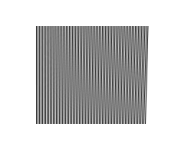
I guess the beat frequency...it was mentioned here a few times and it's in the articles.

The gray lines below in the top-right.

https://en.wikipedia.org/wiki/Kell_factor

"The Kell factor is the reduction necessary in signal bandwidth such that no beat frequency is perceived by the viewer."


Ok, I think I understand Kell Factor now. Correct me if I'm wrong.
It's not something that happens to the image, it's a number that you set the blur amount to in order to avoid weird patterns on your CRT TV. So for example you have to blur your TV resolution by 0.7 to avoid these beat patterns. But the better the TV is, and the more that the camera resolution lines up with the resolution of the TV, the less you have to blur the image. So you are losing resolution because of the blurring.
 
I've only been explaining the definition of Kell Factor and that's about as far as my understanding goes.

I tried reading more about it but life's too short. lol

This is a conversation to have with Ray Kell and his colleagues in the 1940s/etc.
 
But, in general, I think you're on the right track. If those patterns existed on a 1920x1080 display, you'd find the factor below 1 that would produce a picture with a lower resolution (controlling the bandwidth) to remove those patterns, so it's like "blurring" but I don't know if that's the best word to use.
 
So where does the 240 come from

240 is 75% of 320.

VHS was a grid, 320 pixels wide by 525 tall (or 320 x 483 visible lines).

The 483 lines are horizontal lines, which result in vertical resolution.

The 320 lines are vertical lines, which result in horizontal resolution.

To make the screen square: Its aspect ratio is 4:3, which means that you must cut 25% off of the width. 320 x 0.75 = 240.

So a square crop of VHS would be 240x483.

Thank you. But I still don't understand why you want to make the screen square when the actual screen aspect ratio is 4:3. So why would you want to crop the 320 to 240? Wouldn't you want more horizontal resolution to fill out the width of the television, especially if you're already starting with less horizontal lines than vertical lines?
 
I'm not saying that you want to crop it. That is just how they measured it back then. As paulears said, they pointed the gear at test charts. I guess they zoomed into the chart so that it filled the vertical dimension, and the read the lines, for both dimensions, from there, without reframing.

Anyways, the unit of resolution was "lines of resolution per picture height". So, if VHS had 240 lines of resolution per picture height, and the horizontal length was 1.33 times the picture height, then to get the complete horizontal resolution, you multiply 240 x 1.33, to get 320 lines of resolution for the entirety of the horizontal dimension. It doesn't matter so much as long as all manufacturers adhere to that standard. I remember reading that a certain broadcast-level videocamera had 700 lines of horizontal resolution (native in camera, before recording to whatever tape format you chose). I used to think that was the total number of lines. But now I think it was "per picture height", so more like 900 total.

In a way, back then, the unit of resolution reminds me of the printer's resolution: pixels per inch. Let's say a certain printer has a resolution of 300 ppi. Well, to get the number of total dots, you would have to multiply by the number of inches. I know it's weird. In the printer's world, it's useful because the paper sizes vary. In the video world, the aspect ratio was always 1.33. So why not just say the full number? Again, I think it is because of what paulears said, something about their measuring technique.
 
I think the German studio cameras came out in 1978, with 900 lines, just for the World Cup (held in Argentina then) and was a sizable jump in quality. (I forgot where I read it though)

BTW, the in-body upslaling for the analog rear projection TV's was quite noticeable in 1989-90. Mitsubishi was the state-of-the-art then and much sharper to the naked eye than other leading RP brands Sony and Pioneer. A year later, Hitachi came out with a 920 line RP but it was visible only in the middle of the picture screen. It lost a lot of detail and brightness toward the edges.
 
I'm not saying that you want to crop it. That is just how they measured it back then. As paulears said, they pointed the gear at test charts. I guess they zoomed into the chart so that it filled the vertical dimension, and the read the lines, for both dimensions, from there, without reframing.

Anyways, the unit of resolution was "lines of resolution per picture height". So, if VHS had 240 lines of resolution per picture height, and the horizontal length was 1.33 times the picture height, then to get the complete horizontal resolution, you multiply 240 x 1.33, to get 320 lines of resolution for the entirety of the horizontal dimension. It doesn't matter so much as long as all manufacturers adhere to that standard. I remember reading that a certain broadcast-level videocamera had 700 lines of horizontal resolution (native in camera, before recording to whatever tape format you chose). I used to think that was the total number of lines. But now I think it was "per picture height", so more like 900 total.

In a way, back then, the unit of resolution reminds me of the printer's resolution: pixels per inch. Let's say a certain printer has a resolution of 300 ppi. Well, to get the number of total dots, you would have to multiply by the number of inches. I know it's weird. In the printer's world, it's useful because the paper sizes vary. In the video world, the aspect ratio was always 1.33. So why not just say the full number? Again, I think it is because of what paulears said, something about their measuring technique.

Ok so let me sum up then to make sure I'm understanding everything properly.

480 vertical lines is the canvas size of the NTSC signal. It's a constant. And the TV is capable of only that many vertical lines. Visibly.

240 lines, 330 lines, 400 lines, 440 lines, whatever, is the resolution measured by the engineers of whatever camera or recording format they are peddling. That resolution is both a measure of the vertical lines and 3/4 of the horizontal lines. So it is to be assumed that you must add 1/4 back to the horizontal resolution in order to get its true number of horizontal lines.
 
480 vertical lines is the canvas size of the NTSC signal. It's a constant. And the TV is capable of only that many vertical lines. Visibly.

480 horizontal lines. The blue-and-red diagram is right in every way. These are the lines in red.

240 lines, 330 lines, 400 lines, 440 lines, whatever, is the resolution measured by the engineers of whatever camera or recording format they are peddling.

Yes. And those lines run up and down, vertically. These are the blue lines.

That resolution is both a measure of the vertical lines and 3/4 of the horizontal lines. So it is to be assumed that you must add 1/4 back to the horizontal resolution in order to get its true number of horizontal lines.

Not quite. Like your blue-and-red diagram shows, horizontal resolution is composed of vertical lines (blue), and vertical resolution is composed of horizontal lines (red). "Resolution" means "the ability to resolve", the ability to show detail. The more vertical lines you have running up and down, the more ability you have to show horizontal detail, the more horizontal resolution that you have.

Also, to correct something I said before, they probably usually didn't measure vertical resolution (the number of horizontally oriented lines) every time they pointed it at the test chart, because the number of scan lines is fixed by the standard (NTSC is always 525, PAL and SECAM always 625).

It's clearer also if you think as each scan line as a wave. That was how analog transmitted it, as you know. So each scan line is a frequency wave that goes up and down as it writes the line from left to right. The higher the carrier frequency (also set in stone by the standard, whether it's VHS or S-VHS or Betacam), the tighter the little up-and-down waves can be, and therefore how fine the resolution is as it paints itself across the screen from left to right. It paints one line at a time, starting at the top line, and each line it draws with the cathode ray really fast from left to right (or maybe right to left? or maybe it alternates?). At whatever amplitude level the frequency wave is when it hits a phosphor, that is how much electricity that phospor gets, and therefore how bright it is. So as I was saying, the higher the frequency, the more tightly the scan line can move up and down, and the more variation (resolution) you get per scan line.
 
Last edited:
It's a bit trick, but using my UK standard of 625 lines - it uses an interlaced scanning system - so only half that 625 are on the screen, and in fact quite a few are off the visible section of the screen, so the TV can scan maybe 300 lines, left to right, from top to bottom. The 240 lines of VHS resolution mean that compared to off air - the picture is soft. There is no direct line to line comparison because the VCR outputs the same 625 (525) line signal - the 240 lines are the best case figure - stretching the image that's got less bandwidth than the off air signal softens the picture, So it's always a comparison, not a measurable number of lines, because there will always be the same fixed number. Just imagine the 240 lines as being 'taller' so they leak into the one above and the one below, which blurs the image. To be fair that's not a dead accurate description, but does describe what happens. On Trinitrons the vertical mask was a top to bottom slot, not lots of shorter slots - giving the illusion that vertical lines in the picture were sharper.

Another analogy I've heard used is that if you took 240 lines worth and stretched it to full picture height, that would get softer - but again, that's not really correct but does show what happens.

Technically, it's simply a way of describing a reduction in frequency response in a way people can use as a comparison. If TV sets could have displayed the full 625 (525) lines, then the 240 stretch would have explained it better.

Just to make it worse - don't forget that the definition was a monochrome measurement - if you like, the detail channel, and then the colour was sort of smudged on top. That's perhaps going a bit far.
 
When you start to really think about it and how it all worked, especially throwing CRT’s in, it’s nothing short of amazing that it all worked at all. Today’s digital capture, transmission and display kinda makes way more sense, in a way, and the old analog ‘system’ was honestly, kind of voodoo.
 
When you start to really think about it and how it all worked, especially throwing CRT’s in, it’s nothing short of amazing that it all worked at all. Today’s digital capture, transmission and display kinda makes way more sense, in a way, and the old analog ‘system’ was honestly, kind of voodoo.

I'm not fan of SD televison, but when you watch SD today (VHS, DVD, broadcast TV) on a modern television it looks far worse than it did when we were watching on CRT televisions back in the day. There's something about that low-resolution image that looked acceptable on a low-resolution TV that was made for it. So for all you youngsters, when you watch a SD picture on a modern TV, just know that it wasn't THAT bad back in the day.
 
combatentropy - Good explanation. Thank you.

paulears - I assume it's kind of the analog equal to taking a pixel based image that is 320x240 and stretching it to fit a canvas that is 640x480. It's blowing it up to fit the canvas but you're not getting any more detail out of it. In the digital space we would get a jagged pixelated look but in the analog space it just softens it.

Run&Gun - For sure. But that's also kind of what fascinates me about it.

Doug Jensen - Yup. I still keep a little 13" CRT TV around that I've had for about twenty years now. Running the VHS machine through it, or Video8 tapes, or even old game consoles, things just magically have a way about them.

I grew up with CRTs like most if not all of you. Both color and B&W. Shadow mask and Trinitron. My grandfather also owned one of the first TV shops in the area with his brothers in the 1950s. Selling and repairing TVs. When the shop closed down, due to his brothers being greedy, he continued to repair the TVs out of his house. I never met him though because he died when my mom was still a little girl and he was in his thirties. A car accident on a trip to Chicago with one of his brothers. I only mention it because it's kind of ironic that years later my love for film and filmmaking would lead me into a career in video production and an interest in video technology as a whole. Even on a technical level like this. And even if my full grasp of it hasn't been perfect.

I think I understand it all enough at this point. At least better than I did before. So the title of the thread is "Have I been wrong this whole time about resolution?" and based on what I understand now, I'm going to say no. I don't think I was initially entirely off the mark with the way I've understood it for the last thirty years. I just didn't understand the details. Or maybe you could say that I didn't have a high enough resolution understanding of resolution. ;)
 
You really can't use this 320 x 240 analogy, because it's not a thing you can do a direct comparison with. the horizontal resolution is all we were interested in - the number of lines individually definable before they blend into each other. The picture width was irrelevant - we only had 4:3. We also did NOT have pixels. TV sets had phosphor dots, but they were not the same as pixels as we discuss them now. We also had under scan and overscan - so top bottom left and right were not always the same. Some TVs were not rectangular, but had curved verticals and horizontals so the left and right halfway down, and up and down in the centre had more of the picture tube showing. This is where the safe area markings on many cameras originated. Every TV would display images within the safety area, but many people would in effect, have a slightly zoomed in picture, with the top, bottom, left and right edges partially missing. On studio monitors the underscan button would shrink the entire picture, revealing the missing bits. We even hid instructions to warn regional centres about ad breaks and end of programme warnings in the scan lines out of vision - so out of the maximum 625/525 divide by two lots were out of view.

The pixelated digital and soft analogue comparison is a fair one!
 
Last edited:
Back
Top