IATSE going on strike?

"In its over 100-year history, IATSE has never before gone on strike,"

https://www.google.com/amp/s/www.vog...tse-strike/amp

I don't think your point is legitimate. Or at least, the times you're describing are exceptional. What IATSE objects to is the norm.

@ahalpert:
https://www.hollywoodreporter.com/business/business-news/black-friday-hollywood-in-1945-1235021178/
I remember this as a little kid. A car was set on fire at the West gate, right down the street from us.

Sorry that you don't feel my point is legitimate but the simple fact is: Trying to avoid a single extra "normal" shoot day by beating up the crew with a 14-16 hour run is not a productive option, financially or otherwise. That practice presents a clear danger to the health and safety of those who have experienced it.
See Mitch's post below. His point about turnaround time is particularly relevant.
 
There may be a miscommunication here somewhere. I thought you had implied that the only time production maniacally overworks crew is when they are afraid of an impending strike, which did not make sense to me.

I abhor the working conditions and support the strike. i think we're actually on the same page
 
I've been advocating for these issues to be addressed for years. Here are some things to consider as I write this at 12:30pm Saturday after another Fraturday that started at 12 noon Friday and ended at 2:30 Saturday morning and getting home at 3:15am. 3 weeks in and that was the shortest Fraturday so far.

Some crew members want as many hours as possible. I had one prop man tell me he wants 20 hour days as much as he can get. The union has many members that think this way. More money is the only objective. And the possible reason for this is not having a real cost of living increase in place depending on where you live.

Many years back all these issues were addressed in the contracts. Night premium pay after 12 noon, True weekend turnaround (I think was 48 hours plus 9 hours). Triple time pay. These existed not to line the pockets of crew members but to stop productions from abusing work days by making them pay a significant amount of money if they abuse the quality of life of crew. This worked. Productions knew the cost and they made their schedules sane to save money. Through the years each and every quality of life protection in the contracts was slowly eliminated and here we are. The comical thing is what is being asked for now was once in the contracts and movies and television programs were still made on schedule.

I believe the reason this is happening now is that the crews that started work with on set Covid protocols have seen the amount of money productions have spent on those protocols and the ubiquitous lie that "there is no money in the budget" producers have been spouting is just not true.

Producers have turned entertainment products into a assembly line factory mentality. Highly efficient to save every penny. They know they need to add more weeks to a project but since the contracts are so weak with penalties they can make a movie in two months when it should really be budgeted for 3 months.

Take a look at the number of producers in the credits of most film and tV these days. I counted over 20 on one project. I bet each one of those producers gets points and a six figure salary.
 
Ok they're not striking yet. But they will at a pre-determined time if contracts expire, yes?

I’m not in the Union, so someone better versed than me, please step in if I’m off on this. My understanding is, the contract expired in July, then was extended to September to allow for further negotiations with the hopes that both sides could come to an agreement, but those stalled out. Then the call for a strike authorization happened and they voted this past weekend, with apparently the overwhelming majority of members voting yes to authorizing a strike if they can’t come to an agreement. Which it didn’t not look like was going to happen, but now the producers and studios are going back to the table after seeing the overwhelming majority of workers willing to strike.

And poking around on Reddit earlier this evening, it seems like some are saying that the “real” studios are willing to negotiate and if it was just them, that this would have probably been settled already, but Apple, Amazon, etc aren’t, because the streaming and movie making is not their main source of income and they can ride this out while the major movie studios take it in the teeth, and if they are hurt too much financially, they can swoop in and buy them up for cheap, then control it all.
 
The part about the streamers is just theorizing. Certainly Netflix has no other business model.

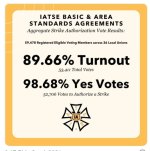
The other side blinked. After nearly a year-long shutdown they were counting on too many below the line crew afraid of losing a paycheck to a strike. Instead they found overwhelming solidarity, with 90% of the membership voting and 98% of the voters supporting the strike authorization. Within hours AMPTP agreed to resume negotiations with IATSE. Mind you there is a very long way to go. What sparked the strike vote was a statement a few weeks ago by the AMPTP that they would not even consider the various demands for better working hours and pay. This is a huge divide between the two sides.
 
.
And poking around on Reddit earlier this evening, it seems like some are saying that the “real” studios are willing to negotiate and if it was just them, that this would have probably been settled already, but Apple, Amazon, etc aren’t, because the streaming and movie making is not their main source of income and they can ride this out while the major movie studios take it in the teeth, and if they are hurt too much financially, they can swoop in and buy them up for cheap, then control it all.

The dangers of monopolies and giant corporations. This is the FAANG way. Squeeze every penny out of your workers' flesh. The first thing Bezos did when he bought Whole Foods was axe Health coverage for part-time employees.

I wonder what we can all do to support IATSE. Thoughts?
 
The strike is off! They reached a deal. From Deadline:

"More details are to come, but deal points include “improved wages and working conditions for streaming,” 10-hour turnaround times between shifts, MLK Day is now a holiday, “Diversity, Equity and Inclusion Initiatives,” increased funding of the health and pension plans and a 3% rate increase every year for the duration of the yett-to-be approved contract, among other changes. The AMPTP had wanted to settle the rate increase at around 3% for the first year and then shift it down to 2.5% or even less for the subsequent two years of the contract."
 
I agree. They agreed to limit hours to a 10 hour turnaround. How gracious. They only have to work 14 hour days now.

The odd thing is that per IATSE documentation, members are employees, not contractors. So why is it that they are forced to work through lunch and not take breaks, which are required breaks per the labor code? Where is California's labor board in all of this?
 
54 hours' rest after 5 days of work is also in the deal. that should put an end to fraturdays? and put an end to the practice Mitch described of having a long night shoot on Friday and then having an early morning call 1.5 days later and having to switch right back to day shoots, which has gotta be murder on the body
 
So if they quit at 10:00pm Friday night, they might have to report 4:00am Monday. That's almost human. In total, that would limit hours to 70 a week, the stuff Type A executives, who make millions, are made of.
 
The length of a shift was not negotiated, so they could still have Fraturdays. But that would mean they might lose the following Monday if they wanted to begin on a morning again.
 
The length of a shift was not negotiated, so they could still have Fraturdays. But that would mean they might lose the following Monday if they wanted to begin on a morning again.

Interesting point Mitch. I don't know how to interpret that. So they could work a 24 hour (or any length) shift, 10 hour turn around, and work another any length shift?
 
Interesting point Mitch. I don't know how to interpret that. So they could work a 24 hour (or any length) shift, 10 hour turn around, and work another any length shift?

Im not sure about that but that would be a terrible idea if you don't want the quality and speed of the labor to drop off drastically in the 2nd half of every workday.

But I think mitch's point was specifically about weekends. If they want to do a long day at the end of the week that bleeds from Friday into Saturday, they still can. But now at least there's a penalty in in that they can't start on Monday morning like they used to
 
It is correct that the 10 hour turnaround has nothing to do with the length of the workday, just that any two consecutive workdays must provide a 10 hr turnaround between them. That is good for the departments that had less, although many were already on 10 hr turnarounds and a few (operator and DP) on 11's. While important, it won't change things drastically. The weekend turnaround is a more significant gain for the reasons stated above. It will throw an entire week into late calls after a Fraturday which would make for difficult scheduling. It will be interesting to see how this is managed--possibly by scheduling the Monday as a short day (so a late call but cutting it down to 8 hours for instance, to get back to a morning call the next day).
 
Back
Top