noisy blue channel

blue channel is always noisiest with
any CCD.

Dino you are correct...
I find this very hard to believe this is some sort of revelation to some. ;)

It only takes a second to look at your blue channel to see this.

http://psp8.homestead.com/Noise_Removal.html


No one needs to guess this stuff... I've certainly learned to trust your own eyes, not someone else.
It's very easy to set up your own experiments and look for yourself.

White balance under 5600K and 3200K extract the RGB channels and check it out for yourself.
 
Last edited:
Yeah.

so anyways, I'm trying to figure this out still....


So what makes each chip less or more sensitive? is it because blue light isn't as common as red light?

in that case, shouldnt the blue channel be MORE sensitive??

Or is it because tungsten is so devoid of blue light
 
Yes, in order to color balance in tungsten lighting the camera has to gain up the blue channel more than it would under daylight color temp.
 
Yes, in order to color balance in tungsten lighting the camera has to gain up the blue channel more than it would under daylight color temp.

That's right, but the blue channel makes up such a small percentage of the signal that it's noise level isn't very apparent in normal scenes.

A white balance circuit or manually painting of the camera is just raising or lowering the preamp gain on each color channel to achieve the balance desired for a given scene/color temperature. The gain range for a given channel in a white balance operation is nowhere near a much as when gaining up a camera to +3db or +6db, therefore any difference in noise level from one white balance value to another should be very subtle, especially when the three channels are combined in normal viewing.

This really is a non-issue from my perspective.
 
Dino and Stevet are right - this is a non issue. Re-read Stevet's post #4. Smart DP's have been white balancing with slightly blueish 'white' cards since the CCD first came out in the early 90's. How else would you get rid of the bluish/pasty whites that have been inherent in video since the begining?
 
So, since color balancing is just a matter of adding gain to the color channels, would the reds appear noisy in an enviroment with mostly blue light?

I mean, even if they dont appear noisy, would they have a much higher gain?


and snp, I get your point. Perhaps it's better to have more reds in tungsten lighting, then try to get a perfect white light. It looks warmer and less videoish
 
and Dino, what do you mean by blue makes up a small portion of the lumanance signal.

I know lumanance of course is the level of brightness, but it seems like daylight has a predominantly blue cast..
 
DanHD,

Your questions are really in the realm of video 101 and I think part of them have been answered previously by a few of us.

I'll give it another go. White balancing a camera requires balancing the three color channels to null out the signal to derive white. A single channel would gain up or down no more than 1-2db would be my guess.

Regarding luminance values, it comes down to reflectivity of each color frequency. Green, where the majority of luminance(light value) is derived, reflects much more than red and even more than blue. Therefore, red and blue are balanced to the baseline of green, which is considered the luminance channel.

This gets us into signal to noise ratio. The green channel will ALWAYS have a much better luminance signal to noise ratio due to the amount of luminance value present in a green signal compared to red or blue due to the reflectivity of the green spectrum, which has a wider frequency than red or blue.

As far as the nature of different color temperatures derived from artificial lighting, tungsten light is very inefficient with most of its frequency in the IR spectrum, but it's cheap. A 5600K, full-spectrum light source such as a fluorescent , LED or HMI source is much more efficient due to its full color frequency spectrum, reflecting all color frequencies, but these sources are more expensive and complex.

This whole camera noise thing has come full circle for me. My first cameras were all analog and SN ratios of the low -50db was common. Then the cameras were digital(except for the CCD's and preamps) and my most recent SD 2/3" cameras have a SN in the low -60db range. Now we're in the HD world and cameras are noisy again, back to the low -50db range or lower.
 
So, correct me if i'm wrong, I'm going to summarize what i've learned here...


soo, there is much more blue light in daylight than there is present under strictly tungsten light, causing the camera to gain up the blue channel in order to compensate to create white light. Daylight has an abundance of all frequencies of light and therefore requires less gain, meaning less potential for noise..
Green light is the most abundant frequency of light and therefore requires hardly any gain to equalize color levels??
 
soo, there is much more blue light in daylight than there is present under strictly tungsten light, causing the camera to gain up the blue channel in order to compensate to create white light. Daylight has an abundance of all frequencies of light and therefore requires less gain, meaning less potential for noise..
You've got it!

Green light is the most abundant frequency of light and therefore requires hardly any gain to equalize color levels??
Not quite. Blue light is the most abundant frequency in daylight, followed by green, then red.

It just so happens that the human eye has greater resolving power with green light than anything else, so bayer filters on still cameras and the RED ONE have twice as many green elements (over red or blue) to mimic this.


I'm going to really expand on things here:

It is a known fact that the RED ONE has a sensor natively designed for daylight, and if you white balance for tungsten, the boost to the blue channel gives a big overall boost to noise. The noise been reduced in newer firmware, but I still try to light everything daylight balanced for it.

For a 3 CCD or 3 CMOS camera, it matters less. I am happy to white balance a Panasonic DVX100 or HVX200 to tungsten and just start shooting.

Some confusion and mis-information is going around here, from 3 CCD sensors being compared to bayer filter CMOS sensors. Though, to be technically accurate, CMOS sensors are slightly more sensitive to blue than CCD sensors, It's the bayer filter that makes the most difference.

If you have a prism splitting light to three sensors, all of equal resolution, then each color makes up 1/3 of the total signal.

If you have a bayer filter, (http://en.wikipedia.org/wiki/Bayer_filter) then there are twice as many green sensitive pixels as there are red or blue. Meaning, you have green making up 1/2 of the total signal, red 1/4, and blue 1/4.

For these reasons, a 3CCD or 3MOS camera should theoretically give a cleaner signal under tungsten light than one with a bayer filter.

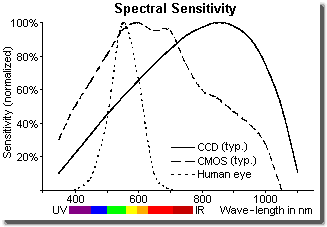
But there's one more wrinkle: spectral sensitivity. Take a look at this:
fip139.gif

And this:
sensitivity.gif

CCD or CMOS sensors are more sensitive to the infra-red end of the spectrum, and need to filter it out.

They are pretty much blind to ultraviolet. More practically, they are less sensitive to the 440–490 nm wavelength where blue is perceived. So, no matter what, a silicon sensor is less sensitive to blue, and if you stick a bayer filter on it so that only 1/4 of the pixels actually see blue, you can see the problem.

Just don't get me started on why your camera can't see violet or purple.
 
First of all thank you SO much for being patient with me and answering these questions..


So basically,

Our eyes our most sensitive to green light?


and also, from those charts, it looks like cmos sensors are more sensitive to blue light than CCD's.....
 
but since blue actually makes up LESS of the total signal in CMOS, they end up upping the gain more?
 
CMOS sensors are more sensitive to blue light, meaning they make up more of the total signal, and need less gain.

As for our eyes, this was copied from http://en.wikipedia.org/wiki/Cone_cell

Humans normally have three kinds of cones. The first responds most to light of long wavelengths, peaking in the yellow region; this type is designated L for long. The second type responds most to light of medium-wavelength, peaking at green, and is abbreviated M for medium. The third type responds most to short-wavelength light, of a violet color, and is designated S for short. The three types have peak wavelengths near 564–580 nm, 534–545 nm, and 420–440 nm, respectively

At moderate to bright light levels where the cones functions, the eye is more sensitive to yellowish-green light than other colors because this stimulates the two most common of the three kinds of cones almost equally.

(Back to me) it's not so much that we see green more strongly, it's that we have more "pixels" that respond to green than red or blue, giving us higher resolution for that color. Ergo, Bayer filters have more green pixels, and higher resolution for that color, to better match our eyes.

Only 2% of our cone cells are sensitive to blue, as mentioned here: http://hyperphysics.phy-astr.gsu.edu/hbase/vision/rodcone.html

So, cameras are designed based on limitations of how CCD and CMOS sensors respond to light, and the bayer filter pattern is designed based on how well our eyes to respond to different colors. Color on video doesn't have to be perfect to nature - it just has to be good enough for our eyes.
 
So essentially, because our eyes are most sensitive to green light, bayer sensors contain more green photosites than blue or red,

and 3CCD cameras use equal amounts of both, leading to less gain needed in the blue channel to balance out tungsten with 3ccd's?

So of course, I shouldnt be afraid to shoot tungsten balanced.


Oh another thing is, is it really neccessary to manually white balance to make tungsten lights appear white? I mean, even the human eye sees tungsten as more amber in tone than daylight...they aren't completely equalized.

And when DPs shoot on tungsten balanced film, they have no manual white balance option, so do they usually allow lower temps to just appear orange?

I guess my point is, perhaps you DONT have to white balance for everything..perhaps some situations look good with some amber or blue cast to them

You eye doesnt balance out everything color temp situation completely...or else you wouldnt really see colored shades of white, right?
 
Back
Top