There Is No Softening When Moving the EX1

musician,

I think that's a great theory.

It makes perfect logical sense to me. The scope would show a softening because it aggregates all of the horizontal lines together - so there's normal motion blur on each line, and all of the lines are slightly offset.

So the sharpness seems to diminish when panning on the spatially one-dimensional scope but not to the eye, when it sees the two dimensional screen.

Barry, what do you think?
 
Last edited:
Interesting idea, but without some way to test it I'm not sure. I know I haven't seen something like this before, but I've also never scoped a CMOS camera either. I wonder what a V1U would look like under the same circumstances?
 
I just ran a little theoretical test to demonstrate what I was saying earlier. Everyone needs to remember that up until Red and the EX1 (and maybe the V1U), these are the first CMOS cameras that would have been scoped by us regular users. People have scoped XH-A1s and HVX200s here, but not CMOS cameras for the most part. Now remember, I've never touched a working physical scope, only software, so again, I may be talking out of my arse. Please feel free to correct me if I am wrong. REMEMBER, THIS IS ALL THEORETICAL AND GENERATED GRAPHICALLY TO PRESENT A THEORY, NOTHING HERE WAS SHOT WITH AN EX1.

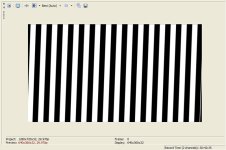
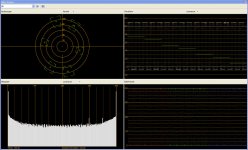
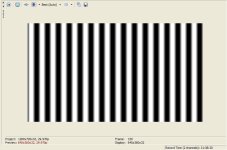
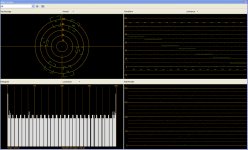
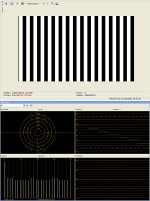
First, I opened up a Vegas project and just put some vertical bars on the timeline. You will see that the resulting scopes show very distinct vertical lines in the histogram, and very distinct horizontal lines on the luminance waveform representing black and white.

screen1.jpg

Next, I added a deform effect to give the lines skew. Because of file size limitations, it will be hard for you to see, but it was very clearly evident on my screen, that the luminance waveform now shows various scales of grey. This is because due to the skew, there are now varying amounts of white and black information in a single pixel colum. Even more evident is the histogram, which went from distinct vertical lines to a fully filled grayscale.

screen3.jpg
screen4.jpg

Finally, I added a little horizontal blur to represent motion blur for a pan. Now you will clearly see the added information in the luminance waveform. You would see this with a CCD camera as well, but like Barry said, it would not be a s severe. I don't think that it is any more severe with a CMOS VISUALLY, but on a scope it looks worse because of the skew. Also, check out the last histogram, smooth as silk.

screen5.jpg
screen6.jpg

From the first picture to the last, the histogram is remarkably different, and the waveform I think shows more varying luminance information than a CCD would. I think that all we are seeing on the EX1 is likely the same CMOS rolling shutter artifact that causes the skew. In this case, it is a little decieving because visually it looks fine and is fine (but skewed), but on a scope it looks noticeably different and I can see where Barry would have thought it was aggressive noise reduction. My hypothesis is that it is not noise reduction, but the softness that he has seen on a scope during panning is worse on the EX1 camera than CCD cameras due to skew, but visually it is not softer. He may find that it still may be something else and I look forward to his results, but these are my thoughts. And please, let me know if I have made any bad assumptions.
 
Last edited:
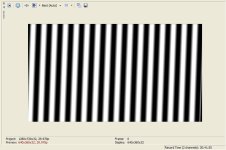
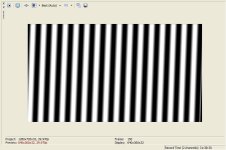
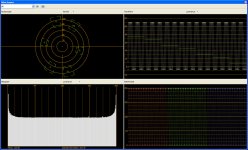
OK, I just thought of a much more effective way to show what I mean. These first two pictures are what vertical bars would look like on a CCD during a pan and the resulting scope readings.

CCD1.jpg
CCD2.jpg

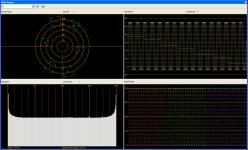
This is exactly the same setup as above, but with skew added. This is what vertical bars would look like on a CMOS during a pan and the resulting scope readings.

CMOS1.jpg
CMOS2.jpg

Looking at the scopes pictures, one can clearly see the drastic differences in the histogram and waveform for identical pictures taken with a CCD and a CMOS during a pan due to skew. But visually, no information is lost. Barry, were you seeing anything like this?
 
Last edited:
Okay, now I'm really curious -- what mode did you shoot these charts in?

Charts were shot at 1080 29.97p

Musician,

You example is clearly correct to my eyes - scope softening but no visual softening. There would be no way to pan without scope softening, on a skewing camera.

--------

Let me revise that thinking. I bet if I tested a slightly pre-skewed chart (such as yours above) and panned on it, such that the skew was counteracted by the pan, I would witness apparent sharpening on the scope. That would be an interesting one to try. Then we could change the name of the thread to "EX1 Gets Sharper When Panning!"
 
Last edited:
Musician, what you're saying may be accurate. I'd love to get an EX1 on the scope again to verify. Whether it turns out to be true or not, thank you very much for taking so much time to share your theory and mocking up graphs to try to illustrate. That kind of dedication to sharing information is what makes DVXUser my favorite place on the web.

matthew, try it! That would be an interesting thing to see, and if you can scope it and see whether it actually does get "sharper", that may explain the issue.
 
Barry, the thanks goes to you for hosting such a site. I read all your posts everyday, and feel that I have learned more from you and the talented members here at DVXuser than I did the entire time I was in college, and I studied engineering. Getting a compliment like that from you has made my year.

Here is to a good year of shooting, learning, and improving
 
I'm a mouse click away from buying one. Good to know rez isn't lost on pans. So I'm closer. It's that skew and strobe artifacting that have me stalling on buying one. I shoot quite a bit of high movement, action and often strobe/light effects. Maybe it'll be one of those cases that you just have to break out the HVX for those special circumstances. It'd be nice to sell my HVX to finance a EX but these CMOS issues will one day end up like this:

"well, we can't really shoot those police sirens"
"What!"
"due to the technical limitations of the blah, blah, blah...."

Not a fun scenario.
 
Holey cow Musician! AWSOME thinking. :shocked:

Your theories, re-enforced by the great visuals, make perfect sense.

I can only imagine how that effect would look on a real image.

BUT, I'm not clear on where the edge enhancement goes .. I guess it has to be motion blur. The edge enhancement of course is a "per line" deal (as opposed to the "per frame" or "per field" deal of the waveform.) so this effect [which needs a name by the way: "Skew Softening"? "Vertical Pan Blur"? "Waveform Parallax Softening"?] wouldn't affect a "peaking" style focus assist system.


Excellent work. :thumbsup:


If this theory is correct, then what Barry saw should occur with *any* CMOS camera (with rolling shutter).

I may have to head into the studio tomorrow and set up some cameras side by side. (Sony A1 [CMOS] and TRV-900 [CCD] for example should show a clear difference.) Hmm, and I've got access to a hardware "soft" (video) scope [that I can capture] and a video mixer to split-screen both cameras together side by side. Yeah, I have an activity for tomorrow.

I will have to test Matthew's sharpening theory too. Genius!

- Mikko
 
so this effect [which needs a name by the way: "Skew Softening"? "Vertical Pan Blur"? "Waveform Parallax Softening"?]

Since it's not really a softening but only gives the appearance of softening on a waveform monitor, lets leave "softening" out of the terminology.

How about "waveform skew smoothing" which refers to statistical data smoothing, or "waveform skew averaging"

Or "waveform skew error"


All this leaves me with the conclusion that with a skewing camera, the waveform monitor is no longer the right tool to use when evaluating resolution in motion. You must use the actual imagery.

Also, what happened on old tube cameras, which also scanned from top to bottom, like CMOS? Did panning show something similar on waveform monitors?
 
Last edited:
Ok, I just got home from the studio. I tested with a Sony A1 [CMOS] and a Z1 [CCD] side by side.
I don't know if it's what Barry saw, but it certainly was 'weird' to someone else who's used to looking at CCD cameras on 'scopes.


I'm going to write up an Article about the test results. With stills & video.


But here's the short version: TheMusician's theory is accurate. Amazingly so. And Matthew's inverse is also true! All that remains is to identify if this phenomenon is what Barry witnessed.

- Mikko
 
Musician, just wanted to chime in and also say that this is awesome what you've done. You appear to have come up with a reasoning behind the claims that softening occurred. Rather than blowing the whistle and shooting things down, you respected the original poster enough to take him at face value and further and properly investigate why he/she was seeing what they were seeing.

Turns out, it appears to be a result of motion blur combined with the unique effects of a CMOS censor that makes it appear as if their is rez loss on a histogram...

That's great. You respected that someone was not just blowing smoke out of their arse, or ignorant; accepted that they must have seen something, and you got to the bottom of it and found out what they were seeing. You rock, man.

Thanks. So, now everyone knows what appears to be really happening. It wasn't what was originally thought, but at least we know what it is.

I'm interested to see your write up Mikko. It should make for interesting reading for a lot of folks.

Great thread.

Later,
Jason
 
Yes, kudos for all who have worked on this. I had hoped to do some more scientific test on both my EX1's and my HVX before it was sold, but the HVX just went out via FedEx (sad day). I kinda wished I had kept one HVX for those days I wold be in a situation where a CMOS may cause problems, but realistically I do not find myself in those often. I will try to do some similar tests. I do not have a hardware scope, but can use the scopes in FCP to test. Thanks Barry for voicing a legitimate concern and thanks to others for doing appropriate leg/brain work to understand what is happening.


Adam
 
How about CSS - CMOS Scope softening? or SISS - Skew Induced Scope Softnening (As you can see, marketing is not my forte)

If you read these forumns a lot, it is clear that both Matthew and Barry are both guys who know what they are talking about. And in the end, I think they are both right. Matthew's tests were visual, thorough, and accurate. Barry's test was scientific and accurate. The discrepancy was only happening during panning, and most of the cameras scoped up until now have been CCDs. This all led to the question, "What is the difference between a CCD and CMOS during a pan?" Answer - skew. And what does skew cause on a scope?

I really appreciate all the positive feedback because I did stay up a bit past my bedtime thinking about this(and I dig that!) I'm geek for good academic discussion. All people know how satisfying it can be to have an idea, and for tests to confirm those ideas. It may turn out to be more involved than my simplifed test, but I think it is a good start. Great teamwork!

MIKKO, thanks a lot for taking the time to test this theory. Your post made my day - WOOO HOOO! I wish I had access to all the equipment that you have, and your findings will go a long way to settle a lot of anxiety that this issue has brought up. I am hoping to buy this camera myself in a couple of months, and I know that it gave me pause. I really look forward to your write-up and can't wait to hear more details on your findings.

And Matthew, thanks to you for taking the time to post visual footage confirming the sharpness of the cam and starting a great thread. I love a useful and constructive thread in a forumn like this. CMOS has some drawbacks for sure right now, but this camera definitely has a place.

Now, about that whole light issue on the Brevis 35mm adapter...hmmmmm :huh:
 
Last edited:
TheMusician. I think you have nailed what's going on with the scope. Thanks for taking the time to deliver this information! Based on your clear examples and results, that makes the most sense.
Also, thank you to Matthew for confirming the visual is actually not affected.

Having said that, I'm looking forward to the next generation CMOS, or CCD that offers decent rez with a gobal shutter. Although for our application the EX1 works well. I imagine the EX1 would not fair well with high paced action sports or movies. I guess it really depends. There's so much care just shooting 24P, but some shots will probably not work. Like the RED, I'd like to see some examples of 3d motion tracking. Of course it would depend on the shot, but I imagine this design will be a problem.
 
Last edited:
I might be able to throw some additional infomration in here that'll shed some more light on these measurements.

Someone did some fairly detailed tests over at DVInfo to measure motion skew from the rolling shutter using a moco head. Results show that readout time is 50% of frame rate. Shutter speed is not a factor, it only affects MB. So at 30fps readout time is 1/60 sec. From a quick eyeball of the results at most practical shutter speeds I couldn't see any res loss due to motion, the impact of MB would totally mask any that one could possibly see, if there was any.

The scopes in Vegas do indeed show the whole frame so they're not a good tool for this kind of test at all. Someone else had some suspect answers regarding something else and when I investigated I realised it was the scopes causing the odd mismatch between measurement and observed images.

Hardware scopes let you select lines. They'd be the way to measure res loss with motion except you'd need a HD scope which are expensive and you'd be hooking them upto the HD SDI output of the camera which is pre the encoder. So what you see on the scopes might not be what gets recorded to the SxS cards.
 
Actually, with further tests, it was concluded that the EX1's readout rate is not proportional to frame rate but is always 1/60 second.

That's from reading the rest of the thread on DVInfo.
 
For those interested, the link is:

http://www.dvinfo.net/conf/showthread.php?t=112362


Assuming my math is correct, the skew is 2.8 degrees (53 pixels). However the pan was very fast, 18 frames (0.6 seconds) from one edge of the screen to the other.

If the pan took 4 seconds from one side to the other, I calculated that the skew would be 0.42 degrees (8 pixels at 1080, 30p).

There is another way to measure the speed of the rolling shutter, but first I need to verify my calculations with Eric, who did the test, before I talk about it.


Sincerely,

Bob Diaz
 
Back
Top