Has anyone used this? - (canon eos adapter for XL)

Charles Lowthian

Well-known member
Hi.
Just wondering if anyone has used the EOS adapter, that was emphasised as a key feature by Canon on their release of the XL1 and now the later XL2, and H1. it's "interchangable" lens ability.
If so, does anyone have some footage or screen grabs they could post to show? - I'm trying to establish the difference between using SLR lenses attached to the camera via this device (ie: XL), as opposed to 35mm adapters.
I see the results of 35mm adapters, as I enjoy my Letus :) but just curious cos I have never seen the XL used in the 'intended' way.

Canon EOS Lens adapter:
https://store.canon-europe.com/serv...ncon&id=ProductDetailsPage&productID=85567900

Cheers,
Charles.
 
I've only played with it once, and not in very high quality test environment either.

Mostly just outside on a tripod that turned out to be far too small for the huge long lenses that we where playing with.

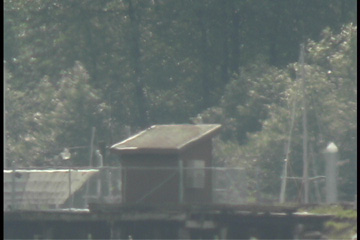
Here's one still that I can't remember much about, except that the lens was about 2 feet long, zoomed in to full Tele.
That's just a small service hut with a medium height storm fence around it.
According to Google Earth, that shot is almost exactly 2 miles to the hut.
XL1_Lens_Douglas_PhotoLongx.jpg


The distortions in the image are purely atmospheric - there's 2 miles of open water between the camera and the hut. And it was a warm sunny day.


Not a super technical post by any means ... but that adapter, with the right lenses, sure does give the XL's a hell of a reach.

- Mikko
 
If so, does anyone have some footage or screen grabs they could post to show? - I'm trying to establish the difference between using SLR lenses attached to the camera via this device (ie: XL), as opposed to 35mm adapters.

The difference is there is a 7.2 crop factor applied to whatever lens you use vs. none for a 35mm adapter. Meaning a 50mm lens becomes about a 360mm. That's why the adapter generally isn't a popular choice because most lenses become too telephoto for your typical narrative work and there's no wide angle option. Here is a comparison of the various FOV by Chris Hurd over at DVinfo:

http://www.dvinfo.net/canonxl2/articles/article10.php
 
thanks for that frame and opinion mikko :) and jade.
yeah, i thought the crop factor would be a bigger outcome than any dof change.

i suppose the eos adapter is more for increasing the zoom as opposed to image qualitys.

just got me wondering that if digital slr's maintain the dof as film slr's, if it would be the same with this. i suppose canon (or others) could simply apply the same design of digital slr's into digital video, and YAY :) but i guess they'd rather not :(
 
just got me wondering that if digital slr's maintain the dof as film slr's, if it would be the same with this. i suppose canon (or others) could simply apply the same design of digital slr's into digital video, and YAY :) but i guess they'd rather not :(

Well, as always, it's a matter of cost. Not all DSLR actually maintain the same FOV as a film camera because it has a smaller sensor. The Canon 20D for example and other camera in that range has a 1.6 crop factor applied because it has a smaller sensor. DSLR with larger chip size costs more. And the chip implementation is different for video than for still. You can't just take a chip designed for a still camera and convert it for video use.
 
I asked Wayne about this when I went to see the Sgpro. He said it works but you dont get the film look, the DOF is fairly wide as the CCDs are not really big enough to generate the shallow focus range, and because theres no GG you get a very clean, un grainy image.

It works well if you want to change lenses but not that well if you want to produce film like video.....
 
Well, as always, it's a matter of cost. Not all DSLR actually maintain the same FOV as a film camera because it has a smaller sensor. The Canon 20D for example and other camera in that range has a 1.6 crop factor applied because it has a smaller sensor. DSLR with larger chip size costs more. And the chip implementation is different for video than for still. You can't just take a chip designed for a still camera and convert it for video use.

yeah, the 1.6 crop factor of dslr's i could live with. and video resolution would require a smaller censor, unless of course they just want to make me a 6K slr lens attachable video camera - i would not mind at all! :)
 
It works well if you want to change lenses but not that well if you want to produce film like video.....

it is a little funny when we evaluate what we are wanting to do (in this forum section) of making a video image look like a film image. why not just use emulsion then? - COS WE CANT $$$$ :cry:
- i laughed
 
Back
Top