Building a 3-Cmaera DVX100 FLypack-Any Advice?

BrianMurphy

Veteran
I have an up coming project that is just going to be easier to do live to tape. I want to build a flypack and use DVX 100B's as my cameras for several reason. I own one, they can be setup to match eliminating CCU and the auto iris on them is very efficient and this will be shot outdoors. I can jam the code as well as record in the camera as a back up to the switched masters.
This will be my second build the first used PD150's and WJMX-50 switcher as the core.
I want to use the NewTek Tricaster Pro with this system. I will feed yc out from the cameras and record yuv to a digital betacam master .
Audio will be a Mackie board and fed directly to the DigiBeta and through a da back to the DVX100's
I would appreciate any comments info or advice this awesome group would offer as I being this build.
 
I have looked at a couple of other options like the Sony and MX4 from Focus. The Sony is overpriced and the mx4 is under equipped. NewTek is a cool little company with offices in the states and from several sources I have heard they have the BEST support around. ANd I got this from a couple of dealers who also deal with Pinnacle and Avid and others. So that and it is a one stop box. I won't be using it for audio and will record to tape and use it as bakc up record but as a switcher, effect.
The content in this case is an exercise series shot outdoors at a remote location where everything has to be shipped in including generators for power. Light weight is important. not having to bring Framestores, multiple monitors for preview and pgm and source etc all makes a difference.
 
The Tricaster is great. I haven't used the Pro, but my buddy has the base model. Easy and fun to use... it'll save you tapes and time.

Tom Green Live! on tomgreen.com (weeknights @ 11) uses the Tricaster Pro as well.
 
If all you want is video switching, look into the far more realiable (and smaller & lighter!) Panasonic AW-SW350 switcher. Very nice and compact, and works like a proper switcher (not like the wanna be 'video mixers' ala Videonics/oldPanny, etc..)

0312_SW350_2.jpg


Half rack, A/B or PGM/PST busses, full tally, 5 inputs with a framesync on ALL inputs (yeay!), looping composite inputs, also has S-vid I/O. Also genlockable, and has a built in DSK from extrenal input or internal frame buffer. Even runs on 12v!

- Mikko
 
That looks pretty cool. Is this what you use? Also, is there any type of internal hard drive for storing clips to be pulled up on demand?

Off I go to google it...
 
My school uses one that I recomended.

Nope, no hard drives, no moving parts, no 'computer' to rely on (to crash [like VT & Tricaster]). It's just a very basic video switcher that's solid as a brick and incredibly reliable. Nothing fancy, it just works like it should. :)

- Mikko
 
Thanks for the info, Mikko.

I know what you mean on the crashing. Tom Green Live crashed a few times when they were first starting up. It was pretty painful... I assumed it was the tricaster. Do you go to school in Finland?
 
He actually does use the NewTek Tricaster. He runs his new show right out of his living room and has given a tour of the "studio." Being a huge tech geek, I paid extremely close attention to everything he was using. I was surprised.
 
Besides the cameras and the mixer, what is the differnce in the other equipment needed for live production? Let me break my question in to two parts?

1) what other equipment do you need for a live production beside the Tricaster?

2) what other equipment do you need for live production besides the Panasonic AW-SW350?
 
It all depends on what you want to do?

Tricaster ahs a built in video recorder and graphics playout. For a the SW350 you'd need a seperate Deck.

However the SW350 has 5 live inputs, the Tricaster only has 3.

Tricaster has the monitors built into the graphic user interfaces on it's one monitor, the SW350 has lit hardware buttons and only needs a monitor for video. Tricaster has an optional Hardware panel, but it has to have the software screen too.

The Tricaster has a few more ins and outs, but one of those is a mains power requirement. The SW-350 can runs on 12v and can be run on batteries of necesarry.

The SW350 has fade and 9 wipes as it's transitions in adition to cuts. However you can cut directly on both busses instanly like a 'real' switcher, Tricaster can run all sorts of advanced effects, however direct cutting happens with up to half a seccond of lag making it tough for fast paced switching.


So it really does depend on the needs of the shoot to decide what else is needed. Live production is complicated.

- Mikko
 
Thanks everyone for the input, it is good to know that Tom Green is using the Tricaster and I am sure many others are too. Sony went to a lot of trouble to do a big pitch on their box the ANYcast a while ago up here.
http://bssc.sel.sony.com/BroadcastandBusiness/DisplayModel?m=10008&p=13&sp=102&id=76323
And that would mean they see it as a future market. Like our cameras it does not always take an atomic bomb to kill a fly.
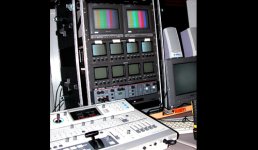
So here is the situation. I have used a variety of switchers and control setups. The lightest weight rig I ever used was the one I built with the wjmx50 (that I admit has it limitations) and the pd150s. There is a photo of it below. It could handle up to 8 camers with a bang box on one of the inputs. It was still heavy with all the monitoring etc. The beauty of the Tricaster is it is light and it does all the monitoring. And if you have an excellent ntsc monitor on the record device(digidbeta in my case) that should suffice. I can record in the camera and jam code with DVX and therefore have my slaves if I need them in post.The switcher is light, its all the monitoring that is heavy and the Marshall LCD rack monitors are NG I have worked with them and if your chair height is not perfect your are out of luck. I am hoping that the TriCaster with some DVX100b's will be the ticket the image quality of the cameras is superb as wel all know... Now can I run 250 feet of y/c cable t the tricaster?will I need a small DA every 100 feet?
 

Attachments

  • NYC_photo_09.jpg
    NYC_photo_09.jpg
    52.9 KB · Views: 0
Last edited:
I'd recomend you go with composite.

Once you start making longet rungs, Composite is more robust. S-video begisn to fall apart, it's jsut not designed for long hauls. Inthe edit bay it's great, for cameras not so much.

I'd get some good Coax cable and use it with composite for you camera runs.

- Mikko
 
This probably won't interest you for a few reasons (only 2 cameras, need AC power, short cable runs, downconversion, 16 x 9) but have you considered buying Sony HD cams and switching HDMI with Blackmagic's On-Air? You get a limited still store, can record a High Def cut to the Mac with the DVCPRO format and downconvert for the DBeta master.

http://www.camcorderinfo.com/content/Sony-HDR-HC3-Camcorder-Review.htm
http://studiodaily.com/main/technology/pvr/7170.html

http://www.blackmagic-design.com/products/intensity/on-air/
 
Ronin Cam said:
This probably won't interest you for a few reasons (only 2 cameras, need AC power, short cable runs, downconversion, 16 x 9) but have you considered buying Sony HD cams and switching HDMI with Blackmagic's On-Air? You get a limited still store, can record a High Def cut to the Mac with the DVCPRO format and downconvert for the DBeta master.

http://www.camcorderinfo.com/content/Sony-HDR-HC3-Camcorder-Review.htm
http://studiodaily.com/main/technology/pvr/7170.html

http://www.blackmagic-design.com/products/intensity/on-air/
This is unfrotunately too small a setup but it is exactly in the direction I would like to go and I wish it were a little farther down the development trail.
 
Back
Top