CINEMATOGRAPHER LAUNCHES HD STOCK FOOTAGE WEBSITE BASED ON
PANASONIC’S AG-HVX200 HAND-HELD HD CAMCORDER ACQUISITION
SECAUCUS, NJ (April 19, 2006)—Dallas-TX based cinematographer Mike Schrengohst has just launched a website, http://www.motionzonehd.com/, that sells affordable High Definition stock footage exclusively. Mostly shot in 2006, the material is not only new and fresh, but also lensed predominantly with Panasonic’s
AG-HVX200 DVCPRO HD P2 hand-held camcorders. The shooters include Schrengohst, himself an HVX200 owner, and a growing stable of HVX200 owner/operators from around the country.
“My background is in video production, where I mainly shot and edited corporate programs,” Schrengohst recounted. “Now with the HVX200, I will be focusing on providing stock footage, which has been my goal since I become involved in video. I used to shoot some high-end corporate pieces with 16mm, and the HVX200 comes real close to duplicating that experience, except now I don't have to wait (or pay) for film and film transfers!”
He added, “I’d purchased Panasonic’s DVX100 24p DV camcorder when it was first issued. I started shooting stock footage with it, and as good as it was, I really wanted to get into high-definition, so decided to wait until HD become affordable. Beyond cost-efficiency, the HVX200 lets me shoot 720p or 1080i, full frame video. It uses DVCPRO HD, which has a proven workflow, and the P2 technology is great.”
The AG-HVX200 offers production-quality HD video with independent intra-frame encoding, 4:2:2 color sampling, and less compression, making HD content easier and faster to edit and more able to stand up to image compositing versus long GOP MPEG-2 systems.
Schrengohst noted, “Stock footage is short - :30 sec clips at the most. The 4GB P2 cards give you about the same time that you have on a 400ft. load of 16mm film--you just don't need a changing bag! I have a 17" PowerBook that I use on shoots, and copy the P2 cards to that. It's all battery powered, and I find that I might do four card loads per shoot. Ultimately, I’ll probably invest in larger capacity media, but for now the 4GB cards are great because I can do a 1:1 backup to DVD-R as well.”
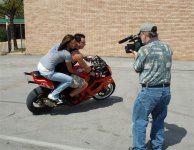
He continued, “All of the shooting I have done with the HVX200 is really photography in motion—for instance, I recently was on location with a stunt motorcyclist. Shooting with the HVX200 reminds me of the days with my Bolex--wind it up and shoot. I travel light--sticks, camera bag, batteries, P2 cards and my laptop. It all fits in a backpack. As I’m getting to know the camera and its settings, I’ll either use Cine-D with -4 pedestal outdoors, or indoors I usually go back to an HD normal gamma. The great thing about shooting stock is I can experiment, and sometimes I will post shots that look similar but might have different camera settings. I am working with professional talent for the most part, and they have been impressed with the footage. Once we play back material--even just on the laptop screen--they can see a difference.
“The dynamic range of this camera approaches my digital still cameras. Being able to adjust the knee levels is very helpful in high contrast situations, and the colors and filmic quality really pop through. The HVX200 feels quite solid; it's a little heavier than the DVX100, but I can tell the HVX200 was designed for more demanding shooting requirements. The variable frame rate function is fantastic! 60 fps looks awesome, but 12 fps is useful as well. I am experimenting with 12fps video that we slo-mo 50% in post—it’s like shooting film. And the interval recording feature is very impressive. The 1080i mode on the HVX gives you a max HD image that is playable as soon as you stop recording. The camera just opens up your creativity and lets you experiment to a degree that was not possible before.”
In terms of the P2 workflow, Schrengohst commented, “We usually shoot everything in 720p 24pN, 1080 30p & 1080 24pA. We shoot P2, then copy to the laptop hard drive, or external drive when available. We can also import P2 into FCP in the field if we need too. Back at the office I copy all P2 material to a FAT Formatted PC drive from the PowerBook and then use the P2 viewer on the PC to log all footage. I back up each card to a DVD-R. Then we only import the files we want into FCP. We extract the 720p and 1080 30p files from the Mac. We use Raylight on the PC to edit the 1080p 24pA files. We want to give every HD editor a choice of files as opposed to a ‘one-size frame rate fits all mentality.’”
He noted, “I have a PC hooked up to my 52" DLP television, and I can tell you that the HD files I create with the HVX200 compare very favorably to anything I have seen in HD. And I’ve had several viewers confuse the HD material with film. I tell my colleagues, if you need an affordable solution to shoot HD, consider the HVX200. If you need to shoot exciting, filmic footage or an indie film, then the HVX deserves a hard look. Full progressive frame rates, variable frame rates, P2 technology—what’s not to like?”
Some of the HVX200 shooters who contribute to http://www.motionzonehd.com/ include Bob Gundu (from 10 Frame Handles, Toronto), Justyn Rowe (HDbaby, Orlando), Richard G. Darge, RGD Films, Los Angeles), and Jethro Senger and Roberto Ballesteros (both of Firelabs, Orlando).