ZOOM H4N and XLR "Y" Splitter cable?

Hello everyone!
I'm fairly new to audio and have a quick question...
I'm going to be working on an Independent film soon and the only audio equipment that we will have will be a RODE NTG-3 shoutgun (with blimp) a Denecke PS-1A - Portable Single Channel 48V Phantom Power Supply to power the mic, and a ZOOM H4N. I optied for the Denecke to power the RODE because I know that the ZOOM's pre amps are abit "noisy".

Okay, here's my question, if i run a short XLR splitter cable out of the Denecke that's powering the RODE, and into the zoom so I can record and "Limit" my dual mono tracks (such as in this video... http://www.youtube.com/watch?v=FBwqmjr-y5U&feature=relmfu ) am I going to be adversely affecting my audio quality?

I will be recording in 48khz 24bit.

Thanks so much!
 
If I am reading this right, my advice is..........not a good idea.

When you split an audio track with just a Y cable, you cut the signal gain by half, but the noise floor will stay the same. Meaning less signal, more noise. When you try to recover the signal output, you will also bring up the noise floor.

Personally I hate Y cables. They lead people to think that it will solve an issue cheaply.

If you want to split your signal, the way to do this is a mixer with "stereo/2 chan" out between the power supply and the H4n. Then use the pan to set up the safety track. This is how I run my personal gear with my H4n.

If you absolutely must use a splitter, find an "active" one. An active circuit will take the signal being split, the boost the audio aspect while leaving the noise floor less impacted. It will have an op-amp circuit involved, so depending on the money you want to spend, that will dictate how quiet it is.
 
Last edited:
Thanks Doc for the quick response!
That's what I was afraid of. Since you work with the ZOOM yourself, if you were in my postion,(without a mixer) what would be the way you would monitor your levels to make sure theres no peaking? I know that the ZOOM unfortunetly does not have a limiter on it for doing this, and I was hoping this might have been a "work around" for that but I guess not :(
 
That's one of the drawbacks of the H4n. I use a mixer in front of mine. Instant access and control of the incoming signal to it. You will be hard pressed to work the record level fast enough on set for any transient hits to it.

Don't get me wrong, as just a recorder and nothing else, I love it. But beyond just hitting record, it is extremely limited on the functionality for set use. I will set my initial levels on it, and then the only buttons I will touch on it afterwards is "record" and "stop". Occasionally "play" to get a playback. Really nothing else in the audio chain.
 
Thanks again Doc, I guess I will just have to try and make due with it all. (I'll just have to get them to do more proformance rehearsals before the actual takes to double check my best level settings:) oh well.

P.s. you mentioned an "Active" Y cable. Would there be one in particular you might recommend if all things considered and worst came to worst and I had to opt for the XLR Y set up?
 
Now I understand! :) I really appreciate all your help Doc! I'm going to try and push for a mixer, but if not I believe this will work.

Thanks again!
 
Hello everyone!
I'm fairly new to audio and have a quick question...
I'm going to be working on an Independent film soon and the only audio equipment that we will have will be a RODE NTG-3 shoutgun (with blimp) a Denecke PS-1A - Portable Single Channel 48V Phantom Power Supply to power the mic, and a ZOOM H4N. I optied for the Denecke to power the RODE because I know that the ZOOM's pre amps are abit "noisy".

...!
By the way, there's a red flag here that got lost in the shuffle. The Denecke is just a power supply, NOT a preamp. Mic level goes in and mic level comes out. It will do nothing to avoid any noise arising in the Zoom's preamps, your signal will still be going through the same pathway as it would if you had powered the mic off the recorder's own phantom supply. All you might gain is the batteries in the recorder won't get used up quite as fast.
 
Whoops, missed that. Saw the "y cable" cable thing.....and totally focused on that. Did I mention how much I despise y cables, LOL.
 
Steve, Good call! I guess I'll have to figure out that issue next :/

wjauch, Thanks, I'll have to mess around with those later on today to see what might work best. Do you have a prefrence as to which ones to use for say dialouge vs. Foley? (i.e. COMP 1 or LIMIT 3?)

Also, Doc I was talking to a friend today and he mentioned he has a Samson S-Direct Plus ( http://www.samsontech.com/samson/products/processors/s-class-mini/sdirectplus/ ) That I could use as an Active splitter. All I would need is a XLR to 1/4" adapter. Do you think this may work like the Whirlwind you had talked about?
Thanks again guys!
 
I looked at the specs, and the one thing I am concerned with is the unbalanced input. Which means your rig will be soooooo much more sensitive to RFI and EMI. Your mic and the XLR cable upto to the S-Direct would be a huge antenna. A little work and a work around would fix that, if the body of the S-Direct would fit an XLR connector on the input.
 
When you split an audio track with just a Y cable, you cut the signal gain by half, but the noise floor will stay the same. Meaning less signal, more noise. When you try to recover the signal output, you will also bring up the noise floor.

I'm a bit curious about this. To specify, wouldn't splitting the signal reduce the whole signal, including microphone noise, up to that point? This means that the only increased noise is the one added in the preamp to bring the signal up to compensate this (I forget, is it 3 or 6dB?) In the case of the H4n, which does not have very quiet preamps, this might be a problem, but using a proper mixer or higher end recorder I don't really see that much noise added.
 
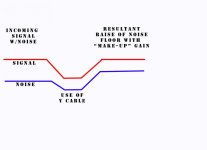
Jema, you would think that, but no........... and yes. The noise floor is irrespective of the audio signal. It is generated by the electronics (mic, recorder, mixer, power supplies) themselves. It's that "hiss" you hear when you crank up the volumes on gear. Some gear you have to push it hard to hear it, and other gear, it's really noticeable fast. And the rule of thumb is: the less expensive the gear, the higher the noise floor. That is called "self-noise". And self noise from the H4n is pretty high. So by splitting the signal in half with a Y cable, yes, the signal is cut, but the noise travels along with it. Now you have to basically double the signal in the H4n to "recover" that signal loss. Everything, including the noise from the mic, power supply, splitter, and the H4n, is doubled as well. Every piece of audio gear has noise, just some are less than others. And using the "Y" cable will double the noise, whatever the level is, just based on that principle. Here's a quick graph to illustrate:

Noisefloor.jpg

An active splitter compensates for this by amplifying the signal being split through op-amp circuitry, which reduces the amount of noise or at least keeps it at the same level as before (Signal to Noise Ratio).

The goal in audio (other than getting gear that has a low noise floor) is to make sure your signal is hot enough to make the noise floor negligible, while maintaining a safe range to prevent clipping.

This is just a quick rundown, I could go in depth on it but LOL, you won't want that. I tend to put people to sleep with my explanations.

Here is the way I set up my gear:

Mixer:
Since the input channels on my mixer are pretty decent with a decent op-amp, I run it about 75% for normal dialogue. And if I am just booming, no lavs or other mics, i set my pan knob so that I have L 12db higher than R.

On the end is my boom mic with 50' of XLR. Mic is self powered. (the phantom power on my mixer injects way too much noise for my taste). On the master out, I run that about 40%, because I have not had the chance to upgrade the amp chip yet. It is noisy too, past 50%. These gain settings, with my mic, give me the best results from the mixer.

H4n:
I set my incoming record levels at about 29-31. With the feed from my mixer, I found this to be a great record level with standard dialogue. Hot enough to give a good signal but keeps the H4n's pre's quiet. But to really monitor the noise floor, I slam my headphone volume on the H4 to 100. It does add some noise that is not being recorded into my cans, but I have learned to overcome that and "filter" it out.

Now, this is just how I do it. I get pretty decent results with this arrangement. But that is just me. Your gear, and how you do it may be completely different and you still get great results.
 
Last edited:
1. As Mr. House observes, the Denecke PS1A is simply a power supply, NOT a preamp.
2. It is not clear that using the phantom power from the Zoom H4N will result in ANY perceptable difference in the SNR (signal to noise ratio). Cetainly not enough to warrant the premium prices of the Denecke product. You would be far better off getting a $150 better recorder than spending that kind of money for just a power supply.
3. Spliting a mic signal with a Y-cable does NOT "cut the signal gain by half". An understanding of source and load impedances is necessary to understand why this is not the case.
4. The Whirlwind SP1X2 is NOT an "active splitter". (Hint: things that are "active" require power, like a battery, etc.)
5. A passive transformer splitter like the Whrilwind actually IS more likely to introduce a slight amount of LOSS than a hard-wired Y-cable. Splitter transformers are invaluable for isolating you from other peoples systems (like the venue PA system, etc.) But splitting a microphone output into two inputs of the SAME device in no way requires the isolation of a transformer (Whirlwind or even a premium brand).
6. There is nothing wrong with Y-cables and they are quite useful for things like this.
7. The technique of staggering record levels is a useful tool.
 
3. Spliting a mic signal with a Y-cable does NOT "cut the signal gain by half". An understanding of source and load impedances is necessary to understand why this is not the case.
I'd like to see your math on that, Richard. And keep in mind, his "loads" and "impedances" are pretty cut and dried in this application. Mic, PS, Y cable, H4 versus the alternative.

If you have an electronic signal/voltage, and you parallel it (split it), the amperage of that signal is cut in half. Amperage is the amount of work possible in a signal. If you have cut that in half........that's half the power. In audio, and any other form of electronics, the main components are resistance, voltage and amperage. Cut either V or A (or increase R), and you have signal degradation.

And keep in mind he is using an NTG series mic, not the hottest output mic out there.
 
Last edited:
Doc:
If I understand this correct, you are saying that dividing the signal in effect changes the snr, since the cable is dividing which alters the proportion of the signal vs the noise, but the preamp is simply doing equal addition?S

ince it can get confusing using a logarythmic scale as dB, let's make an example saying that we have a signal, that we give the nominal value 100. This signal has a noise floor, that has a nominal value of 40. This makes the snr 100-40=60. dividing the signal, it becomes 50, and the noise floor is also halved to 20, making the snr 50-20=30. The preamp then increases these values the same amount, say 50 to get back to the starting signal strength. The signal is 50+50=100, and the noise floor 20+50=70. In the end, the signal is as strong as before the divide, but the noise has increased from 40 before it, to 70 after it.

Am I on the right track?
 
Thanks for all the information guys I'm really learning alot!

Doc, Do you ever use the Mono Mix feature on the H4N while recording? I was testing it out today and it appeared as though the recording levels where a few decibles quiter while having it on, (like -4dbs quiter) than having Mono Mix turned off and just recording in say the left single Mono channel. In your opinion is Mono Mix a good option so as to be able to monitor your Mono recording in Stereo while in the field?

Thanks again!
 
Back
Top