Zacuto Revenge Shootout Part 3

There are careers and reputations on the line here. If you are a DoP and get stuck shooting with a low-end prosumer camera and the client flips out, because there are technical problems with the footage or it doesn't look at good as an Alexa

This has to be the most comical statement in the entire thread. Dude, if your jobs on the line, or if your losing work over a Zacuto documentary, then you might wanna think about a new career.

"Peoples careers are on the line here,
LMFAO." Thanks for that post, I needed a good laugh tonight.
 
This has to be the most comical statement in the entire thread. Dude, if your jobs on the line, or if your losing work over a Zacuto documentary, then you might wanna think about a new career.
.

Agreed. If the producer wants to get the same image with a prosumer camera then let them. Make sure to leave a good impression so that when that ambition fails they will be right back to you. If they succeed is when you need to worry.

This is nothing new. It happened when digital film cameras first came out. The film guys revolted at the thought of doing something for less money and getting a lesser image yet for some clients it proved to be 'good enough' for their needs and others stuck to film because the digital image wasn't there yet.
 
And now for a Moderator's perspective on this thread.

I appreciate these things cause people to form strong opinions and most people want their opinion to be heard. That said this is not your living room - this is DVXUser a forum run by volunteer moderators to preserve a respectful culture in this forum.

At times its denigrating into a school yard argument. I'd hope this can be discussed in a mature manner from here on out - and that includes snide remarks from the sidelines for those doing it.
 
My own belief is that an Alexa is a lot better than a GH2.. a lot lot lot lot better

S

Well, at $89K for a 'starter package' from ARRI... I'd expect so... I would hope that the Alexa was not just 'strings and mirrors', or any of the other high priced cameras... and I just happen to have about 89 cents in my piggy bank towards the purchase... hell forget the purchase... the what $1400 or so, a day rental... oh, and the 'insurance' for loss rider... and since I don't personally have any experience shooting this camera, how about an operator at least... so I suspect it would be about $2K a day to shoot.

So, sure, if I had a 100K or greater project, I'd think seriously about an Alexa... and heck throw in a DP and operator too... non-union of course, because at 100K I still couldn't afford union scale...

I think anyone who has looked into it, knows that the Alexa has a dynamic range of about 12 or so stops... and the GH-1/2, the 7D, and similar have at most 6-7 if they 'squeak' by.

Oddly that's just about what a LCD display gives anyway, maybe even less on 'consumer' grade displays... but I digress...
 
Well, at $89K for a 'starter package' from ARRI... I'd expect so... I would hope that the Alexa was not just 'strings and mirrors', or any of the other high priced cameras... and I just happen to have about 89 cents in my piggy bank towards the purchase... hell forget the purchase... the what $1400 or so, a day rental... oh, and the 'insurance' for loss rider... and since I don't personally have any experience shooting this camera, how about an operator at least... so I suspect it would be about $2K a day to shoot.

So, sure, if I had a 100K or greater project, I'd think seriously about an Alexa... and heck throw in a DP and operator too... non-union of course, because at 100K I still couldn't afford union scale...

I think anyone who has looked into it, knows that the Alexa has a dynamic range of about 12 or so stops... and the GH-1/2, the 7D, and similar have at most 6-7 if they 'squeak' by.

Oddly that's just about what a LCD display gives anyway, maybe even less on 'consumer' grade displays... but I digress...

My F3 in contrasty rec.709 mode has 12 stops. The Alexa has 14. The GH2 8. Haven't seen any solid testing of the 7D. It costs roughly 2k less a DAY on a feature to shoot with an Alexa over a GH2, simply due to the extra time spent in relighting, post production, and the general hassle of shooting a feature on a still camera. This gives a very stepped back look at what the real costs come out to. Zacuto did not mention this once, and this is why people are pissed off.

http://www.ryanewalters.com/Blog/blog.php?id=4955533891225329768

Scroll down to production numbers
 
Well, at $89K for a 'starter package' from ARRI... I'd expect so... I would hope that the Alexa was not just 'strings and mirrors', or any of the other high priced cameras... and I just happen to have about 89 cents in my piggy bank towards the purchase... hell forget the purchase... the what $1400 or so, a day rental... oh, and the 'insurance' for loss rider... and since I don't personally have any experience shooting this camera, how about an operator at least... so I suspect it would be about $2K a day to shoot.

So, sure, if I had a 100K or greater project, I'd think seriously about an Alexa... and heck throw in a DP and operator too... non-union of course, because at 100K I still couldn't afford union scale...

I think anyone who has looked into it, knows that the Alexa has a dynamic range of about 12 or so stops... and the GH-1/2, the 7D, and similar have at most 6-7 if they 'squeak' by.

Oddly that's just about what a LCD display gives anyway, maybe even less on 'consumer' grade displays... but I digress...

Yep its costly. But if you want to record a 12 stop (ill use your figures) daylight scene, the alexa will just do it, the GH2 you will need 6 stops of daylight fill light to control the contrast, renting that lot, and the people to move it the $1400 daily quickly becomes a bargain.

Of course if you are on a shoestring the key is to find scenes that have a 6 stop range naturaly, or are tight/small enough to be controlled to that with a reflector or two.. cloud, shade, magic hour, tight shots in the sun with reflectors

Intelligent scene selection/location/timing is how to shoot amazing stuff on a budget without compormising the image

Or maybe you can tell your story in making use of limited DR, accepting crushed blacks and blown highs..?
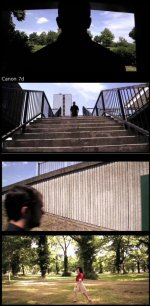
Shot with one light, one silver board, no crew, no post, out of the box profile on a 7d https://vimeo.com/41385659
teaser71.jpg

As for displaying on a 7 stop monitor, well you need to compress the captured data to the output device (final stage in post) - witness HDR photography - a huge DR expressed in the small delivery space of a computer monitor
 
Last edited:
To nerd on about how to get the most out of a limited DR camera, I think blowing some highlights works, now this requires no colour banding at the top end.
I would say banding is worse on sonys that canons, dont know the GH but the AF100 was certainly affected

The shootout, and Able tests, do not explore this in detail, which is a shame as it is a critical attribute to budget shooting.

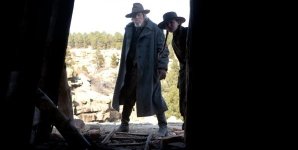
Deakins does it all the time. (he's not a budget shooter but to me defines acceptable practice)
truegrit3-e1296578694572.jpg

to do this often requires good glass clearly outside the remit of the tests
 
Last edited:
My F3 in contrasty rec.709 mode has 12 stops. The Alexa has 14. The GH2 8. Haven't seen any solid testing of the 7D. It costs roughly 2k less a DAY on a feature to shoot with an Alexa over a GH2, simply due to the extra time spent in relighting, post production, and the general hassle of shooting a feature on a still camera. This gives a very stepped back look at what the real costs come out to. Zacuto did not mention this once, and this is why people are pissed off.

http://www.ryanewalters.com/Blog/blog.php?id=4955533891225329768

Scroll down to production numbers


very interesting, and makes a very good point. but i'm not sure i understand how he derived his numbers. that doesn't invalidate his point, but....
 
Hi gang-

I heard there was a conversation about the latest Zacuto test here, and I believe my articles were mentioned, so I thought I'd come over and weigh in and see if anyone has any questions for me that I haven't addressed in my articles at PVC.

Firstly, I appreciate the work of everyone who participated in the tests. I think it's fantastic that people are willing and able to get all these tools in the same place and try to create a presentation that they hope will benefit everyone who watches it.

In my opinion, however--and this is just my opinion--they don't know how to do good comparative camera tests, and from an objective standpoint I believe they are largely a failure.

My biggest problem is that the people who shoot these shootouts for Zacuto most often try to create realistic storytelling situations much like they would find on an average project. That's valuable at some level, because we do want to see how the cameras respond when used in everyday situations, but at the same time many of the conventions of storytelling get in the way. For example, once the camera or the actors move it becomes much harder for our brains to process the differences between camera images because we're paying more attention to the movement than anything else. Also, movement obscures details in the frame that would otherwise be easy to see.

I, personally, want to see static frames and split screens between the cameras, because that's when we can REALLY see, very quickly, what the differences are. (I don't want the camera or the actors to move unless I'm looking only at movement, and even then there are very specific things I would do to ensure a fair test.) Split screens are what I most want to see because no other tool gives us comparative information faster. It is difficult but possible to look at a full frame image from one camera, observe certain areas of the frame (shadows, highlights, etc.) and try to memorize how they appear, and then mentally compare those things to the next camera's image, but this is inexact at best. Human brains just don't do that kind of thing very well.

I completely agree with Zacuto that it is the people behind the camera who make the difference, but I don't think the way to show that is to put a different DP behind each camera. If you really want to see what a DP can do then pick one DP and vary the cameras. Otherwise you have no idea if the differences you're looking at are due to the DP or due to the camera.

For example, the GH2 got a lot of press because Francis Ford Coppola liked it. He liked the Epic and Alexa as well, but the press picked up on the GH2. Why did he like it so much? Was it because Colt Seaman did a hell of a job lighting for it, or does the camera just look really good for what it is? All of -us- know it was Mr. Seaman, but those who are not technical will tend to give credit to the camera. Why? Objects are much easier to quantify than people--and people always want to quantify -something.- Given the choice of quantifying an intangible, like artistry, over a tangible, like a piece of gear that can be set up to create a consistent look, the tangible will always win.

The problem, though, is that many viewers didn't think that some of the higher end cameras looked as good as some of the lower end cameras. How do we know if that's the camera's fault or the DP's fault? I can point at something a camera did and say "I really don't like that!" but it's much harder to look at someone's lighting and define exactly what it is you don't like.

Camera artifacts are much easier to see than artistic artifacts, mostly because everyone can see technical artifacts but not everyone can see artistic artifacts.

If this was a true DP test then it would have been much better to show, say, a GH2 against an Alexa: take them both out into broad daylight, with no fill, and show what they each can do, and then take them into a controlled environment and let a single DP light for both cameras to make them look their best. That way you have a benchmark to compare the cameras against and you can be assured that what you're seeing in the controlled environment is one person working to the strengths and weaknesses of each camera, instead of the cameras saving the DP. (In the first scenario the Alexa would blow the GH2 away!)

You still run the risk of non-technical people looking at the final results and deciding that the GH2 is as good as an Alexa. Tests often have political repercussions, and those have to be considered carefully.

If Colt Seaman had lit for the F3, would we be raving about the F3 instead of the GH2? Who knows? A thorough test should not leave one with those kinds of questions.

The one aspect that really was ignored is the political ramifications of showing that low-end cameras can look as good as high-end cameras. The caveat is that the low-end cameras require a much, much greater degree of control than the higher-end cameras do, but how many people will come away from Zacuto's presentation with that message? Most of the details relating to how much extra work the low-end cameras required are in a separate "technical" document that most non-techies aren't going to bother to download. Unless all of the important details appear on the screen with the presentation there's an incredibly good chance they'll never be seen by those who most need to see it.

Seeing those details with the footage is crucial to creating an accurate first impression of how that camera compares to other cameras, which is important as the first impression is the strongest impression. Separating those details forces viewers to combine the images and the data in their heads, and that almost never works--especially among the least technically oriented. A true understanding of what is happening requires viewing all the relevant information at once, or at least in quick succession, so that the first impression of a test result encompasses as much relevant information as possible.

More important than how the test is executed is how the results are presented. I had a number of problems with this.

(1) Showing the "we can make all the cameras look the same" round first, and making people choose cameras blindly, is interesting but potentially disastrous because of exactly what happened: the most famous person in the room, who is not the most visually sophisticated person in the room, liked a really low-end camera--and that got picked up by the media and spread like wildfire. This is extremely dangerous, because now we all have to deal with "You're going to shoot with this camera because Francis Ford Coppola liked it, and we can afford to buy it rather than rent it." Is it the right camera for every job? No. Are they asking you if it's the right camera for the job? No--because the director of the Godfather has more clout in their minds than you do.

Since publishing my articles I've received emails from about a half dozen people who say that they've run into exactly this kind problem as a result of part two of the tests.

(2) The least Zacuto could have done is show the "pixel peeping" version first, so that we all have a baseline of how the cameras respond in relation to each other. Then everyone could see that all cameras are not equal, but that a good cameraperson can make them look equal under very controlled conditions. This message--"These cameras are all very, very different but can look the same under certain circumstances created by a talented DP"--was completely eclipsed by "Francis Ford Coppola picked the GH2 because he thought it looked as good as an Epic or Alexa!" The order of how these tests were shown dramatically changed how the media were likely to cover the test as well as how non-techies viewed the tests.

Steve says that if he showed the "pixel peeping" version first that nobody would have come back to see the next round. Everyone I know was desperate to see the "pixel peeping" version because that potentially contained the information we really wanted to see. It's clear that Zacuto's emphasis was on marketing, and keeping people coming back for more--and that's perfectly valid in a company-sponsored test. Unfortunately it had unintended side effects.

(3) The inclusion of Mr. Coppola was, I think, a big mistake. It's great for marketing, but he's much better known than any of the other people in the room who viewed the footage much more critically. Fame trumps technical competency any day. Steven Poster, ASC and Daryn Okada, ASC are vastly more qualified to comment on the footage they saw, but Coppola is almost a household name so his comments got the press.

(4) The web is a marvelous medium because it's very easy to segment programs so that viewers can see exactly what they want when they want. I've spoken to a fair number of others who agree with me that the length of the programs, and the pacing, and the fact that the test results were interspersed with long philosophical conversations on topics such as "What is a DP?" kept them from watching all the programs. One of the things that Steve doesn't like about my articles is that I admit that I haven't watched every minute of every video. I'm just not interested in hearing a bunch of DPs talk about what a DP does. I'm a DP, I've been in the industry for 25 years, and I have a fairly good idea of what I do. I want to see test results!

I'm not saying that these kinds of interviews aren't valuable to someone somewhere, and all of us eat this stuff up at some point in our careers (if you haven't seen Visions of Light, you should--it's the best of the best on this subject), but the interviews were aimed at a very different audience than the test results were. Everyone was interested in the test results, but only a few were interested in the philosophizing.

I go into more detail in my articles, and others have pointed out that I haven't even touched on things like color grading (27 layers of color correction? 90 minutes to grade one shot? How is it possible to know what -any- of the cameras are doing under such conditions? And how often do we get these luxuries in the real world?), but the bottom line is that -in my opinion- these tests are a failure and a tremendous lost opportunity. All those cameras were in one place at one time with very talented crews, and there was so much we could have learned, and there is a fair amount that can be learned from what was done... but so many variables were changed so often--including intangibles like artistic vision!--that it's really impossible to get more than a superficial amount of objective information out of these tests.

It has been pointed out to me that maybe I have less credibility than some others out there that have ASC after their names. That may be true... but you don't get into the ASC by excelling at comparative testing of equipment. You get in because you can consistently achieve artistic excellence with your tools. There's a huge difference.

When I perform tests I turn my artistic side down to 20%, or off, and turn my engineering side WAY up. That way I'm testing technical things, which are largely objective, instead of artistic things, which are most decidedly not. By assigning a different DP to each camera the artistic differences made objective comparisons nearly impossible.

Bottom line: This test had an agenda, which is always a little dangerous, and it failed to execute its agenda because too many variables changed. As best I can tell, the goal was to show that it's the DP that makes all the difference in how footage looks--and what a great agenda that could have been!--but by changing up DPs, lighting, cameras, grading, etc. it became impossible to determine who was causing what. As a result, the message picked up by the media was -really- not what was intended by the planners of the test, and it's a really unfortunate message that has the ability to harm us all.

Because of that I felt the need to write my articles discounting the tests. If the media had not picked up on Mr. Coppola's quote I would not have written what I have, but I just can't be silent when the way the media is spinning the results of this test have the potential to cause me technical and political difficulties while doing a job that I love.

I believe the reason the media was able to latch on to what they did is because the presentation of the results was largely a failure. By creating three 30-40 minute segments, released a month apart, and putting incomplete technical details into a second document marked "technical," there's no way to guarantee that most people will be exposed to all the information necessary to understand and accept the test's agenda--let alone be convinced by it.

And, if the audience wanted a behind-the-scenes look that could have deepened their understanding of the tests, they'd have to watch ANOTHER 90 minutes of material. I suspect there are a number of people here who are willing to take that on, but one producer has already told me that he couldn't make it through even the first 90 minutes of material.

This is all completely my opinion, of course--for what it's worth. Some people agree with me completely, others agree with me partially... but I've not found a lot of people yet who completely disagree with me on every point. If you do--and you're not Steve, who has already made his position very clear--please let me know.

Last but not least, I do not consider myself a journalist. I am a DP first, and an educator second. Educators are not the same thing as journalists.

My articles, as well as Steve's rebuttals, can be found at art.provideocoalition.com.

Thanks for reading.

Art Adams
DP/educator
artadamsdp.com
 
Art- thanks for stopping by (and joining) to share your thoughts- the most interesting one being that there is no "control group".

Any scientific test needs that unchanging variable, which in this case was not the lighting, not the DP, but the actors and their actions- walking to their marks. That was the constant variable??? Yikes!

Unfortunately, another comparison, excuse me, shootout, with faulty ground rules.

I'll be heading over to your neighborhood to check out your articles, and Steve's rebuttals...
Well, in their defense, they did do control shots with the base lighting, but they didn't show them until the final part.
 
Thanks for coming over here Art, really appreciate that.

Well, in their defense, they did do control shots with the base lighting, but they didn't show them until the final part.

Yes, you can't blame them for doing their marketing thing. After all it was free to watch.

Since I was able to pull some quite interesting information for me, out of the first parts,
the last part, where all cameras had the same lighting was the most valuable IMHO.

And yeah, 90 minutes and 27 layers of grading for one shot? Really?
I can make almost any material sing with that effort. But can someone pay for it?
And that's the takeaway for me: Yes, even a iPhone can look decent, but it takes a ton of light, crew, time and grading to get halfway close to a result you can have with an Alexa, almost out of the box.

Surprise? Not really.

Frank
 
very interesting, and makes a very good point. but i'm not sure i understand how he derived his numbers. that doesn't invalidate his point, but....

As far as I can tell, he is 'under/over exposing' based on some setting of camera ISO, meter reading. Then 'adjusting' in post, to bring the step wedges back into their 'standard levels'. Otherwise if he over exposed the alexa by 1 stop, the step wedge would get 'lighter', etc... but it doesn't.

On 'under exposing' the 7D, one begins to see obvious noise at some number of stops 'under'.


My comment is 'duh'... for 40x more price, I'd expect at least 10x improvement on performance...

The reason why the feature film use of 'digital' has been 'delayed' has been one of waiting for the technology to obtain the 'near' or now perhaps 'exceeding' Film film dynamic range. For the DLSR shooter the recommended thinking about the 'film stock' is to recommend thinking in terms of positive film stocks... or 'slide film' for stills... both have much less dynamic range and tend to block up the highlights 'quickly' and tend to allow for better recovery from 'underexposure'.

To recall an ancient greek saying... 'gnothi se photographon'... "Know thy camera"...
 
And yeah, 90 minutes and 27 layers of grading for one shot? Really?

In stills we do deep post - have access to very deep files.

In the shoot process the cost of post is a constant consideration.

Literally 'Shall I move that bucket', or is it quicker to get rid in post?

Photographers shoot for post all the time. Same as cinematographers choose green screen rather than blow up the Mi6 building.

Sometimes I will see banding in my FS100, and soldier on knowing that I can kill it in post, and the other compromises available are more 'expensive'

But..
Post is not always cheaper than moving the bucket.. very often not, and that is working single frames.

I think one of the huge challenges of modern cinematography is having a very solid understanding of post, potential, and costs and benefits.

I can see an alexa going a couple under with minimal lighting and a lift in post being cheaper thank lighting to get the skin at desired while retaining the sky.

In a complex to key shot (trees windows) such move may punch you in post and a relight for DR is cheaper.

In stills it is rare to use an ND grad, (which we all did in 1995) because pulling the file is actually a better way of doing it than a grad that we dont control the pattern of..

Another example is lost lights, sometime we throw a light into the scen and know the stand is going later, say lighting from a window its far quicker/cheaper to put the light in the room than rig it outside where we may be 10 stories up!

Again.. I think one of the huge challenges of modern cinematography is having a very solid understanding of post, potential, and costs and benefits.

S
 
My biggest problem is that the people who shoot these shootouts for Zacuto most often try to create realistic storytelling situations much like they would find on an average project. That's valuable at some level, because we do want to see how the cameras respond when used in everyday situations, but at the same time many of the conventions of storytelling get in the way. For example, once the camera or the actors move it becomes much harder for our brains to process the differences between camera images because we're paying more attention to the movement than anything else. Also, movement obscures details in the frame that would otherwise be easy to see.

Hi Art,

If the professionals have trouble judging the image capture from low cost consumer cameras against far more expensive professional cameras when things are in motion, then this statement alone reinforces the idea that maybe the low cost cameras are good enough for low or no cost projects.

I actually liked the fact that Zacuto left the "pixel-peeping" test until the end of the series, as this forced many people out of their comfort zone and asked them to judge things solely based upon what their eyes were seeing, without personal preconceptions/prejudices getting in the way.

For me the best take away from the Zacuto Revenge shootout is that the camera is only one ingredient in the production sandwich, and that maybe lighting ( or light modification ) is more important to the final look of the product.
 
Back
Top