Zacuto revenge of the great shoot out!

I dont really have an opinion - IMO cameras have less or more DR and controlling that takes lights - if you have infinite lighting budget they all look the same

Now give a DP one light, and a window with daylight and differences in the camera would become apparent.. or not

S
 
My favorite part of the video were comments on how cooperative an endeavor film-making really is. I thought the points on working well with others and not being a tyrant on set were great.

My least favorite thing was the camera work for the interviews - the style felt forced and didn't add anything (kind of the opposite of what all the cinematographers talked about in terms of the art of telling stories).
 
I felt like the scene was so dark. I only watched through once but I liked B and G. I am not an expert at looking at footage and knowing what camera it came from or what to look for in an image, but I saw some that looked too blue to me, E & H. Camera "I" looked real flat to me. I felt like I kept checking at the end to see if the girls face was lit properly and I felt like A, C, D, E, and I were too dark. I was too distracted by that to notice other stuff.

 
Last edited:
It was lit to have 14 stops of DR. That would make it inherently darker, no?

Anyway, this is a beautiful mini-doc on the art and artists of cinematography, as well as being a fantastic intro and tease for the actual camera tests. Cannot wait for the rest!
 
I posted this in another thread (on the GH2), but thought it might be useful here too, for those who aren't interested in the GH2:

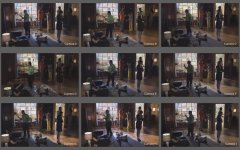
Although it's necessary to watch the video, I put together some some grabs to make it easier to compare certain things side by side. I choose these two shots because I thought they gave the best representations of the scene.

The image are too large to embed here, so I put links to full size versions on my server:

Download: shot-1.jpg
shot-1.jpg

Download: shot-2.jpg
shot-2.jpg

B was definitely my favorite. Followed by F probably. The iPhone had to have been D, right?
 
My least favorite thing was the camera work for the interviews - the style felt forced and didn't add anything (kind of the opposite of what all the cinematographers talked about in terms of the art of telling stories).
I disagree completely. The lighting was simple and almost rough and focused your attention on their faces and what they were saying. Which if anything this worked perfectly with what they were saying. It took me a minute to adjust to the style because I'm used to a much more "flattering" style of light though.

 
Last edited:
I came away from this "test" thinking "to hell what camera I use, I just need to shoot more!"

I love the bit where the guy says "Hollywood doesn't care what camera you use".
 
There's a PDF that actually shows all the camera technical specs as well as lighting setups, which kind of spoils the surprise a bit. At any rate I'm pretty sure I picked the GH2, Alexa, iPhone, and C300 - all of them had an extra 400-650 watt light bounced onto the actors at the front (or in the case of the C300, had a layer of diffusion removed from the 1K that's sitting at camera right).
 
It was lit to have 14 stops of DR. That would make it inherently darker, no?

Anyway, this is a beautiful mini-doc on the art and artists of cinematography, as well as being a fantastic intro and tease for the actual camera tests. Cannot wait for the rest!


The entire test was, how are you going to deal with these shitty conditions in the time allotted? It's supposed to be a real world type of scenario where you have time and budget constraints.

You couldn't get rid of the little light in the far right corner. It had to remain as a practical. You couldn't cut the sun coming through the big window. ON a big shoot with a budget and lots of time you might just cover the window with ND.

It would be a totally different test, and not as useful IMO, if you said ok you have all day just light the scene however you want to and shoot it. No one would purposefully light it with 14 stops of DR.
 
I disagree completely. The lighting was simple and almost rough and focused your attention on their faces and what they were saying. Which if anything this worked perfectly with what they were saying. It took me a minute to adjust to the style because I'm used to a much more "flattering" style of light though.

I had no problem with the lighting. As I wrote, "My least favorite thing was the camera work for the interviews - the style felt forced and didn't add anything (kind of the opposite of what all the cinematographers talked about in terms of the art of telling stories)."

Take this shot for example, which was so bad, they tried to fix it in post. But you can see that they shifted the image when editing (I've enhanced the contrast here so it's easy to see):

4.jpg

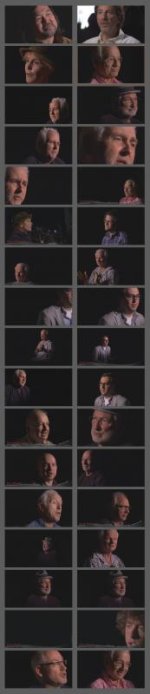
I've thrown together a quick contact sheet showing other bad shots. They appear throughout the interviews. They framed in an attempt to create a style. I believe you should never shoot for the sake of creating style. Story should dictate how you shoot. They even said as much in the interviews. Too bad they weren't listening.....

View large image here
style-not-story.jpg
 
Last edited:
I guess one of the more extreme example of the camerawork/framing was when the interviewer (Weiss?) asks "you ready?" to the DP as the shot is in black, then the camera begins its pan of the subject, bringing him into frame...

My two takeaways, more than trying to guess or rank the cameras, were:
As stated in the film "Hollywood doesn't care what camera you use", then on the site:
Weiss goes on to say it’s about mastering the camera you have, learning how to light properly for your camera’s strengths and limitations, getting your color settings dialed in, knowing how to adjust the grade in post. This, along with understanding how, when, and why you should move the camera and choose a particular angle are more important than the camera will ever be.
So therefore these comparison tests are obsolete, right?

And is it just me (or my monitor), or were those some red-faced talking heads?

Oh, also, the blatantly emotionally manipulative "cinematic" music got on my nerves- could we find something more subtle next time, please?
 
Complain all you want about the style of this one, but I for one am glad that they didn't have the godawful graphics from last year that look like they were designed by a teenager. They were at least trying to do something more serious this time even if it ended up being very hamfisted and annoying.
 
I think the fun part of this test was to watch the footage without looking up which camera is which, then post your opinion of what cameras you liked.

Most tests create some bias because you already prefer a certain brand or camera model and you know what the camera is when you're looking at the footage. It seemed a lot of people for whatever reason didnt' want to state which camera they liked without knowing what it was first. Maybe they felt like they would be ridiculed for liking the wrong camera, or picking a camera that wasn't their favorite, or one they had bashed in the past.
 
@Gilvane I think the reason that a lot of people may not want to state which one they like best is because they are actually picking the lighting setup and coloring approach more than they are picking the camera. :) I have provided many comments about specific aspects about each images and the few instances where I think there are differences that could not be chalked up to different lighting approaches.

G and D both suffer in terms of resolution by comparison to all the other cameras - they also have artifacts that the others do not. The other cameras are at a different level in terms of those things, and I feel confident pointing out that difference. In terms of dynamic range, I would not feel at all confident making many comments about that because the lighting was changed so much between the different approaches.

But I can tell you without doubt that neither G or D was shot by any of my favorite cameras. If I am wrong about that, I'll be happy to take image quality evaluation lessons from a more experienced forum member because it is pretty clear to me. :)
 
I think F and H were my faves, B stood out as videoy to me, though I still kinda like it and D was the only one that stood out to me as kinda bad. Though like a lot of people have said, it is all pretty close, and this is also as much a test of lighting and colour correction skills/tastes as it is camera... But will look forward to seeing the results.
 
Back
Top