Working with Theater Lighting

AlmaVideo

Active member
I'd like to ask for advice and / or references to resources to help me coordinate video lighting needs with theater lighting people on an upcoming live dance show in February.

This local theater has a fairly robust grid and a professional lighting tech. I have an unusual opportunity, in that the director and the theater lighting person are willing to work with me to create a lighting plot and cues that would be friendly to video, while maintaining the prority of pleasing the live audience. In he past have just gotten to work with a given lighting situations, so this is a nice opportunity. There will be 3 performances, but the dancers are amateur and I don't expect the shows to be identical.

I usually shoot with a Panasonic HPX170 for this kind of event. There is usually JUST enough light for the shadows and mid, with blowouts for highlights! I generally set the F-stop to 2.8 so the aperture doesn't change much with zoom, and often have to gain up a little. I've been experimenting with an AF100 recently. It works better with low light, but not excessive highlight. Focus can be tough for these live events using faster Nikon lenses on the AF 100, and zooming isn't optimal. On the other hand, the Lumix 14-140 zooms and focuses nicely but it is, well, slow at f4 wide open, and closes down to 5.8 zoomed in!. I may use both cameras on this shoot. I'll probably get a focus assistant for the AF 100.

My past experience in theaters has been that I have problems with:

1. The dynamic range of lighting intensity is higher for an audience than my camera is "happy" with: blown highlights on some scenes, and hot spots on the stage where dancers or actors move from dimmer to brighter areas and back to dim (resulting blown skin highlights).
2. Color problems caused especially by "warming lights," in pools. Again the dancers or actors move through these pools that are subtle to the naked eye, but trouble when editing the video and color correcting.
3. Lighting sometimes is too uniform, and makes it difficult to separate the area of interest from the background.
4. Managing differences in the images from different model cameras when I shoot multi-cam.

My question is, how would I go about communicating my video lighting needs to the lighting tech? My tentative plan is to:

1. Determing the dynamic range of the camera and scene file I will use on the shoot (CineV, with tweeks) using my WFM
2. Balancing the cameras as best I can using scene files and on-set color balancing. I can record the AF 100 to external pro-res HQ.
3. Translating the incident light equivalents, in units the lighting people use (I'll need to ask how the tech meters a setup) so he knows what the camera can "see."
4. Go into the theater when he is setting up and checking the results on my WFM.
5. Using the vectorscope on the camera to probe the color balance in various areas of the set.
6. Rely on the tech's experience to try to set up the lighting in a way that pleases him and the director, while being sensitive as he can practically be to what I say about the videographer's perspective.

Again, I'd appreciate hearing about what has worked for others, and would appreciate being referred to any learning resourses.
 
Biggest issues with lighting in theatres to be filmed in.

1) color balance - most lighting plots have a "warm" and "cold" feels, but they use a variety of gels, which none are actually 3200 or 5600. Have the theatre perhaps use varieties of 1/4, 1/2, etc of Rosco CT gels. Or have the designer stick to a smaller choice of gels.... R08 is typical "warm", and R80 is typical "cool"

2) Levels - Most lighting designers light by eye, I've been on dozens of shows, and never seen one pull out a meter, because they dont have too. What you see is what you get in theatre, so color, contrast, levels, are all by eye.

3) Contrast - since most front lighting is supplied by spotlights, this tends to wash out the subjects, hense why theatre makeup is so enhanced. most contrast is created through color. but youll be dealing with Dancers so this might not be as big an issue.

hope this helped a little.
 
I've had my best results shooting theatrical dance shows when I could do the recording at a dress rehearsal rather than a live performance with audience, and got the lighting designer to add an overall wash of ambient light to the entire stage to boost the shadow areas and lower contrast overall, then add their normal theatre lighting on top of that. Of course, that requires a very high level of cooperation with the stage and lighting crew and will add time to the production schedule which is best factored in from the very start.

I think Cine-V is perhaps a poor choice of setting on the AF100. It tends to exaggerate contrast and color saturation, which are exactly the problems you are likely to have when working with theatre lights. I'd go for a low-contrast gamma like Cine-D and maybe even experiment with the DRS feature and pedestal settings to see if you can flatten out the image a bit.

The 14-140 lens is great for overall focal length range, but DO NOT try to zoom while shooting with it. The focus and aperture both adjust automatically in discrete steps in response to the zoom setting and will make a mess of your shots -- even in fully manual mode. I don't necessarily think the slowness of that lens will be a huge disadvantage for you as long as you're willing to shoot around ISO 1600 -- which is a perfectly usable gain setting on the AF. It may add a bit of grain to the dark areas, but it's really much less than you'd get with film in equivalent conditions. Having the small-sensor HPX170 as a second camera is great -- the two will complement each other's capabilities nicely, as long as you can match their looks well enough either in the camera or in post.

As Andrew says, I've never seen a theatre lighting person use a light meter. They don't think in terms of footcandles or ISOs or f-stops, just what looks best to their eyes -- as it should be. When working in some of the situations as I outlined above -- I was the unofficial resident videographer for the University of Illinois dance department for a few years -- I've used a meter to help set the added base lighting level, but then let them completely "do their own thing" with the spots and washes on top of that. It's definitely in your favor that cameras are a lot more sensitive than they were 30 years ago when I was doing that, though -- you can get by with a lot less general fill, and higher overall contrast, these days.

Good luck with your project.

- Greg
 
Last edited:
First, I hope the dance group appreciates the effort you are putting into this show.

I like Greg's idea of an ambient wash, but I have never been fortunate enough to get the dance/lighting folks to do anything reasonable. Ever notice that when they run out of ideas, they just flash lights on and off.

The only thing I can add, is that I use a Small HD DP6 in false color exposure mode in conjunction with a DP1x for framing. I run the camera in autofocus and use my free hand on a remote iris control.

Good luck.
 
Thank you all. These are useful suggestions. I'm going to doubt that I will get a for-video rehearsal, but we'll see.

I'll run some more tests on my equipment comparing Cine V with D. I focused my efforts on just the Cine V so far. I didn't work much with the Cine D. I've got plenty of time to do that. I'm still trying to wrap my head around the WFM, and I learn a lot when I do studio testing. I went for Ciine V for lower noise, but really if I have to choose, I'll take noise over bad exposure.

Unless I use the Lumix 14-140, I won't have remote iris on the AF 100.

Thanks again for the encouragement!
 
IMG_2225.jpgGreetings!

First of all, any reason why you don't adjust your iris as you go? It's kind of essential for any interesting stage lighting

Next, I wouldn't use Cine-V. I'd use Cine-D, but only if you'll be riding the iris. Blown highlights are ugliest on Cine-D. If you can avoid them by irising, then Cine-D gives you the most latitude. If you really don't want to or can't adjust the iris as the show goes, then use LOW or HIGH to preserve shadow detail while handling highlights gracefully.

Finally, DON'T try to adjust the color balance for different areas of the stage. The lighting designers are using colors the way they want to... your job is NOT to fight their color decisions, its to capture them.

It's nice that they're willing to work with you, and I'm interested in hearing how it works out! Basically, if it's an event where the performers/producers are very interested in the video product, I'd keep hammering on the idea that the lighting just has to use less dynamic range overall. Go to some of the tech rehearsals if you can, sit at the lighting table, and point out every glaring highlight or murky shadow with important activity that's there as they program the show. Don't aim for or expect perfection, but think instead about a reasonable, balanced improvement (balanced with lighting guys' aesthetics). Tell 'em how great everything looks, and say things like "Oh! I wish I could do that justice with my limited dynamic range cameras, but they just WILL NOT see the guy in the turtle suit in that dark area". Take notes about where your iris(es) should be during each part of the show. It should be fun! again... let us know how it goes!

Hope this helps,
Barry

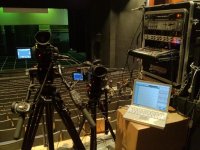
P.S., I often use a 2-camera setup where I have iris controls for both cameras mounted on one tripos... see attached image...
 
Last edited:
I have never been fortunate enough to get the dance/lighting folks to do anything reasonable. Ever notice that when they run out of ideas, they just flash lights on and off.

I'd try to avoid this attitude! I've had the luck to record a lot of shows with GREAT lighting design... and it's easy to fall into the trap of thinking like a videographer about how bad things will come out on video, etc. But step back from the camera, look at it as a HUMAN, and appreciate it, then try your best to capture it. "Reasonable" for video is very different from "reasonable" to a lighting designer.

Mind you, sure, there's bad lighting design out there... but even then its best to step back and avoid the trap. You're documenting what they do, and you can always do that cheerfully or grumpily.
 
If they're using modern tungsten stage lighting then I'd set the WB to 3200K, as that's the colour temp of CP class theatre lamps. If they'e using LEDs then it's anyone's guess. Note:Tungsten lamps get warmer as they're dimmed, LEDs do not.

I'd agree with CineD, that's the setting I used when filming school theatre productions on my HVX, which, incidentally I also lit, so I was coming at it from both directions.

When lighting "The School Play" I lit for the audiance, and no, I've never in 18 yrs or so used a lightmeter to set my lighting, only exposure for photography. When I've lit examination pieces I've deliberately avoided anything too extreme in terms of heavy gelling, or deep shadows, as everything HAS to show on video.
Again for exam pieces, where the camera has to be untouched throughout I've set the exposure by bringing up my brightest state, and setting the zebras at 100% so only the very brightest specular highlights show up, then check that my deepest state still has enough light to register the action, then adjusting it if it's too dark. It might be an idea to work with the lighting designer to avoid too deep states but accept that they may be needed artisticly

Dance is diferent to "acting" with "usually" a heavy emphasis on side and back lighting, with very little front light.

Another thing is that what the audiance doesn't see can be just as important as what they do, deep shadows are as much a feature and creative tool of theatre lighting as is brightly lit action, so try to make use of it.

Hope this goes someway towards helping

Dave
 
Finally, DON'T try to adjust the color balance for different areas of the stage. The lighting designers are using colors the way they want to... your job is NOT to fight their color decisions, its to capture them.

It's nice that they're willing to work with you, and I'm interested in hearing how it works out! Basically, if it's an event where the performers/producers are very interested in the video product, I'd keep hammering on the idea that the lighting just has to use less dynamic range overall. Go to some of the tech rehearsals if you can, sit at the lighting table, and point out every glaring highlight or murky shadow with important activity that's there as they program the show. Don't aim for or expect perfection, but think instead about a reasonable, balanced improvement (balanced with lighting guys' aesthetics). Tell 'em how great everything looks, and say things like "Oh! I wish I could do that justice with my limited dynamic range cameras, but they just WILL NOT see the guy in the turtle suit in that dark area".

This is extremely helpful. I can attend the tech rehearsal, but also be there during much of his setup. How about setting up a camera, and running SDI out to the light board and another on the stage w/ monitors so he can see for himself what the video does as he works?
 
First of all, any reason why you don't adjust your iris as you go? It's kind of essential for any interesting stage lighting

Next, I wouldn't use Cine-V. I'd use Cine-D, but only if you'll be riding the iris. Blown highlights are ugliest on Cine-D. If you can avoid them by irising, then Cine-D gives you the most latitude. If you really don't want to or can't adjust the iris as the show goes, then use LOW or HIGH to preserve shadow detail while handling highlights gracefully.

It's the blown highlights that have been really ugly, especially when the subject is in the pool of a "warming light." I'm going to work on my Cine D scene file as several have advised it will work better...advice taken.

I can see now that I'll probably do better with my HPX and my friend's HVX than trying to use my AF 100 for this type of work. That way we can zoom, work the iris and focus the live action better.

P.S., I often use a 2-camera setup where I have iris controls for both cameras mounted on one tripos... see attached image...

Please explain to me how you implement this setup. It would seem very difficult to operate iris for 2 cameras while working framing and focusing on one! Yikes!

Again, I really appreciate the thought you guys are putting in to helping me.

Here's a link to a clip from a video we did in 2008. PASSWORD IS dvxuser

 
It is sorta difficult, but becomes easier the more familiar you are with the show (ie, after a few rehearsals). Knowing in advance what lighting changes are coming up helps a lot, as does knowing the stage action… especially knowing with pretty good certainty which camera will be in the final video at certain times. Also… setting up the cameras so that the iris settings should be the same for each lighting situation (HPX and HVX200A is a good match for this… with the AF100, exposure settings would likely have to be different for the two cams).

Actually, that's general for the exposure…. The trickiest moments are when I try to use the cameras at different exposures to capture dark areas with the close cam… but again, knowing that, eg, I can leave the close cam steady for a few seconds during a particular bit of stage action, and that I'll need the wide shot iris adjusted during thathose seconds to be ready for a certain entrance, is what makes it all possible.

And, of course, not expecting true perfection!
 
......knowing the stage action… especially knowing with pretty good certainty which camera will be in the final video at certain times........And, of course, not expecting true perfection!

Yes a shot list and planning would be good!!

Hey, I just noticed "Cochabamba." I have gone to a place 444 Cochabamba in Buenos Aires a few times. May I ask where is Cochabamba for you?
 
Ullanta,

Reading your post again...are you operating a close and a long camera from the same location? Or are there 2 camera operators?
 
Hopefully the pic of my setup went through… basically yes, a close and wide camera (and multitrack audio systems) from the same location…

Cochabamba is Cochabamba! Qhochapampa! The heart of Bolivia! Viva Cochabamba mayllapipis!
 
Now I undertand the setup, thank you!

I should have looked first at the map! The place I mentioned 444 Cochabamba in Buenos Aires is where a lot of great tango dancers went to learn from the old maestros.
 
Is Cochabamba a street in Buenos Aires? Or is 444 Cochabamba just the name? Did you dance? Sounds like a great place!
 
Back
Top