working getting film, and to digital, with an Arriflex S35, say the 535

Anyone used in those times ?

Is it expensive today days, the make a possitve from the neggative ?
Just looking at see vs scanning,

A) so cost of doing manually: say convert the film to possitive, then cut's / join (aggregate) (mounting the clip), then optionally, B
B) having possitve, to convert back to negative, then optionally C
C) scaning to 4K

Say for 33 minutes at 24P, so say if my math are of, using 1000 ft, = 5-6 minutes, means, 6000 ft aprox (once mounted the clips, of course some bad shoots might be , but do not count on scanning)


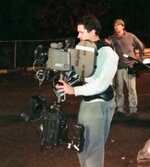
today I found my dream Top 1 film camera, that's still my top 1 camera
PD: Now I have the F65, and since today, a RED Ranger 8K S35 which I'll test soon, but I am considegin purchasing the 535B, that, if company may look to sale, and price is ok, I will purchase
 
If understand correctly, you are pitching shooting on 35mm, making selects and cutting the negative to match, and then either scanning the negative, or making an interpositive and scanning that, or making an internegative from the print and scanning that.

What is your thinking behind going through the printing stages? Trying to gain more of a film look? You'll build up contrast and grain but...hard to see the logic in it.

535B was a decent enough camera in its day, but the Arricams that followed it were much better and certainly lighter. The B was only considered light against its predecessor, the 535 which was a real behemoth. I shot part of my first feature on the 535B.
 

Attachments

  • me 535-topaz-sharpen-2.jpg
    me 535-topaz-sharpen-2.jpg
    320.4 KB · Views: 1
It's not clear to me what step B means. When you say "B) having possitve, to convert back to negative", I assume you mean to cut the negative to conform the the positive edit, not print a negative.
I'm wondering as well. If your output is 4k, then why not scan the camera negative and edit digitally? Is this an effort to experience editing print film the way it was done in the past?
 
Last edited:
why not scan the camera negative and edit digitally? Is this an effort to experience editing print film the way it was done in the past?
If I can purchase, I want to, not edit digitally at first, so just like the old school.

I am not sure, but, as I said, I think that, in order to edit, I need to convert the film negative (the one recorded from within the camera, say the 400 or 1000ft), to positive (opposite of negative, excuse me English, I am Spanish, soy de España, de la tierra que descubrió América), in other words, negative to print, in order to be able to edit (just by cut and join), then optionally B, then optionally C according to my first message
 
Yes, you need to get a positive printed for the editing. You need to have the keycode reprinted onto the positive print as edge numbers. The lab will do this. You also need the sound transferred to magnetic film stock.

Will you use a Moviola or flatbed to edit?
 
Currently looking just tu purchase , with a bit of luck, this year, as yesterday purchased a Ranger 8K S35 full set.
Looking forward the short future.

I suspect that this machines (moviola etc..) might be difficult or not, to found someone on second hand, as prices are sometime in the lower ballpark, I mean for film edit era. Am I wrong Paul F ?
 
Back
Top