Wireless for International Use

keylight

Veteran
I frequently have to travel internationally and I'm wondering if anyone has advice on a good quality wireless system that doesn't run afoul of international restrictions. I believe 2.4GHz is a safer route to go (they can operate in most countries without licensing) but if anyone knows of a switchable UHF system that is approved internationally.......

Thanks!
 
In recent history there are fewer and fewer available bands where you can use wireless microphones. In ANY country, and ESPECIALLY in high-tech areas. My advice would be to go for 2.4GHz mics because, as you say, they are inherently legal anywhere on the planet.
 
I've been researching this issue for a while and wanted to post some information that I've found with the thought that it might be useful to others in the future.

First off, none of this is certain to be correct so just use it as a starting point for your own research. Here goes.....

United States Frequencies
Before tackling international use, it's good to start with frequencies here in the United States. (I realize that this bit probably isn't new to most, but it's worth summarizing). Anything in the 700 MHz band (698 - 806 MHz) is illegal (as of June 12, 2010). Period. Anything in the 600 MHz band is.... tenuous. The FCC is planning to auction off some/most/all of that band in the coming months. You can read all about it from the FCC.

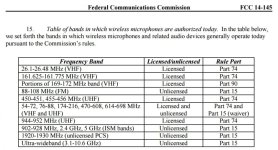
What bands are legal? The FCC helpfully lists them in their document that discusses finding ways to promote spectrum access for wireless microphones (FCC-14-145, PDF!)

16-05-29- 003.jpg

The sweet spot for legal, unlicensed wireless microphones seems to be in the 470-608 MHz range, although an informative article here indicates that 470-548 MHz is the "safe zone" in terms of future operability. There are also higher frequencies available (from the FCC):
Also, wireless microphones have been developed that operate on other frequency bands on an unlicensed basis under the FCC’s Part 15 rules. These frequency bands include the 902-928 MHz band, the 1920-1930 MHz band, and the 2.4 GHz band.

2.4 GHz is pretty well known, although it's also a frequency known for being used by many (MANY!) wireless devices (like wifi routers) that can cause issues.

Now that we've got an idea of what's allowed in the United States, let's look at...

International Frequencies
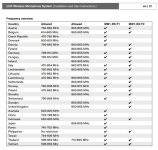
The closest I've been able to come to finding a listing of allowed frequencies comes from a page out a manual for a Bosch Wireless Microphone (PDF!). Who knew Bosch sold Wireless mics?!

16-05-29-.jpg

This (rather random seeming) list is far from exhaustive, and there may be other frequencies that you can legally operate in for the countries listed. (It's possible that this list only covers frequencies available in products that the company sells, although it looks like it might be a bit broader than that.)

Will mics operating in the US legal bands work legally internationally? 2.4 GHz is said to be legal in almost all countries, although as indicated above, it can be a rather crowded frequency. As for the other US legal bands... it's possible they are legal elsewhere but it's still not clear and I continue to research.

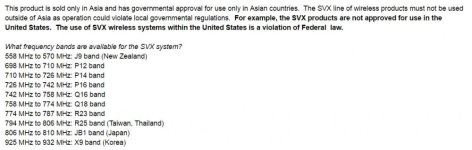
One thing IS clear; at least some of the legal bands in other countries are definitely illegal to use in the United States, as this warning from Shure about their SVX system (for karaoke!) highlights:

16-05-29- 002.jpg

If anyone has information that clarifies, corrects, or adds to the above... please do post!
 
Last edited:
Just competed the Sennheiser wireless training course at work and can highly recommend reading this book if you can:


They also have an ENG style system that works in the 1.9ghz range that is used for dect phones and is ideal for short hop and a basic kit that will be OK world wide!

More details here: http://en-uk.sennheiser.com/news-se...wireless-microphone-systems-for-video-cameras

It avoids the 2.4ghz wifi band and I was very impressed with it : http://www.bhphotovideo.com/c/search?Ntt=avx&N=0&InitialSearch=yes&sts=ma&Top+Nav-Search=
 
Last edited:
What sorts of things are covered in the book?

That looks really promising. Thanks for sharing info about it. I found a couple of videos on it from NAB 2015 (below). One thing that leaves me scratching my head though, is why they went with an integrated battery with a 4 hour run-time (on the receiver). Perhaps to sell $50 batteries? :shocked: Although it is small, which is great for travel and unobtrusive operation on a camera.


Last edited:
All sorts of radio theory are covered in the book and after 36 years in broadcast the course was most helpful in finally nailing how multiple radio waves can interact to create the potential chaos that can ensue with radio mic useage.

There is also a great deal on antenna placement and how to use combiners and boosters to get the best out of their systems.

In the UK there is lots of bandwidth that can be licenced on a one indoor event basis and allows hundreds of channels to be used even though the TV transmission system may be close to frequencies.

Careful calculation of the different frequencies that are used can allow for some very complex systems to be built.

I am sure if you contact sennheiser they will be able to advise you if the book is generally available and it is very good with lots of examples and pictures.

The 1.9ghz system is very easy to use and ideal for a self shoot camera who may just need the basics for presentation and generic interviews on location. As for the battery I guess it is to allow operation without having to carry extra supplies and it charges via a std USB port.

Sorry about the link and I think I have put the correct one up for B&H now: http://www.bhphotovideo.com/c/search?Ntt=avx&N=0&InitialSearch=yes&sts=ma&Top+Nav-Search=
 
Last edited:
Thanks for the input everyone. I just ordered an AVX system. Sennheiser has a rebate promo going on right now that drops the price by $150 if you trade in an old (working) system. Dug through my old gear drawers and found an old, horrible-sounding-but-still-working system that'll net me that rebate.
 
Back
Top