Yeah there are people in town who know how to light a scene, but not so many who know how to move the camera around in it, with the way I want it to look on screen. There is one guy who has dollies and tracks but they make noise. He says the sound guys just remove it in post, but that's just more post work. I wanna do it the old fashion way to get it right on set. Perhaps I could have it so the dolly does not move during dialogue parts, but not sure if that's a good thing or not.

Navigation
Install the app
How to install the app on iOS
Follow along with the video below to see how to install our site as a web app on your home screen.
Note: This feature may not be available in some browsers.
More options
You are using an out of date browser. It may not display this or other websites correctly.
You should upgrade or use an alternative browser.
You should upgrade or use an alternative browser.
Will this type of filmmaking bore modern audiences?
- Thread starter ironpony
- Start date

CharlesPapert
Director of Photography
Not to be a dick, but that entire post is surreal to me. This guy you describe--it's a little bit like owning a restaurant and admitting that people get sick from your food (because you are not familiar with nuances like refrigeration or soap), but it's the diner's fault because they should have hardier constitutions.
It's a lot harder to light well than to silently move a dolly on track.
It's a lot harder to light well than to silently move a dolly on track.
Last edited:
vincent6805
Member
This technique is done more often than you might think. A good example is David Chronenberg, and the opening scene to; A History Of Violence. These type of shots are well planned out, then walked through a couple of times, then shot. Only way to find out though, is to do it. Remember, directing is subjective. Be the one.
I would recommend Hong Sang-soo's films for an interesting take on long shots, particularly Lost in the Mountains where the average shot length is around 40 seconds. He uses pans, zooms and tilts in his long shots to make the most of his location and follows his characters while he explores a variety of compositions within the space he has to work with.
Personally, I'm not a fan of Sang-soo's style but it is different from Sergio Leone's style in the dollars trilogy. Not sure if this has been posted here yet but I found it very interesting:
Personally, I'm not a fan of Sang-soo's style but it is different from Sergio Leone's style in the dollars trilogy. Not sure if this has been posted here yet but I found it very interesting:
Okay thanks, but that youtube video is no longer on there. Aside from using long takes the script I want to make, I also do not have a lot of time on sets compared to bigger budget movies. The location owners will rent out their property but only for a few hours, and not a full days shoot. So this is another reason why I am relying on few shots for each scene, and good acting to help it work.
pulpfiction007
Veteran
I am practicing towards making my first feature film. Am doing my second short film now, and still working up. I wanna practice how I want to make a feature, and have a couple of scripts to choose from.
I was thinking of shooting it like you see in a movie from the 30s to 50s, where a large portion of the scene is shot all in one take. However will modern audiences get bored with that if the are so use to constant cutting? I want to create my style, but at the same time not create a reason for why my movie could not hold people's attention. I want to do a thriller with a script that is not slow paced and gets to the point but do audiences still need quick cutting, even so?
There are many directors today who use a longer scene style...it's one I prefer personally. Much of Tarantino's work is set up with long scenes (not one take or one angle but the scenes breathe) esp Pulp Fiction. No Country For Old Men by the Coens really breathes as well in a lot of spots. As long as you are holding the audiences attention, you don't need a cut every 5 seconds...lol. I personally can't stand super fast cuts all the way through a movie.
KrickProductions
Member
I would say it would come all down to your lighting and your backgrounds. Of course story is the most important issue to wether it will hold the audiences attention.

CallaghanFilms
Veteran
Black font will bore 'em every time.

Ted Spencer
Veteran
I think long takes, if well performed and shot, and *as long as they stay interesting*, are fine, but they're largely going to be noticed by/meaningful to film buffs and other filmmakers. The average viewer will just follow the action and dialog, not caring whether it's continuous or not, and in most cases not even noticing. But there's nothing wrong with giving a little treat to the enthusiasts I say, as long as the old 'do no harm' axiom is observed. I love the tracking shot at the beginning of "The Player", but am not at all sure I noticed it the first time I saw the film years ago, when I was less of a technique enthusiast than I am now. When I last saw it it completely rocked me, but in no small part because the blocking, acting, framing and everything else were handled so brilliantly. It would have been a great scene even if it had been shot in pieces, which is key. But doing it continuously was a kick for me because I *understood* what that involved, and how expertly and appropriately it was executed.
Last edited:
Well now I am kind of giving it second thoughts. I mean most real locations suck for art direction. And I don't have the budget to build sets of course. So if I were to do deep focus master shots, like an old movie, I would need the background to be out of focus still, so the audience does not notice how sucky the background is. Or I could light it so that the background is dark, and only the characters are lit, but that will just look strange to the audience, probably, for a non-surreal movie. What do you think?

nycineaste
Well-known member
simple answer: no, it will not bore audiences, as long as WHAT YOU PUT IN FRONT OF THE CAMERA IS NOT BORING. notice that the scene below couldve been shot by ANY OF US as far as resources. Suits, a car, fake blood. AMAZING, if you think about it. Fight tooth, claw, and nail to develop the best SCREENWRITING SKILLS YOU CAN. That's (a big part of) my plan, anyways, and I'm quite sure its sound. no fancy cutting here: nsfw: http://www.youtube.com/watch?v=vOsFMMjdHrc
nycineaste
Well-known member
Well now I am kind of giving it second thoughts. I mean most real locations suck for art direction. And I don't have the budget to build sets of course. So if I were to do deep focus master shots, like an old movie, I would need the background to be out of focus still, so the audience does not notice how sucky the background is. Or I could light it so that the background is dark, and only the characters are lit, but that will just look strange to the audience, probably, for a non-surreal movie. What do you think?
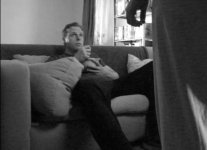
COMPOSITION !! make ......A PICTURE......with the camera....by DIVIDING THE SPACE/ARRANGING THE SHAPES in an interesting way (rule of thirds helps).....and also REMOVING ANYTHING DISTRACTING.....by POSITIONING ACTORS AND THE CAMERA TO CREATE DEPTH...... dont worry about the set. Attached is a still from my latest movie, its n ot graded, the highlights look blown here, etc. the lightings weak, I have ALOT to learn. Buuuttttt I made a PICTURE......by..... ARRANGEMENT OF THE SUBJECTS AND PLACEMNET OF THE CAMERA ......and by REMOVING THINGS.... (no FIDDLY BITS!!!!---no random SHAPES in the background that DISTRACT). Arrange the actors, REMOVE DISTRACTING THINGS FROM THE FRAME.....create depth (shoot over foreground objects when you can!).....make moving.... PICTURES..... also maybe you can throw a light-shape/shadow on that background of yours, with a gcookie or gel or sumpthin? PS I need sleep.
Attachments
Last edited:
A lot of the quick cutting style comes from music videos where it is necessary to keep the viewer off balance so they don't wise to the fact that the "talent" has no talent. In films quick cuts are often used for the same reason. Story and acting are king. If you have a good story and actors and director, you can get away with fewer gimmicks.I am practicing towards making my first feature film. Am doing my second short film now, and still working up. I wanna practice how I want to make a feature, and have a couple of scripts to choose from.
I was thinking of shooting it like you see in a movie from the 30s to 50s, where a large portion of the scene is shot all in one take. However will modern audiences get bored with that if the are so use to constant cutting? I want to create my style, but at the same time not create a reason for why my movie could not hold people's attention. I want to do a thriller with a script that is not slow paced and gets to the point but do audiences still need quick cutting, even so?
nycineaste
Well-known member
erm, not too sure about that one. http://www.youtube.com/watch?v=DLEE2UL_N7Q ...anyways if you're gonna develop a style that minimizes cutting (not my style- im very much into cutting/montage- check out my sig), then you prolly...erm...I dunno.... should LEARN STAGING--- how to STAGE actors in DEPTH. THATS whats happening in those "old-timey movies".. SOMETHINGS gotta move, them being MOTION PICTURES and all. start with this: http://www.davidbordwell.net/blog/2010/06/01/the-cross/ this is cool too: https://www.youtube.com/watch?v=_3UR3VtazuQA lot of the quick cutting style comes from music videos .
Last edited:
DeathChamberzMusic
Member
If it's a good story than yes as some people miss that style of film
I would say do it only if you have a precise vision that makes you want or need to do it that way
I would say do it only if you have a precise vision that makes you want or need to do it that way
Firstly, apologies for my english as it's not my spoken language.
Tarkovsky and Robert Rodriguez, one an auteur, and the other a commercial film director. Very different, and they are to be.
IMHO, no one filmmaker or style is better than the other as both of them cater to very different cinema audience.
I enjoy watching Tarkovsky films very much, it resonate with me and engage me spiritually. As for Robert Rodriguez films, I'm still a fan since his El Mariachi debut.
When I watch Tarkovsky, most of the time I watch it alone, and when I watch Robert Rodriguez, it's with my mates, beer and snacks.
Talking about Montage, Tarkovsky was never a fan, which he had openly opposed. I mean, how could he embraced Montage right? Montage will only take away all the space and time he so enjoyed in his film.
Tarkovsky admired directors like Bresson, Bergman and Kurusawa etc...just ask him what he think of Steven Spielberg's film, I don't think he has any nice thing to say about it.
Auteur directors like them worry more about the art in their film, much more than entertainment and box office taking.
I think its easier to mimic say a Robert Rodriguez style than trying to be poetic as Tarkovsky or Bergman.
I can't wake up one day and say I want the Tarkovskian or Bergman style in my film, these auteur are more than just film directors, they are artist, film theorist and poet, all in one body. It's "Poetry in Cinema"
I can definitely mimic Tarkovsky long take or even holding the shot longer than the master himself, but whether I can get the rhythm and pacing right in the frame is a different story.
Mise en scene or Montage? Art or Commercial? I think it's important to know what type of director you are or aspire to be? And if you know who your audience is, ultimately your film will find it's audience.
A lot of the quick cutting style comes from music videos where it is necessary to keep the viewer off balance so they don't wise to the fact that the "talent" has no talent. In films quick cuts are often used for the same reason. Story and acting are king. If you have a good story and actors and director, you can get away with fewer gimmicks.
Bourne Identity is a good example of having actors who are incapable of performing believable action sequences so you cut quick to make it look more intense than it is. A lot of movies today do this as well.
I like quick cutting in some parts and longer old style takes in others. It all depends. I only want to shoot my script like an older movie in about half the shots. But now I am thinking I shouldn't do it deep focus though, cause a lot of the background sucks. I should shoot shallow and blur the background out since realistic locations are not very goodlooking for a professional production design. Take this scene from The Big Heat for example, if you fast forward to 2:47 in:
http://www.youtube.com/watch?v=LCx9hnWr40Y
Notice how they are both in focus, but if I want to blur out the background I would have to rack focus back and forth between the two of them. If I were directing that scene, just as an example, do you think it would be worth racking focus to the wife, to show emotion, or would it not be worth it since you cannot see her face, compared to him?
I can't find the person who said it now, but I remember reading an article about a famous director that was just getting started. he said he got to talk to a well established director before shooting and asked his advice on what to shoot, how to shoot it. The advice he got was all you need is a "a master and two pops". The "pops" were close ups. And they can be anything, cutaway, close up of actor, etc.
That doesn't mean you want your two "pops" to be random. You want to choose your two close ups for maximum effect to tell your story, but it really does work. You can spend all day on a story board with dozens and dozens of cuts, but really you can tell your story with a master and two pops. Your two pops can come anywhere as well, right together, at the beginning and at the end of the scene, both in the middle, etc. There's actually a lot you can do with just these two cuts.
Of course you can break this "rule" any time. Don't add any pops if scene works better with one continous shot. Add extra pops if you REALLY need them to communicate to the audience or add a certain mood to the scene. Like, maybe your fight scene needs a few more cuts to add some action or a feeling of tension.
You can shoot really fast this way two. Shoot your master. go in for your two pops. Boom! next scene.