Will 416 and MKH 60 work well as a stereo pair

Artkoudos

Member
Hello there,

I have a 416 already on my first kit and I'm trying to build up a second kit. I found a very good offer for a MKH 60 but I have never used one to know how it sounds in general. I know its a great mic and with very low self noise but at the same time I want to be able to use this mic in combination with the 416 for stereo ambient track and wild track when I have both of them available.

I dont know how the two will blend. Obviously they will sound different but I doubt if the difference would be really noticeable on the left and right when played as a stereo. Any thoughts on that from somebody that has already tried that or that is more experienced with location stereo techniques?

Thanks in Advance.
 
At the very least, stereo pairs should be the same make and model of microphone. At the high end, some mics are available in matched pairs, of similar serial numbers, that are tested (and perhaps tweaked) at the factory to respond as identically as possible and are packaged together (so they're always exposed to the same environmental conditions throughout their life). Most of us probably wouldn't be able to hear the difference from one individual microphone to another of the same type unless one was actually defective, but it's another one of those "why take chances on an important production" kind of precautions. But I'd never mix models for this -- it will actually exaggerate the audible differences between the mics.

- Greg
 
No, they are very different mics.

On paper their polar-patterns are similar, but the 60 is a lot quieter, has much lower distortion and has a smoother off-axis response.

Personally, I would sell them both and get a pair of the new MKH 8060.
 
Hello guys and thanks for all the answers.

I have the usual problem: Budget... I would like to have the luxury of a MS stereo pair but at the moment I need a second shotgun mic for the other kit and for shots that I use two booms. This way i can also have a stereo pair when the second kit is not out on another job. I understand that there are many good mics out there and its not only about the 416 anymore in the Industry but again due to Budget reasons I'm looking for second hand gear and I can go up to maximum of £400, something that makes 416 a very good candidate. I haven't seen many 2nd hand 8060 around but its something that I will consider for the future. I've read good stuff for the whole MKH 80 series but I guess the best thing would be to rent a mic and test it out first. The 8060 is significantly shorter compared to the 416 but does it match the long reach of the 416 when it comes to mid/wide shots?

Which mic would you recommend if I was to make an MS pair along with a 416? I was also wondering if one should always use the main dialogue mic as the Mid mic on an MS pair, so that dialogue and ambient tracks blend together better when it comes to post?
 
I don't think it wise to make MS out of 416.. ideally you should have the same mic preamps.. such as a MKH60 and MKH30. Schoeps recommends this on their website.
Nothing will go good with the 416.
MKH8060 just released, you will not find used at this time.
 
...Which mic would you recommend if I was to make an MS pair along with a 416? I was also wondering if one should always use the main dialogue mic as the Mid mic on an MS pair, so that dialogue and ambient tracks blend together better when it comes to post?

Mid-Side does Not mean recording a "dialog track" and an "ambient track" at the same time. M/S is a specific way of generating left and right channel signals for a stereo recording by matrixing, not just mixing, the signals coming from a coincident pair of mics, typically a cardiod "mid" and a figure-8 "side". Where the idea that the mid could be used for dialog comes from the fact that the mid signal can be used by itself for a mono mix or as the centre channel in a surround mix. But the result of MS micing is not a dialog track and an ambient track, it is a single stereo track with conventional left and right channels.

I think shotguns such as the 416 have too narrow a pattern to be optimum for the mid, perhaps with rare exceptions. Imagine you're recording an orchestra spread out across a stage. You're standing in the centre aisle at row 5. You want the coverages of mid and the side mics to overlap from one side of the stage to the other. The long axis of the mid mic points straight in towards the stage center. With a cardioid pattern, it covers the entire stage from left to right. The side mic's axis, a vertical line drawn down the centre of the loops of the '8', is set at 90 degrees to the mid's, with the 'front', the top loop, of the pattern pointing due left. The mid mic also sees the entire stage in its pattern, the side of the top loop of the 8 covering the left half of the stage and the side of the bottom loop covering the right. The left side of the mid's pattern and the top loop of the side pattern overlap on the left-hand side of the stage while the right side of the mid's and the bottom loop of the side overlap on the right. An instrument in the centre of the stage is picked up strongly by the mid mic but relatively weak by the side. An instrument on either the far right or the far left of the stage is picked up equally well by both mics.

To generate the stereo signal you split each mic signal in two. You take one split of the mid signal and mix it with a split of the side signal - the result becomes the left stereo channel. You take the second split of the mid signal and mix it with a 180-degrees phase inverted split of the 'side' mic signal to generate the right stereo channel. L = M+S, R=M+(1/S)

If you're recording mono dialog and stereo ambient and plan to mix them, there is no reason you need to match the mics. This is true regardless of whether you record ambient as MS stereo or with some other mic technique. It's even true if you record MONO ambience. Ambience does not even need to be recorded at the same time, or even the same place, as is the dialog - in fact, it usually isn't. Ambience is NOT room tone, the sound of the silences between words of dialog. Ambience is essentially a type of sound effect, sounds added to the scene designed to give it a realistic feel and the audience a sense of place. Imagine you're shooting a lover's tet-a-tet in a crowded restaurant. The scene is all closeup and their table is against a wall so you won't see other tables or patrons. There's no reason you have to shoot that in an actual restaurant ... setup on a sound stage where you can control everything and capture their dialog with total silence around you. Use the mics that most favour their voices. Then at some other convenient time you and your sound person visit a real, operating, restaurant when it's open for business, pick a convenient table, order coffee and record a half hour or so of the ambient sounds around you, using whatever mics you judge will give you the best rendition of THOSE sounds. That's your ambience track. Mix it with the dialog in post to create the illusion the lover's scene was shot in a working restaurant.
 
Last edited:
I don't think it wise to make MS out of 416.. ideally you should have the same mic preamps.. such as a MKH60 and MKH30. Schoeps recommends this on their website.
Nothing will go good with the 416.

Thanks for the input.
Would you recommend to get rid of the 416 and get another mic like the MKH60 that could be also used in a MS pair, would you use the 416 for dialogue and have an MS pair from different mics or should I use two 416 as a AB or XY pair? What was the practice in the past when 416 was the main mic around?

Weirdly enough when I was at uni doing Music Tech we used the MS technique a lot but many times we would use different mic i.e the AKG 414 with the Neumann U87. We never got a negative feedback from tutors regarding this and I had some great results on acoustic guitars and once on a group of people that were clapping in a Flamenco song. To be frank we were always told that we should use matched pairs when it came to AB and XY techniques but I cant remember anything for the MS.
 
Thanks for the input.
Would you recommend to get rid of the 416 and get another mic like the MKH60 that could be also used in a MS pair, would you use the 416 for dialogue and have an MS pair from different mics or should I use two 416 as a AB or XY pair? What was the practice in the past when 416 was the main mic around?

...

The 416 was never "the main mic around." It's been a standard mono mic for dialog for many years but that's far from making it the standard all-around mic for recordings other than dialog. IMHO, it's not really suitable for use in a stereo pair at all, regardless of the specific mic technique employed. A/B is usually with omnis, X/Y or ORTF usually cardioids or variations thereof. Shotguns are specialized tools and have far too narrow a coverage for use in a stereo array. In a multi-track envirnoment you might use them IN ADDITION to a stereo pair as a spot mic covering a soloist, for example, but not as one of the primary stereo mics.
 
Mid-Side does Not mean recording a "dialog track" and an "ambient track" at the same time. M/S is a specific way of generating left and right channel signals for a stereo recording by matrixing, not just mixing, the signals coming from a coincident pair of mics, typically a cardiod "mid" and a figure-8 "side". Where the idea that the mid could be used for dialog comes from the fact that the mid signal can be used by itself for a mono mix or as the centre channel in a surround mix. But the result of MS micing is not a dialog track and an ambient track, it is a single stereo track with conventional left and right channels.
On a project a couple of months ago I had the chance to have two 416 on the set so when I was recording room tone and wild tracks for the whole action without dialogue we would use a near coincident pair with the two 416s. It did sound good but obviously given the room etc. I am thinking of an MS pair for the future for similar purposes and not for dialogue but I dont think I will have the luxury to have different mics for every application due to budget and that's the reason that I was asking for a mic that could be also used as the mid on a MS pair.

If you're recording mono dialog and stereo ambient and plan to mix them, there is no reason you need to match the mics. This is true regardless of whether you record ambient as MS stereo or with some other mic technique. It's even true if you record MONO ambience. Ambience does not even need to be recorded at the same time, or even the same place, as is the dialog - in fact, it usually isn't. Ambience is NOT room tone, the sound of the silences between words of dialog. Ambience is essentially a type of sound effect, sounds added to the scene designed to give it a realistic feel and the audience a sense of place. Imagine you're shooting a lover's tet-a-tet in a crowded restaurant. The scene is all closeup and their table is against a wall so you won't see other tables or patrons. There's no reason you have to shoot that in an actual restaurant ... setup on a sound stage where you can control everything and capture their dialog with total silence around you. Use the mics that most favour their voices. Then at some other convenient time you and your sound person visit a real, operating, restaurant when it's open for business, pick a convenient table, order coffee and record a half hour or so of the ambient sounds around you, using whatever mics you judge will give you the best rendition of THOSE sounds. That's your ambience track. Mix it with the dialog in post to create the illusion the lover's scene was shot in a working restaurant.

I'm working more in the independent film industry at the moment and there isn't always the budget for controlled situation as the one you are mentioning above. What happens when you are filming on a less friendly environment and you are recording ambience on location in order to have fills for gaps that are created in the edit. Obviously there could be another more suitable track on the background but if the dialogue track is noisy already one will probably be able to hear the gaps in the edit even if you lay different ambience on the soundtrack. In an attempt to cover those gaps what technique would you use for ambience? Also there could be various problematic sounds in between dialogue that the sound editor would like to get rid off in post and that's why in order to provide material to the editor after the end of a scene I ran the action again but without dialogue. In the past I used to do this mono with my 416 but does it worth doing it stereo regardless what technique or pair of mics one is using
 
The 416 was never "the main mic around." It's been a standard mono mic for dialog for many years but that's far from making it the standard all-around mic for recordings other than dialog. IMHO, it's not really suitable for use in a stereo pair at all, regardless of the specific mic technique employed. A/B is usually with omnis, X/Y or ORTF usually cardioids or variations thereof. Shotguns are specialized tools and have far too narrow a coverage for use in a stereo array. In a multi-track envirnoment you might use them IN ADDITION to a stereo pair as a spot mic covering a soloist, for example, but not as one of the primary stereo mics.

By saying the main mic around I did mean the standard mono mic for dialogue in the film industry and not an all around mic.

Thanks for the useful info. I once used two 416s in a near coincident pair for wild tracks and it sounded relatively nice and natural at least to my ears but I do not have much experience on this. Unfortunately I haven't had the chance to experiment with different stereo techniques and mics on the set and I would love to have more mics to work with but it's all about budget and since there were two 416 around I tried a stereo pair with them. What would you recommend as a good solution for a stereo ambience and wild track recordings on the set?
 
Mid-Side does Not mean recording a "dialog track" and an "ambient track" at the same time. M/S is a specific way of generating left and right channel signals for a stereo recording by matrixing, not just mixing, the signals coming from a coincident pair of mics, typically a cardiod "mid" and a figure-8 "side". Where the idea that the mid could be used for dialog comes from the fact that the mid signal can be used by itself for a mono mix or as the centre channel in a surround mix. But the result of MS micing is not a dialog track and an ambient track, it is a single stereo track with conventional left and right channels.

On the reply to this post I accidentally put part of my answer in the quote so I dont think you spotted it and I'm sending through again

"On a project a couple of months ago I had the chance to have two 416 on the set so when I was recording room tone and wild tracks for the whole action without dialogue we would use a near coincident pair with the two 416s. It did sound good but obviously given the room etc. I am thinking of an MS pair for the future for similar purposes and not for dialogue but I dont think I will have the luxury to have different mics for every application due to budget and that's the reason that I was asking for a mic that could be also used as the mid on a MS pair. "
 
I'm working more in the independent film industry at the moment and there isn't always the budget for controlled situation as the one you are mentioning above. What happens when you are filming on a less friendly environment and you are recording ambience on location in order to have fills for gaps that are created in the edit. Obviously there could be another more suitable track on the background but if the dialogue track is noisy already one will probably be able to hear the gaps in the edit even if you lay different ambience on the soundtrack. In an attempt to cover those gaps what technique would you use for ambience? Also there could be various problematic sounds in between dialogue that the sound editor would like to get rid off in post and that's why in order to provide material to the editor after the end of a scene I ran the action again but without dialogue. In the past I used to do this mono with my 416 but does it worth doing it stereo regardless what technique or pair of mics one is using
You're talking about room tone, NOT ambience here. Room tone to fill gaps left when cutting dialog should be done with the same mic as the original dialog itself and like the dialog is recorded mono. You are correct as to the importance of having it for the editor. But be perfectly clear that room tone is not ambience and they are two separate recordings obtained for two separate purposes. The idea of room tone is that if the dialog line as recorded is "You dog!" and I cut between the words to add a 2 second pause to make it "You ... dog!," it should sound like that was the way it was originally spoken - there's silence as far as the speech is concerned but not a complete blank in the recording recording between the words - the space is not dead. It needs to be obtained with the same mic in the same environment as the dialog was recorded. One technique is to brief the cast and crew to hold still and maintain silence when a scene has played out so that you can keep rolling for 15 to 30 seconds at the end of a scene to record 'silence' before calling cut. Or, after cutting a scene, before moving on to the next setup, everyone cast and crew holds position and stays still and quiet, the camera tilts up to focus on the boom mic, and you roll again for another 30 second or so take expressly to get room tone. Shooting a picture of the mic during the take gives the editor an on-screen visual reference that that particular take has been done expressly to give him tone to work with. Ideally both the dialog track and the room tone track are completely free of ambient sound but that may not be possible in uncontrolled sets. Ambience, OTOH, is to capture the sounds of the environment and is recorded completely indpendently of the dialog recording.

So dialog with a shotgun (or hyper in a reflective environment) shot mono with as little intruding ambience as possible, room tone with the same mic as dialog also shot mono also without any ambience if possible, obtained by continuing to roll at the tail of each take or as a separate take but shot contiguously with every dialog setup, with the same personel and equipment positioning used during the scene, and ambience, recorded separately in your choice of mono or stereo using whatever equipment and situation gives you the highest quality recording for those particular sounds. I think a mono recording carefully made with a high quality omni mic would give you a better overall environmental recording than trying to get it in stereo on-the-fly as your shooting dialog.

I still maintain that a shotgun is a special purpose tool built for dialog and not really suitable for most other types of recording, including ambience. IMHO, it's false economy to try to force it into a role that is better served by a different type of mic (such as trying to use it instead of a cardioid as the mid in an M/S pair). A couple of good quality cardioids and/or omnis in addition to your 'gun don't have to be budget breakers - for example, I have a pair of excellent sounding Audio Technica AT3031 cardioids that were only about $250 each. The spendy part of an M/S pair is not the cardioid for the mid but the figure-8 mic for the side.
 
Last edited:
The 8060 is significantly shorter compared to the 416 but does it match the long reach of the 416 when it comes to mid/wide shots?

The 8060 is exactly the same length as the 416 when it comes to the length of the interference tube that defines its directivity. So the 8060 will have the same theoretical pick-up pattern as the 416, but will be quieter, lower distortion and a smoother off-axis response.


Which mic would you recommend if I was to make an MS pair along with a 416? I was also wondering if one should always use the main dialogue mic as the Mid mic on an MS pair, so that dialogue and ambient tracks blend together better when it comes to post?

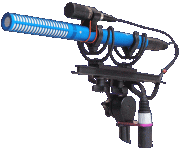
I would go for the new Ambient ATE 208 EMESSER - small and light ad will clip to virtually any mic. for MS - only I would ditch the Ambient back-to-back clip and get the new Rycote one as it's very much better.

ate_aktuell.gif

It's shown here on a Schoeps CMIT 5U, but will equally fit the 416 or the 60 (or the 8060).

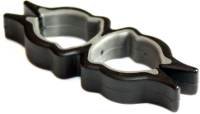
This is the new Rycote back to back clip:-

1sk-ryc-b2bsoftgrip.jpg

It will fit any microphone from 19mm to 25mm in diameter including the flat-sided Sennheiser series (MKH 60, etc.).

The Sennheiser MKH 30 is a better fig-8, but it's a lot more expensive.

I hope this helps.
 
You're talking about room tone, NOT ambience here. Room tone to fill gaps left when cutting dialog should be done with the same mic as the original dialog itself and like the dialog is recorded mono. You are correct as to the importance of having it for the editor. But be perfectly clear that room tone is not ambience and they are two separate recordings obtained for two separate purposes. The idea of room tone is that if the dialog line as recorded is "You dog!" and I cut between the words to add a 2 second pause to make it "You ... dog!," it should sound like that was the way it was originally spoken - there's silence as far as the speech is concerned but not a complete blank in the recording recording between the words - the space is not dead. It needs to be obtained with the same mic in the same environment as the dialog was recorded. One technique is to brief the cast and crew to hold still and maintain silence when a scene has played out so that you can keep rolling for 15 to 30 seconds at the end of a scene to record 'silence' before calling cut. Or, after cutting a scene, before moving on to the next setup, everyone cast and crew holds position and stays still and quiet, the camera tilts up to focus on the boom mic, and you roll again for another 30 second or so take expressly to get room tone. Shooting a picture of the mic during the take gives the editor an on-screen visual reference that that particular take has been done expressly to give him tone to work with. Ideally both the dialog track and the room tone track are completely free of ambient sound but that may not be possible in uncontrolled sets. Ambience, OTOH, is to capture the sounds of the environment and is recorded completely indpendently of the dialog recording.

So dialog with a shotgun (or hyper in a reflective environment) shot mono with as little intruding ambience as possible, room tone with the same mic as dialog also shot mono also without any ambience if possible, obtained by continuing to roll at the tail of each take or as a separate take but shot contiguously with every dialog setup, with the same personel and equipment positioning used during the scene, and ambience, recorded separately in your choice of mono or stereo using whatever equipment and situation gives you the highest quality recording for those particular sounds. I think a mono recording carefully made with a high quality omni mic would give you a better overall environmental recording than trying to get it in stereo on-the-fly as your shooting dialog.

I still maintain that a shotgun is a special purpose tool built for dialog and not really suitable for most other types of recording, including ambience. IMHO, it's false economy to try to force it into a role that is better served by a different type of mic (such as trying to use it instead of a cardioid as the mid in an M/S pair). A couple of good quality cardioids and/or omnis in addition to your 'gun don't have to be budget breakers - for example, I have a pair of excellent sounding Audio Technica AT3031 cardioids that were only about $250 each. The spendy part of an M/S pair is not the cardioid for the mid but the figure-8 mic for the side.

Thanks for all the detailed info. More or less this is what I have been doing for the past 3 years since I start getting into location recording. As I said before I haven't had the chance to do many stereo recording on location and that's why I'm asking for advice. I have always been using a mono track to get room tone and also for wild tracks when there is need to replace parts of the soundtrack in between dialogue due to noisy locations or due to any other set related noise issue (crew, clumsy boom movement etc). At the same time though I was looking for a cheap or a clever way of getting a setup for the ambience recordings as well. The M/S technique is highly regarded in the industry so I was looking for a solution that would work without having to invest a lot of money.

Would you recommend using any of the already configured stereo mics out there? I have a couple of good studio omnis but I'm reluctant to take them on a film set. Any good priced omni that you have tested?
 
The 8060 is exactly the same length as the 416 when it comes to the length of the interference tube that defines its directivity. So the 8060 will have the same theoretical pick-up pattern as the 416, but will be quieter, lower distortion and a smoother off-axis response.


I would go for the new Ambient ATE 208 EMESSER - small and light ad will clip to virtually any mic. for MS - only I would ditch the Ambient back-to-back clip and get the new Rycote one as it's very much better.

View attachment 36975

It's shown here on a Schoeps CMIT 5U, but will equally fit the 416 or the 60 (or the 8060).

This is the new Rycote back to back clip:-

View attachment 36976

It will fit any microphone from 19mm to 25mm in diameter including the flat-sided Sennheiser series (MKH 60, etc.).

The Sennheiser MKH 30 is a better fig-8, but it's a lot more expensive.

I hope this helps.

First of all thanks for all the info and going back to an older question.

It sounds like you have tried the combination of Shotgun and the ATE 208 Emmeser. Would you compare it as an emergency setup, given you cannot afford a proper M/S pair or is it a pretty decent setup?

Very interesting the points you made regarding the 8060. It is looking like a smaller 416 but I did not think that the actual interference tube is the same length. I will definitely try and get my hands around one as soon as I can and test it out. I do need a second boom for a feature that I start shooting in August and will need to make a decision soon. I didnt want to exceed the £400 margin for a new mic cause I've recently upgraded recorder and mixer and I haven't fully cured the economic consequences. Trying to find a 2nd hand 416 in a good condition and relatively cheap. if nothing comes along soon I will consider going the extra mile with the 8060.

Do you think that having two different shotgun models in the same shot will cause problems when it comes to post? I was also considering a Rode NTG3 in the case that none of the Sennheiser options work for me at this point. I've used it once on an easy shoot and it sounded pretty good but to be honest I haven't put it down to the test. Any Input welcome.
 
First of all thanks for all the info and going back to an older question.

It sounds like you have tried the combination of Shotgun and the ATE 208 Emmeser. Would you compare it as an emergency setup, given you cannot afford a proper M/S pair or is it a pretty decent setup?

The ATE 208 EMESSER is made for Ambient by MBHO in Germany. This is a top-notch fig.8 microphone and, IMHO, equal to the Schoeps fig.8. Although the EMESSER is not expensive, it's not a cheap option.


Very interesting the points you made regarding the 8060. It is looking like a smaller 416 but I did not think that the actual interference tube is the same length. I will definitely try and get my hands around one as soon as I can and test it out. I do need a second boom for a feature that I start shooting in August and will need to make a decision soon. I didn't want to exceed the £400 margin for a new mic cause I've recently upgraded recorder and mixer and I haven't fully cured the economic consequences. Trying to find a 2nd hand 416 in a good condition and relatively cheap. if nothing comes along soon I will consider going the extra mile with the 8060.

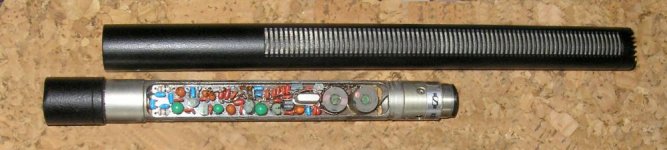
Everyone thinks the 416 has an interference tube longer than it does.

The capsule in the 416 is actually about half way along the slots - it really is the same as the 8060.

MKH 416 disassembled.jpg
 
The ATE 208 EMESSER is made for Ambient by MBHO in Germany. This is a top-notch fig.8 microphone and, IMHO, equal to the Schoeps fig.8. Although the EMESSER is not expensive, it's not a cheap option.

I was actually talking about the combination of a super cardioid and a figure of 8 mic since most of the people use a cardioid on a M/S pair due to it's wider polar pattern. I would love to make a comparison recording between a super cardioid/fig.8 and a cardioid/fig.8 pair.
 
I was actually talking about the combination of a super cardioid and a figure of 8 mic since most of the people use a cardioid on a M/S pair due to it's wider polar pattern. I would love to make a comparison recording between a super cardioid/fig.8 and a cardioid/fig.8 pair.
I'm not sure just how well that would work. The stereo image in an M/S array is generated by the phase interactions where the patterns of the mid and side mics overlap. The supar-cardioid pattern would resemble a beam squeezing out from BETWEEN the lobes of the figure-8 side mic with minimal overlap. I would expect it to result in a strange sort of stereo soundstage.
 
Last edited:
I have been reading a bit more for M/S and what you say makes sense but its interesting to know that a well establish company is branding a quality product as a fig.8 mic to accompany shotgun mics. Surely they have tested it and that makes me curious to see if its all a marketing thing or if there is more to it.
 
Back
Top