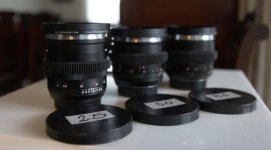
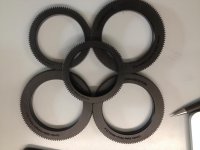
Why pay for Duclos when you can 3D print?

A mate of mine just sent me this photo..... Aparently he had lens gears printed that are tight fits. No slippage and so on.

I love the low profile this have instead of those protruding gears that you often see.
I'm trying to find out which printer he used and so on. Told me I could have the sketch files to use for myself.

The lenses he had the gears made for are the Leica R lenses.
I would consider a set of ZEs with these printed gears.
11251442_10152847019717997_1753665356_n.jpg
 
Not that many years ago, a guy who was working for me built one from wood, cog wheels, motors etc - it made a terrible noise in the office and took all night to produce a tiny object. Now he has moved to California, has loads of people working for him, and makes 3D printers in his own factory. That's progress for you!
http://www.typeamachines.com/pages/company
 
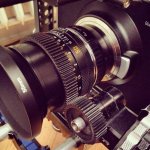
I've been using them with Zeiss ZE, though I'm selling them since I 'm building a Canon CN-E set. I also prefer the low profile ones, compared to the Nikon Ais he sent me, which are quite thick (I forgot to mention it to him), and odd looking. Here is how they look

IMG_7714.jpg
 
Those followfocus lens gears rock. They can be made for any lens including Leica & blow away all those dumb zip gear or worse still the screw spacer options out there.
 
Helicopter Sean is very helpful too - I recommend him to anyone. The gears are as if they're part of the original focus ring.

I would pay for Duclos because it's a guarantee and if the lenses are expensive enough I wouldn't risk even an excellent 3d print. With the printed gears, sliding them to the focus ring can be a struggle with some lenses.
 
I got one from helicopter Sean. They work well, perfect fit. But what I noticed the old style flexible lens straps seem smoother, specifically the wide open camera ones. Maybe it's my FF but the flexible ones seem less rigid.
 
Delrin is more expensive than aluminum, might be worth considering a material change. And what's wrong with well printed gears made out of nylon or similar plastic? I was going to start ordering some so I'd like to know why they are not as good.
 
Delrin is more expensive than aluminum, might be worth considering a material change. And what's wrong with well printed gears made out of nylon or similar plastic? I was going to start ordering some so I'd like to know why they are not as good.

Delrin is much quicker to machine, self lubricating, available in black (no need to anodize) and therefore a really good and also cost effective choice.
3d printed gears tend to loosen over time and slip since they are not shrink fitted. They are not very accurate, and the surface finish is fairly poor. Material strength is also an issue with 3d printed parts. A shrink fitted machined gear is superior to a 3d printed gear in pretty much any aspect. Don't get me wrong, 3d printing has it's place. I'm printing stuff almost every week and it is great especially for prototyping.
 
How long does the plastic stay hot? I've had a lot of problems doing different things with friction fits and temperatures, must often the cold part gets hot and expands and the hot part cools and contracts before I get things lined up.

Helicoptersean says he is printing a Delrin like plastic, I assume he could print 1 or 2 thousandths smaller and heat them for install too.

But this doesn't really fix the issue that these gears are plastic. And plastic under force will flow over time. That said I don't have a huge amount of experience with Delrin. I have machined a bit of it, and found that while it resists being pulled towards the cutter better than most plastics, my accuracy is far better if I use a downward spiral endmill (pushes the chips down vs. pulling them up like most drills do). That tells me it does stretch. Also you still have the rubber underneath the gear which will flow over time.

Now all that said, I'm not trying to defend either method, I also just found your step up lens fronts which will be purchased soon, so get some gears up for us to look at and compare prices so I can decide which way to go. Definitely want to gear my nFD 15f2.8 lens, probably a 24mm when I get one that works correctly, and a few others a little later. They will need step up rings too. Maybe you can put together some package deals of gear and fronts for us.
 
How long does the plastic stay hot? I've had a lot of problems doing different things with friction fits and temperatures, must often the cold part gets hot and expands and the hot part cools and contracts before I get things lined up.

Helicoptersean says he is printing a Delrin like plastic, I assume he could print 1 or 2 thousandths smaller and heat them for install too.

But this doesn't really fix the issue that these gears are plastic. And plastic under force will flow over time. That said I don't have a huge amount of experience with Delrin. I have machined a bit of it, and found that while it resists being pulled towards the cutter better than most plastics, my accuracy is far better if I use a downward spiral endmill (pushes the chips down vs. pulling them up like most drills do). That tells me it does stretch. Also you still have the rubber underneath the gear which will flow over time.

Now all that said, I'm not trying to defend either method, I also just found your step up lens fronts which will be purchased soon, so get some gears up for us to look at and compare prices so I can decide which way to go. Definitely want to gear my nFD 15f2.8 lens, probably a 24mm when I get one that works correctly, and a few others a little later. They will need step up rings too. Maybe you can put together some package deals of gear and fronts for us.

It is hard to say exactly how much time you have to line up the gear, it varies a little bit. I would say it is about 20-30 seconds till it starts "grabbing on" and then you can keep moving it for another 20 seconds or so.
I think shrink fitting 3d printed gears would be very tricky. First of all, you usually don't print parts with 100% infill (solid) because it would take way too long to print. This will make it very hard to predict how much shrink/expansion you will get when heating them. Also, you might actually get delimitation from the stresses caused in the plastic because 3d prints (FDM) usually don't have very strong z layer bonding. The other thing is accuracy, those FDM printers usually don't have very good dimensional accuracy. On a part of that size, you can pat yourself on the back if you get parts that are within 4-5 thousands, and the surface finish is pretty rough. It is sometimes hard to see in pictures, but just take a look at some high rez pictures and you will see what I'm taking about.

( http://www.tmophoto.com/WP/wp-content/uploads/2014/09/MG_8715.jpg )

About plastic flow and the fit of machined gears: Shrink fitting machined delrin gears is standard practice for years by professional "lens maintenance" places, and I never heard of anybody having a problem with it. You get plenty of shrink so the gears are rock solid. Usually you can't even remove them by hand if you wanted to. Also, delrin is very widely used to make gears, in all kind of industries. Considering that delrin gears are usually used in pretty high rpm and high torque applications, they are going to be plenty good for lens gears (very low rpm and torque). One of the things that makes plastic tricky to machine are the internal stresses in the plastic that get released as you machine it. This can actually make it quite difficult to hold tolerances. It took me quite a lot of time to figure out how to machine them and how much they expand/shrink etc. It's quite tricky, especially considering that the lens data you get from customers might also not be very accurate.

If you are interested in cine rings or gears, just message me through my website and let me know what you are looking for.
IMG_3454.jpg
 
Last edited:
Thanks. I read about annealing Delrin last night, something I didn't think would be of value with plastic but it seems to make it better.

The first I'm going to do is my 15mm, but my calipers aren't long enough to accurately get the diameter. Need to check my big micrometer and see if it goes small enough to measure it. If not I may need to put it on my mill and measure with the attached scales for the dro.

I should probably teach myself how to machine these rings and buy the rest of the tools I would need to cut them.
 
Thanks. I read about annealing Delrin last night, something I didn't think would be of value with plastic but it seems to make it better.

The first I'm going to do is my 15mm, but my calipers aren't long enough to accurately get the diameter. Need to check my big micrometer and see if it goes small enough to measure it. If not I may need to put it on my mill and measure with the attached scales for the dro.

I should probably teach myself how to machine these rings and buy the rest of the tools I would need to cut them.

Not sure how easy it would be to measure it with an indicator on the mill because the grip on the focus ring is usually ripped so it will be hard to get a good reading. Might be possible to clamp it very lightly in a vice and then measure the spacing of the vice jaws.

Unless you plan on making a whole lot of gears, it's probably not worth the effort. To make the gears on a regular 3 axis mill you would need a cutter that is <1/32" and can cut 3/8" deep just to get reasonably close to the correct geometry of a mod .8 gear. I don't think such cutters are available, and if they are they would probably cost a little fortune. Just my 2 cents...
 
Yeah, the edge finder will probably have a hard time indicating the edge. I do have a laser I can put in the mill, but I've found it is harder to get better than about 3-5 thousandths accuracy out of it, I'm sure this isn't good enough and would probably be worse trying to find the edge of a cylinder. Using the vise jaws is a good ideal as long as I don't put too much pressure on them measuring the plastic focus rings on these old FD lenses.

The gear cutters aren't too expensive, anywhere from $100 for a set of 8 to around $40 for a single value. I would probably only need a single value cutter, I have the rotary table and dividing head, so it might not be too much of a stretch to be able to cut these in Delrin. I doubt my machine is rigid enough to cut gears in metal unless I make many shallow passes.

If I compute a single outside diameter (say ~80mm) then I could determine one cutter and get going. Looking like I need a #7 or #8 module 0.8 cutter and mandrel. And then I need a bunch of delrin scraps for practice and probably end up building some kind of fixture to hold everything and allow the cutting without hitting my rotary table. Have to think about this a little more and decide on value vs. time to produce what I need. But I do like making my own stuff, it can be very relaxing to sit at the mill and cut parts. And this said, I can't thread parts so you'll be getting some front end sales from me once I get lenses all worked out. Trying to figure out what to do with the 15mm since it has a petal hood and no internal threads, I think it is small enough for a clamp (might need a shrink fit here too) on 80mm front but I need to do more measuring (again kind of big for my largest caliper jaws). I'll probably start with a 24mm once I get a good one.
 
If you already have an indexing head things get definitely easier, just make sure you can actually move it the proper amount to create the gear teeth. A cnc controlled 4th axis would make this real easy :)
Initially I was thinking about making a broaching tool that I could chuck up like a regular tool. I could then write a routine that just moves the z axis up and down to shape each tooth individually. I saw I guy that was using this method successfully. It was quite a clever set-up since he didn't even need an indexing head or similar. He just used the previously created tooth to index for the next tooth. If time spent isn't an issue, this might actually be something worth looking into.
 
Yeah, I'm going to look into design and and see what the real costs are going to be, it's still worth trying if the costs are reasonable because I like to be able to make my own parts.

Here's the kit I have, it's decent enough if I can make the number of divisions fit without too much grief:
https://littlemachineshop.com/products/product_view.php?ProductID=3131&category=1963256910

I might be able to drill holes for half steps if I find I need the smaller spacing, but with 72:1 it is already pretty small.
 
Back
Top