Why Aren't There Standard Measurements For LEDs?

digitalinnovations

Well-known member
The title somewhat says it all. I'm researching some different LED lights and pretty much all of them use a different measurement in terms of output. Some measure at 2 meters. Some at 1 meter. Some give you LUX and others FCs. It makes me long for the days of tungsten lighting measured in watts; obviously the instrument / housing impacted the output at given distances but it seems a bit simpler. Of course, I don't claim to be a lighting expert by any means and obviously need the info to be as clear cut as possible and uniform to allow me to directly compare various models / manufacturers.

All that said, is there is anyway I can compare the LUX output of one panel at one meter to the LUX output of another panel at two meters? It seems the falloff is pretty rapid with LED but I don't know how to calculate that with any accuracy - at least to get me in the ballpark.
 
You might have to factor in the angle of illumination, as an LED light with a 25 degree spread might be very different from an LED with a 120 degree spread. I don't think there's any way you can get an accurate picture of what a light does just by looking at it's specs. Real-world tests beat specs every time.
 
TheDingo is right, there are no apples to apples standardized measurements of LED output or CRI. Almost all new LEDs are claiming a CRI of 95 to 98 but if you read the fine print, the way manufacturers and testers are rating CRI varies a lot. I personally find the CRI and output measurements that Matthew Allard of Newshooter.com publishes to be most useful, he goes way into depth and obviously uses some sophisticated testing equipment to record the measurements. http://www.newsshooter.com/2017/02/...-amaran-m9-a-tiny-on-or-off-camera-led-light/ Unfortunately he probably hasn't written up and tested every panel you would like to evaluate. There are broad generalizations you can use which kind of go like this:

1. Generally, sub $500.00 LED lights will not be as color accurate as more expensive LEDs and the output will vary widely, regardless of specs. Your best bet is to try them first hand or at least look at YouTube comparison videos.
2. The mid range LED panels and COB lights which run generally from about $600.00 to $1,600.00 will have generally pretty high output levels for pro work and will be more color accurate as the cost increases. I own two of the Aputure Lightstorm LS 1S which claim a pretty high CRI but they still have some green bias in them. Whereas a Litepanels Astra that costs twice as much will generally have more accurate colors. Also, some of the newer SMD designs re-write the book on CRI and output for the relatively few actual diodes that they use when compared to traditional 5mm LED bulb panels.
3. The LED lights that approach $2,000.00 and retail for up to $6,000.00 like the Rotolight Anova V2, Litemats, Arri SkyPanels, etc. generally will have very accurate colors and measurements, although still the way that they measure the output and CRI is not industry standardized.

it will sound cliche' but it is true, with LED lights, you generally get what you pay for, other than with a few outliers. There are too many LED technologies, implemented in too many different designs for a standardized output rating to work.
 
Last edited:
Do you know how the Dracast LED1000 stack up to the Aputure Light Storms (both in daylight only)? I'm looking at picking up a pair of these or something similar.
 
Do you know how the Dracast LED1000 stack up to the Aputure Light Storms (both in daylight only)? I'm looking at picking up a pair of these or something similar.

A friend has been shooting with me a lot, using my Aputures, he is buying his own lights and was looking at and comparing them to the Dracast. We both like the Aputures but dislike the AC to power brick to control box to light head cabling, it's kind of a hassle to hook up and break down, although it works okay once you get used to it. I bought a couple of the Neoprene power supply holders that Erik Naso reviewed and they help. The Dracast lights are all over the map in product line (they have something like four or five series of lights and multiple models in each series) as far as model selection and in reliability. There are a few threads here and elsewhere that detail how wildly the reliability of the Dracast lights varies and you can check out the user reviews over on B&Hs site as well. The Dracast, for the same money, only has about 60% of the output of the Aputures, 1,000 LED bulbs versus 1,536 bulbs on the LS 1S. Bottom line, between the two, for the same money, I would buy the LS 1S again. For less, I like the Drascast for around $300.00 better than the plasticky Aputure 672, better build. If I was buying again and could step up, I would get the Litepanels Astra Softs but about double the costs of the LS 1S so it's all relative and depends on how much you can spend.

FWIW too, neither the Aputure or the Dracast build quality are anything to write home apart, both feel as if they will fall apart under a year or two of heavy pro usage. In my market, the Litepanels are the standard for LED panels, it's what the pros use. Aputures and Dracast are used more by hobbyists, indies and wedding people. Not that there is anything wrong with that, but when I show up on bigger sets for promo shoots, commercials, i see the Astras everywhere.
 
Last edited:
Thank you for the in-depth reply. I guess that's the "price you pay" when you're only willing to pay this kind of price, huh? :)

I was initially leaning towards the Aputures due to the majority of reviews saying the output and color rendition is pretty outstanding and that's even before the price-point. I just actually stumbled upon the Dracasts and couldn't really find any direct comparisons - at least any in-depth info or thoughts.
 
Just got off the phone with my colleague who has been really researching these lights, I am a bit out of the research loop since i sprung for the Aputures, I have two of them. All I am looking for now is a good, small LED hair/rim light (I may try the new Switronix TorchLED Bolt 250 as I can also use it as an on camera light for an upcoming doc shoot in Brazil I am doing) http://www.coreswx.com/product/tl-bt250/ and I may spring for an Aputure COB 120D with the fresnel attachment for doing BGs, need an LED fresnel with the ability to do cuts and slices.

My friend told me he looked into the Astra Soft but was soured when he learned it was another $200.00 for the V-lock mount, he didn't like how the V-lock mount mounted to the yoke and you still are using a lame cable to power the light, the barndoors are an extra charge and you even have to pay extra not only for the barndoors themselves but for some kind of barndoor attachment kit as well for even more money. $1,600.00 aint cheap and then having to add another $500.00 to power from a battery and have usable barn doors. No thanks, I don't like companies that try to nickel and dime you to death when you have already paid a premium price for the product.

He did buy a small, cheap Dracast for a hair light (something around $200.00 on sale?) and he likes it so far.
 
My friend told me he looked into the Astra Soft but was soured when he learned it was another $200.00 for the V-lock mount, he didn't like how the V-lock mount mounted to the yoke and you still are using a lame cable to power the light, the barndoors are an extra charge and you even have to pay extra not only for the barndoors themselves but for some kind of barndoor attachment kit as well for even more money. $1,600.00 aint cheap and then having to add another $500.00 to power from a battery and have usable barn doors. No thanks, I don't like companies that try to nickel and dime you to death when you have already paid a premium price for the product.
Astra V-mount is $148.

https://www.bhphotovideo.com/c/prod...els_900_3508_anton_bauer_v_mount_battery.html

You can mount it from yoke with that, mount it from a light stand with a light stand battery mount (as shown in the Astra Soft to the right in the photo below), or put it on the ground.

Compared to the Skypanel even a fully kitted Astra Soft is cheap. Skypanels also have a lot of expensive accessories.

IMG_1333.jpg

To me, that battery setup, for the price being asked, looks just as messy and cluttered as the Aputures with brackets, cables and clutter. No barndoors either, I must have barndoors for how I light or light goes everywhere. Personally I am not crazy about mounting a brick on the back of the light, I think it makes the whole light way too top heavy. I know the Astras are great lights, we just don't like paying over $1,500.00 for one, then paying more to run on battery, then more to have beam control and more to mount the barndoors to have beam control. And if you are going to pay less and get the cheaper Astras, less power and you are back down in the the price range of a lot of competing lights.

We could never afford Skypanels. We shot a couple of stars on a reality show set and the entire set was lit by Skypanels, I did some math, it was one room, lit by about $80,000.00 worth of Skypanels, which is insane.
 
Last edited:
The design of the Astra's and the cables for power are a mess. But a few zip-ties, some sticky back velcro and some adhesive backed mounting points and you can neaten it up dramatically. If I get a chance, I'll snap a picture and post it.
 
The design of the Astra's and the cables for power are a mess. But a few zip-ties, some sticky back velcro and some adhesive backed mounting points and you can neaten it up dramatically. If I get a chance, I'll snap a picture and post it.

If you have the barndoors on yours, will you snap a few pictures of those too, how they look, work and attach to the instrument?
 
Dan, sounds like your main issue with the Astra is price, in which case there are lower priced (and likely lower quality) alternatives available for different budgets. You get what you pay for, but if you can find something that is cheaper and better then that's likely the way to go and in that case I can see the price complaint being legitimate. It's not the most expensive LED panel out there and I find it to be a reasonable price for a quality that is better than most of the competition. The flip side of being nickel and dimed for accessories is having to pay a lot of money for accessories you don't need that are part of a base kit which to me would be more annoying.

Before I bought my Astras I was seriously considering the Area 48 LED and the prices for its accessories are around two to three times as much as the Astra's accessories, so I guess I just didn't find the Astra accessories to be that costly, comparatively speaking. I spent $1620 for the Astra Soft and around $400 for accessories, while I recall for the Area 48 it was going to be $2500 for the light and I estimated $1500 for accessories. And again with the Skypanel, its accessories also cost more than Astra accessories; I think I'm looking at $1500-$2000 for accessories I'd want for a Skypanel if I end up getting one. I'm hoping NAB will announce a similar RGB panel light that is lighter and cheaper than the Skypanel.


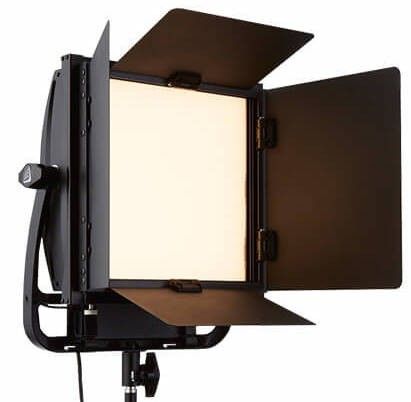
Below is a photo of the barn doors below I found from Google images. Always seemed like kind of a pain to use them since they require a second adapter to attach them (which might make them finicky), plus the reviews for the Astra barn doors don't look good on B&H. If I want extra control without using flags I'll put a softbox with a grid on my regular Astra (I use D-fuse which is a cheap $60 for both a softbox and grid ($30 each)); putting the softbox on the Astra Soft seems like an overkill of diffusion and will diminish brightness, so I only use it on my regular Astras. Barndoors are known to not be very effective on 1 x 1 panels like they are on Fresnels, so I haven't bothered with them; flags are much more effective, though of course take more time to setup. Another option for when I want more control is to simply use a Fresnel instead.

I suppose if the Astra barn doors were said to be good I'd buy them, but I guess the bright side of them not being good is it saves me money. That's one thing about the Skypanels; the accessories look so well designed and useful you end up wanting to buy a lot of them. Do you find the barn doors on the Aputures to be effective? What beam angle light did you get? I'd imagine barn doors would have more effect when the light has a tighter beam angle.

The Astra Soft is listed as a 45 degree beam angle on its spec sheet, which is the same as the regular Astra; I believe the spec sheet is incorrect though as the Soft appears to have a wider beam angle.

If you don't want the brick mounted on the light than where do you want it mounted? I already pointed out it can be mounted on the light stand, the ground, or elsewhere if you don't want to mount it directly to the back of the yoke. I find for Hollywooding a light it's nice to have the battery attached to the light; I guess if the battery was seperate it would be a bit less weight for the person to hold up, but they'd also have to keep unattaching and reattaching the battery to their belt (or wherever they end up putting it) each time they pick the light up and put it down, which I could see wasting time, and no one wants to wait on the PA or lighting person holding a light for a shot to reattach the battery to their belt.

The same goes for taking the light out of the bag; the battery going directly to the light will setup quicker than having to setup a separate battery holder on the light stand or elsewhere. With my Practilites I have to mount the battery to the battery holder on the stand, which takes extra time to setup; the battery setup for the Astra is quicker. It's an 8 lb light, so an extra 2 lbs of battery up top doesn't make a ton of difference in terms of being top heavy.

litepanel_astra_1x1_soft_with_barn_doors.jpg
 
Last edited:
Here is my crazy metric.

The Fstop value when the light is positioned to illuminate an 8.4 board with no more than 1 stop of drop off centre to middle, camera set on 1/50 800 ISO (nikon D600 in raw mode metered off a grey card in the middle of the board)

I came up with this metric as I mainly want a fixture that can illuminate an 8.4 scrim as a soft key.

And in Mar16 I came up with this.. sorry the tabulation is lost. See it here ..https://docs.google.com/spreadsheets/d/1X68SIDZJs7xo3Cnoat7QvNpQCyJLEgtO0CK_WAIO7Pg/edit?usp=sharing

Only the Mole, Joker, and CTB tungsten were considered to be 'cuttable with daylight'

Light Temperature Tint cover 8ft, 800iso 1/50 Power Draw
Mole 400 6535 0.7 16 400
Filex 1000 5773 3.6 11 360
RPhos chroma q 5993 3.6 8 120
Joker 800 ( think using frost front killed it a bit) 5153 -0.4 8 800
Phton Beard Highlight 6907 -1.4 8 330
Diva 4 bank 6907 -1.4 5.6 220
CTB Gelled redhead 5366 0.2 5.6 800
DIY Led Bar light (with mag correction!) 7284 -14.8 5.6 140
Dedo Led 4.1 6352 8.3 4 40
Dede DLH4 (with correction filter) 6305 9.2 2.8 150
Cineo Maverick 5532 -3.8 8
Area 48 120
 
Last edited:
To be fair, watts don't really tell you anything about the actual output of a tungsten light either. They too have somewhat non-standardized photometric data, with good reason too - what good does it do to tell you how many foot-candles a 20k is from 5 feet away? That said, as long as you have a lux or foot-candle reading for a given distance, you can easily determine what that level will be at just about any other distance. Falloff might seem to be more of a problem with LED's since they're generally not as bright, but a sky panel at full heat sure won't seem to fall off. The inverse square rule is pretty universal and 1FC is equivalent to almost 11 lux. A minimal amount of math will get you whatever information you need to compare how they perform on paper. Lumens is the one unit that really doesn't do you much good since it's simply a measure of how much light is being generated by a source, not how it's focused and how much of it will land on a subject at a given distance.
 
Back
Top