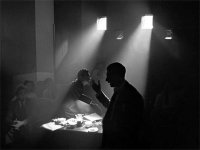
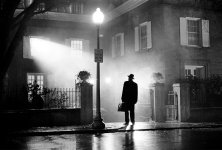
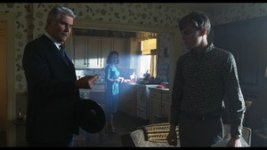
Which size hmi lights are in these screenshots?

Hutchman

Active member
Hey guys,

I want to move up into HMI lighting and was wondering if you could share your advice please. I have access to a 2.5Kw, 1,2Kw and 575W HMIs, all PARS. I can get access to larger ones, but not as easily, so would prefer to stick with the 2.5Kw as my largest for now.

I really love the idea of reverse key lighting with a light beam streaming in through the window/s.

I've read the "HMI HOW NOT TO DIE" thread which was great in terms of the safety/operational side; my question is, how "punchy" will the above lights be? I hear that the PARs output more than fresnel HMIs, but are harder to control?

Will they get anywhere near the screenshots below?

Are there any special cutters etc, they use to get that "light beam" effect, or is that inherent to HMIs already?

Also, will this generator be able to power the 2.5kw?

http://www.ebay.com.au/itm/NEW-GENP...694?pt=AU_Hardware&hash=item1e72060b9e&_uhb=1

MANY THANKS :)
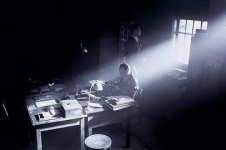
cinematography.jpgcitizen_kane.jpgexorcitst.jpgscreenshot-0034489-I-300.jpg
 
Just a guess, but the first three screenshots you provided were probably lit with arc lights, which pre-date HMI units.

Getting beams of light like that is not necessarily dependent on the light unit itself. Generally, haze or fog is used to define the beam, and of course using distance to create a nice hard shadow. Dependent on the relative brightness of the rest of your scene, you could create this effect using a number of different units. The cheapest alternative I have seen is 4 1k PAR can lamps.

Also, that generator can NOT handle a 2.5kW HMI. It specifies that each leg of the generator can take only 2000W. But I'd get a second opinion I'm not up and up on the Australian power system, and not really in the mood for doing the math.
 
The bigger the unit you can get, the more even your ray of light will be, also it will allow you to back the unit away and get much harder shadows and more defined rays. If you want to know how punchy your unit will be at a given distance, with a given lens, you can look up the photometrics of the unit on google. If its an arri unit, they have their own photometrics calculator (http://www.arri.com/lighting/lighting_emea/photometric_calculator.html#top).

I wouldn't say that they are harder to control, but usually when you use a par, you bounce it off something or shoot it through diff, so naturally it requires a bit more work to control it. Bigger sources require bigger flags and more space.

The other thing you'll need is a hazer. That's what will get you the light ray effect. I also find that it will be the most defined if your background behind the light ray is dark.


I'd look more into a Honda 3000 or 6500w generator.
http://www.maxtool.com/us/products/...&cagpspn=pla&gclid=CPy8v9uq6bcCFSVk7Aod3V0ADA

Good luck!
 
Not sure what makes you think that those are HMI's in those black and white screenshots, that effect can be done with any number of things. If it's a smaller ray of light like the two top photos, a shiny board or mirror on a sunny day would be far more effective than a 2.5k. But a 2.5k PAR should have enough punch to do things like that if you're not fighting high ambient levels with it.

As for the generator, I would have to agree that it probably won't power a 2.5k. If it could output 2k on each leg at 120v, that would be a different story since you could run the light off of two legs at 208v. But to my knowledge (at least this is how it is in North America), HMI ballasts can't take the 415v that you'd get from combining two 240v legs.
 
Thanks a lot guys, very informative! Yeah I should have said I live in Australia, where we have 240V mains, so I assume I could actually run a 2.5Kw (but not much else!) off a 15amp circuit? Those Honda generators look great, and I've seen the 6500W version in a few rental catalogues, I just thought I could use the 415V 3phase plug on the cheaper generator? As you can tell, I don't know much about electricity, and will need to get up to speed on it! Although I've heard that you should use inverter generators only due to the fluctuation of the HMI, especially when striking, although I've heard others say if you get a normal genny with 50% more output than your maximum load, it should be fine? So in other words that Honda 3000W could be used exactly for a 3000w load, wheras a 6000W normal genny shouldn't be used for more than 3000W or so if you're using HMIs? Will look into a hazer, sounds great! I found this example which definitely is starting to look like what I'm after, he said a fog machine could work too but not as well? :
 
Thanks a lot guys, very informative! Yeah I should have said I live in Australia, where we have 240V mains, so I assume I could actually run a 2.5Kw (but not much else!) off a 15amp circuit?
Yes, definitely. I know someone who did this in Italy with no issues.
Those Honda generators look great, and I've seen the 6500W version in a few rental catalogues, I just thought I could use the 415V 3phase plug on the cheaper generator? As you can tell, I don't know much about electricity, and will need to get up to speed on it! Although I've heard that you should use inverter generators only due to the fluctuation of the HMI, especially when striking, although I've heard others say if you get a normal genny with 50% more output than your maximum load, it should be fine? So in other words that Honda 3000W could be used exactly for a 3000w load, wheras a 6000W normal genny shouldn't be used for more than 3000W or so if you're using HMIs?
You have to keep in mind that for example, a 1.2k HMI isn't necessarily drawing exactly 5 amps. It's just about always more, how much more depends on the ballast, voltage coming in, and the age of the globe. With magnetic ballasts or power factor corrected electronic ballasts, the number of amps you'll draw will be close to, but at least, the number of paper amps that the light pulls. Not sure if paper amps are something you guys use in Australia or any 240v land, but in America it goes like this - 1000w = 10 amps (this isn't factual, but it gives you some extra headroom when "calculating" your total load, and makes it much easier to do the math). But a 1.2k HMI will actually draw at least 12 amps on 120v, mine with it's old magnetic ballast draws right around 13 amps. On an older electronic ballast that doesn't have PFC, it can draw up toward 18 amps, hence where doubling the size of the generator when using HMI's comes from.

I would forget about getting a non-inverter generator personally. Guy Holt has some great write-ups on this subject on the website for his rental company, dvxuser.com
 
Last edited:
The first problem is the generator. It's lacking in technical specs to back up the comments, but the key feature is that at the UK/AU mains supply voltage, you have 10A of available current. So for a 2K HMI, that's close to top limit. However, you could also have a problem with circuit protection. Few manufacturers reveal in their specs the surge current when the lamps strike. As an example, I can run 4 575W discharge fixtures from one 16A distro outlet, BUT I have had to set them to random strike mode - something some have that strikes a random time after power is applied. If they all try to strike at the same time, the circuit breaker trips. The generator has a ganged 3 phase mcb fitted, so it's quite possible it will trip with the excessive inrush current. You won't know till you try it! Just remember the current specs are the running spec, NOT startup - which could be considerably more.

Seeing light beams is not difficult with the right kit. Cameras in general see through haze, but they see smoke. So you source a haze machine for haze, and smoke for smoke. They are NOT the same. In general it's particle size, but the fluid used can be water or oil based. Google DF50 hazer or Neutron haze for some good explanations. Things like these pump their fluid through tiny nozzles so the droplet size once heated is so small the haze tends to hang in the air for a long time, so you can fill the space, then turn them off for a take, because they sound like tanks! Cheaper DJ machines have a larger particle density, so use more fluid and it sinks quicker, meaning you need them on for longer, with again, a noise issue. A smoke machine uses a similar but critically different system that burns the fluid which changes colour, producing large droplets that sink very quickly, and get carried on drafts. The burnt liquid also lands on everything, making a mess quite quickly. The floor starts to get slippy, and your lenses need protection. As with everything, a quality smoke machine does the job much better - just remember the difference is one is made to be seen, the other only made visible by shafts of light.

OK - now the light. Seeing shafts of light has been a requirement in film and stage for a very long time now, and the techniques haven't really changed very much. The real sun has, because of distance, a near parallel beam spread. A Fresnel, for example, doesn't. Sure, you can narrow one down, then bring in the barn doors to contain the beam a little, but chopping out light with the barndoors throws light away - you are left with the centre which is not bright enough. Years ago, people needing sunlight produced specific designs that had a reflector, a lamp, and a small disk that was fixed to the open front, just large enough to prevent any light directly going forward, bouncing it back to the reflector, to be re-bounced out. Beam spread was down to about 5 degrees or less, and even with the low wattage lamps available then, the beam concentration was enough to punch through. Look at any TV pop show nowadays and you see loads of moving lights with pencil beams that are really bright. They are not, they are just designed to be concentrated like that. Even though you can try a CP60 narrow PAR, you'll need a cluster, and this messes up the beam spread by making the combined source softer, so not so sharp where it cuts through the window. Your local rental house will probably have something in stock that you can put further away - which always improves things - but if you need to buy, I doubt the budget works. It's quite common in lighting opera to use a single, powerful back light - 5K HMI, or even bigger. As far away as they can manage, up stage, and high enough to not blind the front row. If they have the front to back depth, the effect is stunning, along the lines of the picture of the house outside up the topic a bit. If they have to reduce the distance in a smaller theatre, it never looks as good.

So to conclude. The generator may be able to cope. If the mcbs are B type, which is usual, they may well trip on the surge, C type would probably not.
A single PAR with CP60, may work, but you may need to restrict the level of the rest of your lighting to make it more visible - it needs to be able to be up quite high if you increase distance.
You need a hazer, NOT a smoke machine, and NOT a budget hazer. For example a Neutron looks identical to the Chinese copies like Chauvet - results are very different, as is cost.

Mains power techniques in 110V territories are very different in 220-240V territories, especially when dealing with 3 phase, because going between two phases gives over 400V, so is not to be messed with. The US method of using two phases to give extra capacity and 220V is just being able to use voltage settings meant for 220/240V areas that are often a switch on the appliance - such a feature is unavailable in 220/240 land.

Last comment - haze outside, as in that picture is hugely difficult to do, and needs no wind, and a constant humidity, or you can pump all night long and see nothing!
 
Last edited:
Great , thanks again. Yeah, will definitely hire one of the Honda gennys. And keep the hazing inside!

So the 6500 would handle a 4Kw HMI if I could get hold of one, since it has a constant rating of 5500kW, but not a 6Kw HMI?

 
Last edited:
I would test it out at the rental house. Let it run for a good 30 minutes. Some 4k ballasts can draw well over 5500w once they warm up.
 
an HMI is an arc light, just an enclosed arc.
A beam projector would be a better source for the shaft of light effect you're looking for, along with a hazer
http://www.scribd.com/doc/98133907/58/BEAM-PROJECTORS
Right. And, it's an arc that doesn't operate on DC and doesn't emit poisonous fumes of which CO is probably the least concerning.
Besides which, the way in which they produce light is completely different from a carbon arc. HMI's are a discharge source, generating light from gases in the globe moving from a high to low energy state each time the electrical current reverses. Carbon arcs are closer to incandescent bulbs, the light being emitted is coming from the intense heat generated by the current.

Agree that a beam projector would be the correct tool for this effect, provided that you can get it far enough back to cover a whole window.
 
Thanks, although I don't have access to a beam projector :( Is there something to put in front of the 2.5K that could narrow the beam?
You can cut the beam with doors and flags. If it's a parnel you have various lens options for beam spread, and you also have the focus knob on the fixture (parnel and fresnel). But if you're renting the shop might have beam projectors. Even if the shop doesn't own their own they could probably arrange a rental for you if that's what you need/want.
 
Assuming you have light control like all the images posted in the first post a Dedo 400w daylight unit with ballast and 650w globe with projector could get you there. Much less power requirement.

Where in Aus are you located? You'd want to test it of course, but in theory it should do the job.
 
Thanks, although I don't have access to a beam projector :( Is there something to put in front of the 2.5K that could narrow the beam?
Putting nothing in front of it will give you the narrowest, brightest beam. I generally wouldn't advise this though, you'll at least want the frosted lens in there to smooth out the defects in the beam that are nearly unavoidable with PAR fixtures.

A beam projector really isn't all that different from a PAR, except that they instead use a HUGE glass reflector, as well as a small spherical reflector directly in front of the lamp so that every ray of light coming out of the filament is being properly focused by the parabolic reflector (no spill, or field outside of the main beam). Regular PAR's just have the added feature of stippled lenses to change the beam angle.
You can cut the beam with doors and flags. If it's a parnel you have various lens options for beam spread, and you also have the focus knob on the fixture (parnel and fresnel). But if you're renting the shop might have beam projectors. Even if the shop doesn't own their own they could probably arrange a rental for you if that's what you need/want.
PARnels are a specific single-lensed fixture made by ETC, there is no such thing as an HMI PARnel. I think you're talking about plain old HMI PARs (though not the older sealed beam models; no focus knob on those).
 
As has been suggested, try things out at a rental house and has also been said, a 4K ballast can certainly draw more than 4000 watts. A number of factors there, including whether its square wave or not.The other thing to know is that the maximum rating for a generator is typically for temporary use. With the Honda EU 3000 for example, the maximum continuous rating, if I recall correctly is 83.3% of that, right on the edge of 2500 watts - not too likely to hold a 2500 watt HMI. The advantage of the inverter series generators is that the stability their frequency is not rpm dependent as with others gennies. For that reason, film industry generators are speed controlled through an electronic govenor. I would be hesitant to say the least (ie, I wouldn't) to use, as someone suggested to you, that any genny with double the ampacity of your needs would be okay to use. I'm in Canada, 60 cycles. In order to ensure that there isn't any flicker, there can't be more than a + or - .25 deviation from that. I imagine in Australia with 50 cycles, its the same or similar. Personally I don't feel comfortable unless the genny is within .1 + or - of 60. Remember that HMI flicker typically can't be seen by the human eye, but the camera will see it. In fact, more often than not, when you can see flicker its not a frequency problem to begin with.
 
It's worth remembering that the current use of PAR is being distorted - the Arri HMI PARs for example, I believe their naming is because of the PAR like beam. Nowadays the usual explanation of PAR is Parabolic Aluminized Reflector, which works with the Arri type products, but we should remember that before the lamps were hijacked for theatre and video, PAR meant something else, and the original defintion still works for most PAR lamps. Precision Aligned Reflector. So the sealed beam units - like the old car headlamps, aircraft landing lights and of course the PAR 56 and 64 lamps have an aluminium (proper British spelling and pronouciation) parabolic reflector, and the combination of fixed lens and lamp and reflector provides accurate and repeatable performance. An ancient Fresnel would have been considered different to a PAR when it was made, but now, we can consider them PARs, by the current definition - which seems wrong to me. Having a parabolic reflector made from a particular material seems a bit loose to me - but it's what we're doing now.

Oddly, the 1970s explanation - pre-internet, is no longer Google-able on the net. In fact, the only results for the old Precision Aligned Reflector are not helpful - posts by me on forums in 2006/7!

Books at that time used the old definition, which back then worked fine - now, almost anything can be a PAR, which I maintain is just wrong. However - if I'm the only one in the world worried about it, I'll give up.

In my own head, a sealed beam lamp, is a PAR. A Fresnel is a Fresnel because of it's lens, and an ellipsoid(US)/profile(UK) can project patterns inserted at the focal point.

The real useful facts seem to be quite simple:
Fresnels have soft beam edges and merge well with others. They have beam spread from narrow to flood, and barn doors can control spill.
Ellipsoisd/profiles can be fixed beam angle or zoom. They have sharp or hard beam edges, and frequently have four shutters at the focal plane point with a slot for a gobo to enable patterns, logos and shapes to be projected. You can insert at 'top hat' into the colour runners at the front which will sharpen up the edges of projected patterns. You can on most adjust the relationship between reflector and lamp to produce a flat, or a peaky field - as in a hot centre, and dimmer edges, or and even beam.
PAR Lamps have fixed beams that are oval in shape. The only adjustment is to spin the lamp in the housing.

The lamps themselves can be filament types or discharge (or of course now LED). Things have changed since people burnt a chunk of lime in a gas flame, haven't they! Good job film was black and white - can you imagine the colour problems with limelight!
 
... As you can tell, I don't know much about electricity...

I would strongly suggest getting more familiar with 'electricity' before taking on projects that require really big power. 'big power' being anything that draws more than what you usually plug into your home/office plug.

My rule of thumb for 'what size generator' has always been 2x the average load. So, in the case of a 3K load, I'd go for 6K of generator. These days with more efficient 'ballasts', perhaps one need not use 2x, but to account for momentary start up spikes/surges, 2x is usually enough, and not so expensive.
 
Back
Top