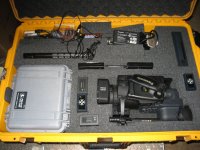
With about 25 years of camera work behind me, I have found the Pelican cases to be the best protection money can by for production gear. They are solid, water-tight unites that can take years of hard treatment from yourself, assistants and all those tough guys at the airport! I currently own four of the 1550's - one for audio gear, one for a matte box, one for batteries and one for a three light Dedo kit. The great thing about these cases is that once I pack them well (not just throwing stuff into them, but every thing in it's place) I know that everything inside is safe. I can't tell you how many times after a shoot that I have just tossed a few things in the back of the truck because I'm tired and I'm not driving too far, only to find something broken because I had to stop quickly or turn sharp.
Having said that, I must admit that with my recent purchase of a HVX200P, I elected to purchase a Portabrace bag first. I reasoned that the camera will be with me not not shipped, and that the Portabrace is much easier to work out of that a hard case. I purchased the CS-DV4, which conforms to current airlines carry-on restrictions. If I had my choice, I would have picked black instead of the standard blue, just because it is a little more nondescript. I'm sure every thief in the world knows that any "Portabrace Blue" bag has something good inside!
On the topic of air travel, I have a couple of quick comments.
First, batteries can be issue. Although most Lithium-Ion batteries that we use are small in size, the number of batteries can be an issue. I now carry a declaration of the larger Pag batteries I use when shooting Betacam.
I too try and wait for security to inspect my cases so I can "lock" them. I use those quick one-time use "zip-locks". If someone really wants the goods, they are going to take the whole case. I'm more concerned about the case opening in transit or on the luggage belt - I've seen that! I also understand that if officers want to take a look inside your case and your not there, they just cut the locks. If they cut my zip-lock - no problem. They cost about .10 cents. I keep a bunch in one of the cases that will be checked and only take out the four or whatever the number is of what I need to lock. You will not be able to take them on-board.
A couple of months ago, I did a job for a company out of L.A., and they simply shipped a Sony PD150 by FedEx to Toronto, Canada. It arrived in two days - in a Pelican case! We used their camera and shipped it back down. No problems at all.
For overseas work (and for me entering the US), the best way to move gear in and out of a country is a Carnet. This is quite the document and requires customs officers at all boarders to sign various forms, but bringing gear is never an issue. You get them through your local Chamber of Commerce. I'm not an expert on using the Carnet, but I'd be happy to try and answer any questions anyone has.
Michael Strange