Which mic to hang

patrickbaldwin

Well-known member
I am filming a musical stage production in a few days and I would like some advice about hanging a microphone from the roof. Hanging a mic is really my only option I think because I am right on top of the show, maybe as close as 8 feet and it is being staged in traverse with me and two other cameras along one side so my feeling is that there is no room to put mic(s) on stands in front of the show as it were. There is no audience. My plan is to hang one Octava 012 from the roof using the cardioid capsule. I was thinking this would be preferable to the omni capsule because then I wouldn't get any noise from behind the mic from things such as scrolling gels. Is this a good plan? The stage width is probably about 35 feet with a 4 piece live unamplified band at one end. The roof height is probably about 20 feet. I do have a matched pair of the Octavas if anybody has a different plan they think would work.
 
with the risk of re-=repeating myself;
The Octavas would probably be ok for the band, but for dialog, the Octava 012 has low sensitivity/output (10mV) which would require lots of 'clean' mic preamp gain. Even with expensive mic preamps, they don't have much 'reach' to get decent sounding dialog from more than a foot or two away.. If good quality wireless lavs are not an option, I would recommend two or three boundary mics on the stage floor or choir/gooseneck type hanging mic from front/above.
 
I would use mics that are designed for this very purpose. If you google search "hanging stage microphones" you'll come up with solutions. I wouldn't use Oktava mics for anything.
 
I like Oktava's but I wouldn't use them in the way you are talking about.

So lets get some terminology straight, the roof is outside the building, I'm assuming you mean the ceiling. But this sounds like it's an actual theatre so below that you have the grid, what the lights are hanging on.

Also with a band this is probably a musical. The standard way to mic that if you can't use wireless is to run boundary mics such as a PZM across the front lip of the stage. about every five feet is ideal, so 4-6 (depending on blocking you may not need one or both edges.

For mid stage and back you would use drop mics, they look like lavs on a really long cable. It depends on blocking but two rows of three to four is about right. One at about mid stage and the other farther up stage.

Again you can cut down if there are areas of the stage that won't be used.


The easier alternative is to set up a stereo pair in the house about 1/3 of the way back. If an audience can hear the show so will the mics.

You might also mix and match, just use the boundary mics and a stereo pair in the house.

The up side to onstage mics are that you might get a "closer" sound on some songs/dialog. Since a lot of the time especially with musicals the leads tend to be downstage and more center, the boundary mics may help a lot with that. With out knowing the blocking your only real option is either the house or very heavy coverage over the stage. With out heavy coverage you are going to have wild fluctuations in level and "closeness" that is going to be very problematic when you try to put it all together. The Plus for a stereo pair in the house is everything will be better balanced and at an even distance. If you get some mics on the lip you may be able to get some "close up" sound for the close up shots IF you happen to have a mic close to where the actor is.

If they have newer robo lights they are pretty quiet, older ones are noisier than a (name something awful).

Also anywhere close to the lights and wiring is going to be an RF hell. Lights are dimmed by chopping off the sine wave of the AC power. This makes the power going to the lights much closer to a square wave and that means they have a LOT of harmonics that are broadcast out to any waiting receiver such as a mic capsule or cable. So keep your stuff as far as you can from any of the lighting and light cabling.


Yes the plan was to hang it from the grid as close to the top of my video frame as possible.
The actual staging area will be traverse like this: http://en.wikipedia.org/wiki/Traverse_stage
Its a pretty small studio. As there will be seating on both sides the actual "depth" of the stage will only be about 15 feet maximum.
I am definitely leaning towards the stereo pair now which has been suggested elsewhere and given what you have said makes the most sense.

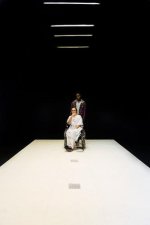
Regarding the RF pollution I have bought enough length of star quad cable in an effort to help that issue plus now if I do the stereo pair hopefully it will be less of an issue. The image is from another show but shows what the stage will be like although this is end on. The three cameras and now stereo mics would be down the right hand side of this image. Those lights are up against the grid to give you an idea of what I'm dealing with..
Thank you very much for all your help. Its greatly appreciated.
PB_141211_0361.jpg
 
I would use mics that are designed for this very purpose. If you google search "hanging stage microphones" you'll come up with solutions. I wouldn't use Oktava mics for anything.

What would you suggest using David? I'd happy to hear suggestions at all budgets.
 
Ouch, So this is a big thrust stage? The overheads would then go front to back lengthwise instead of side to side. BUT you will probably run into lighting problems, mics casting a shadow. PZM's should work quite well but it's going to take a LOT to cover that much thrust. Figure one every five feet or so. The big plus with PZM in this case is that they are inherently in phase so you can mix them with out having crazy phase issues. Personally I would probably skip the overheads and stick with PZM's and a stereo audience pair. Especially since you don't have an audience to worry about. You could also run a bunch of omnis around the stage but then you would have to worry about phase issues.
 
Sorry for the confusion. The audience would be on each long side in that shot not end on as the camera is here. Its been mentioned elsewhere that because of the traverse staging the performers will at times have their backs to the camera and hence the microphones if i was to use a stereo pair which is a very good point. With that in mind it was suggested that given my available mics I should hang one either side of the stage, not mix them live and mix them in post to mitigate actors facing away from mics. This does make a lot of sense.
Its not possible budget wise at the moment to buy some PZMs or the time to rent them but I will definitely consider it for the future. Right now I have to be as discreet as possible so putting PZMs on that stage would have had to have been a decision made earlier in the production process. My mixer is an SD 552 so I would be limited to 5 mics anyway wouldn't I without additional purchases?
Thanks for all the help Scott. I am learning so much.
 
PZM's really want to mounted to a large flat surface so stage is pretty good, also walls and in a pinch a 2X2 piece of plywood or plexiglass works also. If you ask around there are probably some available. Theatres, especially ones with smaller budgets used to have a lot of the ones made by Crown and sold through Radio Shack. They were ~$50 and with a few easy modifications became quite decent mics. A lot of theatres use them for the monitor system (the one that pipes sound from the stage back to dressing rooms and Green rooms and such).

The disadvantage of two non PZM's in your case is that your really likely to get some phasing. I'm going to assume that there will be people talking in each direction that will overlap at times.

Since this is not an out of the bag gig you could get a bigger mixer, but what you really need with a lot of mics is a lot of record tracks so you are right, that would get problematic quickly. It is the kind of situation Boom Recorder is great for.

So given the limitations, if I had a choice I would probably use four PZM's on ply situated in the first row, two on each side. You could also mount then hanging from the grid, but if possible I would probably go low rather than high.

Second choice would be four stand mics in second or third row two each side. Coverage though is going to be a major PITA (depending on blocking).

If you have to go down to two mics they need to have a really wide pattern, or be fairly far back. Ironically this is the kind of case where a camera mounted mic may work just about as well as any of the other options.

That actually might even be a decent choice. Have something decent on the camera as the over all sound and stick your two plant mics as close as you can to where there will be some featured songs. Or if you have a shotgun that is decent in a bouncy space (the Sanken ones are pretty happy indoors - but I would test in the venue) use that to capture some "closer" songs. If you have a second mic and boom you can do that on both sides at the same time. In post you phase them in to which ever camera shot is being used and you will be able to get some perspective changes on solos etc.
 
Speaking of boundary type mics, a while back there was some posting about boundary mounting products that would take a typical small condenser. It had some type of suspension inside and was made of formed sheet metal. It might have been of German manufacture. Could anyone who recalls this product give a name or a link.

Thanks Grant

Dave, this might be an easy product for K-Tek to do, you already have suspension systems…….

The two problems I would see are that the distance between the plate and capsule are critical and that might be very hard to do as an after market product and B) it would eliminate one of the advantages of boundary mics and that is their very low profile. Once you mount up those omnis in the bracket your going to have what looks like a candlestick with a really large base, and with a mic cable coming out like a very long wick.
 
Speaking of boundary type mics, a while back there was some posting about boundary mounting products that would take a typical small condenser. It had some type of suspension inside and was made of formed sheet metal. It might have been of German manufacture. Could anyone who recalls this product give a name or a link.


I believe it was called "The Turtle" and made in Germany.

Naiant also will do custom versions of their lavs so you could have a bunch of omni hanging mics for relatively cheaply. And they have an adapter to turn their lav into a boundary mic, but no idea if it works or not.
 
PZM's really want to mounted to a large flat surface so stage is pretty good, also walls and in a pinch a 2X2 piece of plywood or plexiglass works also. If you ask around there are probably some available. Theatres, especially ones with smaller budgets used to have a lot of the ones made by Crown and sold through Radio Shack. They were ~$50 and with a few easy modifications became quite decent mics. A lot of theatres use them for the monitor system (the one that pipes sound from the stage back to dressing rooms and Green rooms and such).

The disadvantage of two non PZM's in your case is that your really likely to get some phasing. I'm going to assume that there will be people talking in each direction that will overlap at times.

Since this is not an out of the bag gig you could get a bigger mixer, but what you really need with a lot of mics is a lot of record tracks so you are right, that would get problematic quickly. It is the kind of situation Boom Recorder is great for.

So given the limitations, if I had a choice I would probably use four PZM's on ply situated in the first row, two on each side. You could also mount then hanging from the grid, but if possible I would probably go low rather than high.

Second choice would be four stand mics in second or third row two each side. Coverage though is going to be a major PITA (depending on blocking).

If you have to go down to two mics they need to have a really wide pattern, or be fairly far back. Ironically this is the kind of case where a camera mounted mic may work just about as well as any of the other options.

That actually might even be a decent choice. Have something decent on the camera as the over all sound and stick your two plant mics as close as you can to where there will be some featured songs. Or if you have a shotgun that is decent in a bouncy space (the Sanken ones are pretty happy indoors - but I would test in the venue) use that to capture some "closer" songs. If you have a second mic and boom you can do that on both sides at the same time. In post you phase them in to which ever camera shot is being used and you will be able to get some perspective changes on solos etc.

Hi Scott. I have run out of time to hire anything so I am down to my two Octavas. Do you think it might be better to have one on each side on stands as opposed to the same two hanging from the grid?

I do have my NTG3 which I could camera mount and record into my 552 while recording the Octavas into the 722.
I'll be honest I have so much on my plate already coupled with my lack of experience with this equipment that I think that workflow might just overwhelm me.

I have come to the conclusion that in terms of end product this test will be a washout so I am going to use it to test myself and my camera assistants and all my equipment so that I have a bit more experience to take to the next one.

There has been so much talk of PZMs that I suspect a few of those would be a good investment. If you happen to have a recomendation I'd be very happy to know it.

Boom recorder looks amazing but then so would the sound desk I'd need for it! I worked for AMEK in the early eighties. I should have nicked one whilst I had the chance:-)

Thanks for all your help Scott.
Best wishes. Patrick.
 
I worked in theatre for a long time, still do periodically. With a pair of cardioids to cover two sides of the runway there are no good options.

1) hang them over the stage. My big worry is you would have sizable dead spots and the levels would be a nightmare in post. This is why one would generally use omnis or mics like a PZM which are essentially omni going forward and nothing from the back. If you hang them high enough to get coverage you are going to be up in the lights and it can get very reverby up there. Also Oktavas are too big to hang very low, because of casting shadows.

2) one on each side. My worry there is again the pattern is not wide enough so you are going to have to be pretty far back to get much coverage and then, your far back...

2.1) you might, if a lot of the main stuff happens closer to one end set up the mics to shoot down the side a bit. You get more fall off at one end but a better sound at the other and you can be closer and still get some coverage of the whole stage.

3) Go crazy and (assuming the walls are not padded) place one each pointing into the corners of the theatre off the end of the stage. The corners will act like a big reflector and you will get a louder and more even signal. There are a number of ways this setup can crash and burn. If the room is really badly designed the corners could be a bounce hell. The walls could be padded and you will be much worse off. The corners could be a long way off, usually there isn't much audience on the tip of a thrust that extreme but? When it works it works quite well, so if you have the time you might want to give it a test.

Given the choice between somewhat distant coverage that covered everything and closer sound that missed some parts of the stage I would go distant.

This isn't a narrative film, and unless it's an original play this can only legally be recorded as an archive (with out buying the "movie rights") so you audience are the folks on stage and they will not be happy if you can't hear them. Far better that they sound a bit distant than they be really inaudible. Placing the mic close will mean having to do a lot of gain riding to even it out and no mater where you do that you will get a really ugly noise floor pumping in and out along with the gain because theatres are noisy places, the are not sound stages. IF you go that route I would recommend setting a level and sticking with it. If you ride live it will be VERY difficult to get any decent noise reduction in post and I will tell you now that which ever route you go you will want to slap some noise reduction on the tracks.

I would use some camera mounted mics also if possible. Most shotguns will probably sound bad in an empty theatre but?

To help with that I would ask everyone you know to loan a packing blanket or regular blanket and drape them over as many seats as possible. Theatres are really meant to have a lot of soft bodies in the seats breaking up the bounce. With out an audience most theatres sound like an empty hangar.
 
Hi Scott. I do have omni capsules for the Octavas. Would you recommend those over cardioid?

As I said I've accepted that this gig isn't really going to work so I'm paradoxically more relaxed about it now and will try and experiment. Unfortunately I won't have much time. I have to photograph the first dress but it will be recorded somehow in a set it and forget it fashion and there will be one camera rolling I think and then we have to shoot it for real as it were in the evening. There is only about an hour between rehearsals so not much time to review and make changes. The show is an hour and a half without interval.

I will definitely give your suggestions some deep thought.
Thank you very much.
Patrick.
 
It's probably worth linking the topic in 'the other place' as you have some duplicate stuff, and contradictory stuff - as always happens. http://www.dvinfo.net/forum/all-things-audio/526766-mic-hang.html

Realistically, there's no budget or time to do a good job. For me, as somebody who records in theatres as part of my job, the things that will make it worse, like mics on cameras, need to be avoided. Static mics - on both sides looking at the actors is important. Flown microphones are never on my own list of solutions. They pick up the noise of the actors feet, but very little direct sound from their mouths. They always sound distant, and can never be flown in low enough to be effective because they look dreadful. No mention is made of recording the piano - so it's going to be tough.

The need for star-quad cable might be a little too much, as although problems still happen from time to time, dimmers seem better designed nowadays - at least proper theatre type ones are. The real issue in this case is simply the awkward space, and the multi directional requirement for the actors, which doubles at the very least the number of mics. PCCs on the stage edge, looking inwards are my usual tool. The only real snag is that unless you can record all the mics individually, you need a person to mix it to 2 channel. If you use multiple two channel cameras, then 2 to each camera and sync later may well be possible - but it's very time consuming.

It's going to be a video and audio challenge, so the very best of luck. It's doubtful it will sound dreadful, just thin and unbalanced. The good bit is that without an audience, 4 cardioids on stands could be split two on each side, and would stand a lot better chance of capturing the singing.
 
Back
Top