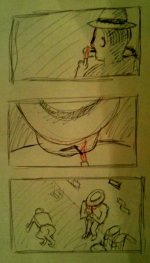
When camera directions are important

Egg Born Son

Veteran
What is the proper method to insert a critical camera instruction into a script?

The line in question is:

He lights his cigarette. The flame illuminates his face (but frame so as not to reveal his identity).

The flame of the lighter is important symbolism, so the light it casts is notable. At the same time the man's face is an important reveal further down the track so it must also be noted that it not be revealed at this point. It's easy enough to describe this important shot in the script but what would be the correct way to scribe it? As written, I'm not happy with the line. It draws both too much and too little attention to the camera direction, lacking visual clarity on the page and introduces parentheses which don't belong in action/description.
 
Heres the wierd thing:

the instructions to screenwriting beginners about not including camera moves and feelings of characters is because a beginner will do too much of that stuff and then not learn to write visually (ie telling the story through words and actions). once you get to the point where youve gotten rid of the bad habit of directing on the page, then, the thing is, its actually ok to start directing on the page a little bit again, because if you dont do it all, you end up writing too dry and miss out on opportunities to paint a movie picture in the readers head. Pros DO direct in the page. They just do it well, and they dont dont overdo it.

if a beginner types "joe is worried" thats bad. if someone more experienced types "joe is worried" then thats obviously a reaction shot with joe shooting a worried look.

in other words dont direct in the script unless you know that youre good at not directing in the script then you can start directing in the script, cause directing in the script is vital in making a movie in the readers head.

personally I think your probelm is that your shot idea sucks (no offense). who wants to see a flame light the bottom half of someones face. i think youre having trouble describing it cause its awkward thing to have happen (someones face is lit up, without revealing them?). I dont even think you have a full image of what the shot is. otherwise you'd type "he lights a cigarrette, illuminating the bottom half of his face" , or "he lights a cigarrette, throwing his shadow across the wall".

you want the guy lit up and concealed at the same time? odd.

if so , however, what does that actualy look like? I dont think you decided.
 
personally I think your probelm is that your shot idea sucks (no offense). who wants to see a flame light the bottom half of someones face. i think youre having trouble describing it cause its awkward thing to have happen (someones face is lit up, without revealing them?). I dont even think you have a full image of what the shot is. otherwise you'd type "he lights a cigarrette, illuminating the bottom half of his face" , or "he lights a cigarrette, throwing his shadow across the wall".

you want the guy lit up and concealed at the same time? odd.

Illuminating the bottom half of his face. Actually the close up shot you're describing is quite common in cowboy films, detective noir and graphic novels. Who wants to see a shot of half a face, a jawline? Anyone who likes mystery, suspense or thrillers. You never show your monster well-lit, out in the open at the beginning of a film. But what I have is not a shot idea, it is an instruction with at least half a dozen completely different ways to achieve that I can think of. You've come up with two I didn't even think of. Not what I had in mind but could work (if I end up giving the guy a human face - still split between two ideas about exactly what will be revealed).


Maybe I should have included more context, the lines leading up to it but I was simply asking for the writing convention. He wears a hat that keeps his face in shadow throughout the story. His identity reveal is the climax so his face can't be shown in the opening scene. The lighter flame is important to reinforce a fire symbolism so a shot that can achieve both these goals will be powerful. The obvious shot is to put the camera behind the character and treat the lighter as a backlight but I want to leave it to the director to decide how to shoot/frame this. However it needs to be clear to the director to conceal the identity.

I'm not after shot suggestions, they don't belong in a script. I'm after the correct way to add an instruction to a script to guide the director in coming up with a visual that meets the story needs. An alternative would be to include the shot specifically in the script:

Camera behind the actor. He lights his cigarette.

It is more succint and reads better than my original line but it is far more limiting. It is what I am trying to avoid. This is the only such instruction needed in the script, in fact the only occasion I've ever needed to include such an instruction. Sometimes an instruction is needed and I'm sure there is a convention for doing so. This is the point I'm stuck on. If the imagery of lighter flame wasn't important I could just add a note when initially describing the character to never show his face. I can leave it in some bastardised form like I already have, perhaps:

He lights his cigarette. Do not show his face.

but there has to be a more elegant solution.

All that said, the story is morphing even as I write it. My original concept of who the man was going to be may turn out to have a more serendipitous closed-loop solution, making the total concealment of his face unnecessary. Even if this instruction is rendered unnecessary I would still like to know the answer for future reference.
 
Or maybe something like this?

He lights a cigarette-- momentarily revealing parts of a face that for the most part is still hidden in the shadows.

I like that a little better but damn it, you've just made me realise a potentially fatal flaw for the scene. The other character present is going to see his face even if the audience doesn't. Either he or the other character is going to have to look away when he lights up or the scene has to go. Either way it looks like my problem will be moot now. Curse you "logic", the bane of every writer!
 
Heyyo,

I know we've discussed this before in regards to my scripts, but have you considered a more prose-like format, at least for this particular scene? I feel in some cases, adapting a more eloquent, prose-like style can be more effective. After all, our goal is to paint an image in the reader's mind. "He lights the cigarette, illuminating his face just enough to see the outline of his figure." I don't know, it's hard to give a great example without knowing the script, but do you know what I mean? Sometimes in a screenplay there isn't always an eloquent solution though. Sometimes just the best thing to do is to say "He lights his cigarette, but the illumination of the flame is too dim to reveal most of his face." This is why I love screenplay format.
 
OK, I know **nothing** about this. But it does seem like you are trying to convey the frustration of not knowing, as much as the visual of the event. Maybe something like:

"As 'The Stranger' lights his cigarette, 'Actor2' strains to catch a glimpse of his face. But The Stranger is turned partly away, and ducks his head into his hands."


I don't know if this is needed as an add on. This is more direction, but also description?

"The pool of light from the flame shows only the back of his hands, with deep shadows blocking his face."

Sorry, just trying to learn by thinking through this myself.

Cheers!
Michael
 
Yeah, I know what you both mean. The bit that's tricky is that you can't light a cigarette without lighting up your face, especially with a souped up lighter. But I don't want to show his face so it pretty much necessitates a camera instruction. Otherwise 'He lights his cigarette' would be plenty. Your suggestions are otherwise pretty close to what I need. I particularly like the 'outlining his figure' turn of phrase but it isn't quite enough to make it obvious that the camera in that instance must be behind. Both of nycineaste's suggested lines worked too but locked in a specific shot. Which is something I've been at great pains to avoid.

I came equal first in the last fest on the strength of my story and characterisation which offset my poor application of scriptwriting convention. It read easily but that's because I'm an experienced prose writer with a good grasp of language, but it was too prose. Like everyone else I've read a lot of scriptwriting theory but it was the feedback received in the last fest that made a lot of pennies finally drop. I've subsequently been putting a lot of effort into taking the lessons on board and putting them into practice. I essentially have to destroy everything I've spent 20 years building. It is heartbreaking and liberating at the same time. I haven't felt this engaged in my writing in a while.

I'm being very mindful of brevity; being action-centric and doing not telling: Joe isn't worried - he shuffles his feet and his eyes dart about; and being specific enough to give the other creatives some meat while leaving room for them to bring their own interpretation. This last one is the hardest one. My writing method, even for prose, is essentially that I see movies in my head and then transcribe what I see. I'm very visual. I have to take something that is real in my mind and abstract it. I could easily give two pages of elaboration on every paragraph but that isn't helpful. Even if I am going to direct my own script I don't want it to stifle my creativity when I put on my director's hat any more than if making someone else's script.
 
I'm very visual....

I could easily give two pages of elaboration on every paragraph but that isn't helpful. Even if I am going to direct my own script I don't want it to stifle my creativity when I put on my director's hat any more than if making someone else's script.

I think that is the base problem for you - you are a film maker.

Starting with a script, then developing characters, creating a bio and background, clothing, doing a story board, etc. are all really just **abstract** process steps.

You could just as easily make up a process that worked by merging steps 1&3, or 1&4, or 2&5, depending on who you are, how you think, etc.

But, you are trying to follow a rigorous, externally imposed process. So you are trting not to leave "notes" to your self on how you "envision" the scene, because technically that is not your "job" as a "scriptwriter."

I admire your devotion to the process and discipline - as long as that doesn't get you bogged down in administrative tasks, so that you can't get the creative/content as the focus (which is true almost always when learning a new process.)

But you say you are focused & energized, so it sounds like it is worth teh investment right now.

If you have never seen "The Five Obstructions", that is a wonderful map of the creative process, with incredible variety arising out of a specific process. A great road map for creatives! Jorgen Leth. Unfortunately, not streaming on Netflx USA (OK, I see you are in Austraila. Never mind! Can't see that when replying.)

https://movies.netflix.com/movie/Th...id=sCBd7F4jS&gclid=CMXdw-TTg7ICFSVgMgods30AMg


Good luck!
Michael
 
I was still unclear about what we see from your initial description. The intent is to not see his face, but if you have his face in front of a lens and a cigarette lighter lights it, it will be seen. So, we need to be looking at something else.

--Behind The Stranger as he lights his cigarette, the flame silhouetting him in the rain...

--A butane flame touches the tip of a Marlboro, and the unseen figure draws deeply...

Something can indicate what we do see as distinct from what we don't.
 
Cutting a shot simply because it's hard to write elegantly in the script is weak. The shot itself is really easy. There is no technical or story reason that makes it difficult in any way. Anyone who thinks you can't have a character light a cigarette without showing their face demonstrates a serious lack of imagination in regards to shot selection! The only sticking point is that it breaks writing convention to insert a direct camera instruction into the script. Writing conventions are intended to make scripts easier to read, not restrict story content.

I'm going with:

He lights a cigarette. Don't show his face.

It will have to do. Better than what I had.
 
well your original plan was to have the cigarrette light him up, yet keep him concealed. so yeah it was an awkward idea to start with.
"dont show his face" is waaaayy bad- talk about knocking the reader out of the movie.

If you really insist on doing this:


The shadowy figure lights a cigarette.

or...


back to us, he lights a cigarrette.

or

ANGLE ON HIS HANDS AND LOWER FACE

He lights a cigarrette.

Like I said, I dont think you've decided what your shot LOOKS LIKE (not trying to be mean, just pointing it out):

IS HE CONCEALED IN SHADOW,

OR...

IS HIS BACK TOWARDS US...

OR..

IS IT A CLOSEUP OF HIS HANDS AND MOUTH?

Why havent we seen his face so far? Has he been in shadow, or his back to us, or is the camera only taking closeups of him?

----------Either one is EASY to write, please tell me what it is!?!?!??------------

please tell me!!!!

This thread is driving me MAD HAHAHAHHAHAHAAHHUHUHUHHOHOHOHHHHAHAHAHAHHAH !!!?!?!!?

<runs around insane, robs a liquor store wearing a tin foil hat>
 
Last edited:
Its 2012. Screenplays are online. Download and read the screenplays from the top 100 movies. Count up all those with camera instructions. (Guess what the number will be?)
 
from the fight club screenplay:

------------

MOVE IN ON JACK'S FACE.

SLOWLY PULL BACK from Jack's face. It's pressed against TWO LARGE
BREASTS that belong to ... BOB, a big moose of a man, around 35 years
old. Jack is engulfed by Bob's arms in an embrace. Bob weeps openly.
His shoulders inhale themselves up in a long draw, then drop, drop,
drop in jerking sobs. Jack gives Bob some squeezes in return, but his
face is stone.

------------

Its ok to do the camera a tiny bit. Even though I never do, and see almost no reason to ever do it. Theres too many better ways to paint a movie picture in the readers head.

MINOR SLUGS are the best way to do camera- youre literally telling the reader/filmakers WHERE THE CAMERA IS AT (the slug). which you treat as a sub-scene within the scene.


AT THE WINDOW

the shadowy shape approaches....

Theres a book called "your screenplay sucks" that has a whole chapter called "physical writing" that goes into what words to use and avoid.
". Really trained me to write visually and almost never ever bother with camera moves cause theres rarely need to. Even the fight club example could do without it- if you write "Jack's face is pressed against TWO LARGE BREASTS that belong to ... BOB" notice how your mind pictures Jacks face on the boobs first, then you imagine Bob. Its a pull back or a punch out to wide without writing it.

camera directions suck , but you can do a little if you insist on it.
 
Last edited:
I know exactly what the shot looks like (first one below) but I'd just draw a storyboard if I'm going dictate shots. I've since come to like the idea of the third one if I have the means to get up high enough. By not writing the first one into the script I retain the flexibility to choose my shot. All three have a lighter, all three conceal his identity. That said, my question was never about shots yet there seems to be a fixation on this shot being impossible for some reason. It clearly isn't, here are just three ways the shot can be achieved.

light up, no face (x3).jpg

The minor slugs noted above are the closest thing to an answer to my actual question (which was about formatting convention rather than shots) but are also precisely what I want to avoid. Minor slugs are for camera directions, when I want to write a camera instruction. To not show the face is the only requirement of the shot (for plot reasons). Any shot that meets this requirement is okay. To include camera directions for any one of the above three examples would preclude the other two.

I don't need shot suggestions, story advice or help getting unstuck. I'm not stuck, I'm not stressed. I was merely raising a question about formatting. The story is going fine, the scene is fine, the shot is not difficult. Currently I've removed the reference to the flame lighting up his face, as it is redundant; and I've gotten rid of the brackets. Unless someone actually knows of a formatting convention for a framing instruction (as opposed to a camera direction) I am happy with:

He lights his cigarette. Don't reveal his face.

Still not perfect but more elegant than what I started with and more flexible than anything else suggested. Four words are not going to bring the whole thing crashing down.

I was briefly worried about the other character seeing his face but it was a false alarm. The other character is prostrate on the ground after receiving an 'education' from a bouncer and is unaware of the man's presence until after he lights up. Even if it hadn't been, it would have been an easy fix.
 
Back
Top