What's your preferred color accuracy metric? CRI vs R13 vs TLCI vs TM-30 vs SSI etc

ahalpert

Major Contributor
I still feel like most of the best LED fixtures have inferior color reproduction compared to actual blackbody radiators. (I remember Brawley saying that he lights wides with HMIs and LEDs and then brings in tungsten for close-ups.) Which color accuracy metrics do people like to use to evaluate lights before rental or purchase? Or do you feel like the latest releases are good enough that you don't care, and anyway you might be more concerned by other features?
 
This is an interesting topic. Really it’s best to look at all of these metrics to get a better feel for a light than just one score alone. Personally I also like to look at the spectrum graph. Some new daylight LED’s have a secondary blue chip for much improved SSI scores. They are not all the same though. Some manufacturers actually push this second blue led too far into UV light (below 400nm) for the purpose of improving their scores. Daylight SSI improves as you add more UV even if this UV light is not visible to your camera sensor.

The iFootage LED COB lights are some of the best in my opinion as they cut the blue spectrum around 420nm - where most camera sensors also have their cut-off. LED lights like the ifootage are now so good with colour you don’t have to worry.

Also note that not all HMI ballasts / bulbs are created equal. I have a bunch of Dedolight HMI lights I use as an artificial sun and they are scoring 97+ CRI, 90+ SSI and 99 TLCI combined with a shadow sharpness high powered LEDs will never be able to match with current technology (the COBs are getting larger and larger as power increases).
 
We all love having hard and fast numbers that we can compare and, in theory, be able to say that X is superior to Y, based on those numbers, but we all know that it's not always that easy. SSI and TLCI are supposed to be better than CRI and get us into that area, but to me, the definitive test is still how the light looks on camera.
 
This is an interesting topic. Really it’s best to look at all of these metrics to get a better feel for a light than just one score alone. Personally I also like to look at the spectrum graph. Some new daylight LED’s have a secondary blue chip for much improved SSI scores. They are not all the same though. Some manufacturers actually push this second blue led too far into UV light (below 400nm) for the purpose of improving their scores. Daylight SSI improves as you add more UV even if this UV light is not visible to your camera sensor.

That's interesting. I didn't know that about the UV bias distortion for SSI. I suppose that could also foul up a comparison between 2 lights because whether or not they match in the UV wavelengths will affect their score but not their look. But hopefully UV is less of a factor for 3200K SSI and so the truth can come out there, and there's less motive for a manufacturer to use a UV cheat on a bicolor light. I wonder if there's an indirect way that UV can affect visible color rendering. I guess probably not.

What would you say is your thought process or order of operations for evaluating metrics? And are you looking for different things depending on the purpose of the light? Like for an accent light or background light, for example.

The iFootage LED COB lights are some of the best in my opinion as they cut the blue spectrum around 420nm - where most camera sensors also have their cut-off. LED lights like the ifootage are now so good with colour you don’t have to worry.

Interesting. The amaran x S series also has a dual blue chip but i dont know where it's distributed. The amaran has the same tm-30 and cqs scores as the iFootage SL1 200DNA. But the SSI is 5 points higher while the CRI and TLCI are 3 and 1 points lower, respectively.

Also note that not all HMI ballasts / bulbs are created equal. I have a bunch of Dedolight HMI lights I use as an artificial sun and they are scoring 97+ CRI, 90+ SSI and 99 TLCI combined with a shadow sharpness high powered LEDs will never be able to match with current technology (the COBs are getting larger and larger as power increases).

Does the ballast affect color rendering? I would have thought it was just the bulb.

It's interesting to me that Prolycht has a reputation for good color but they have somewhat lower metrics than some other manufacturers. Except they have some of the best R13 numbers, if memory serves me. And maybe that's their design priority and also the priority of their customer base.

One thing I can say with a relatively high degree of certainty after looking through many charts is that RGB-type lights seem to score worse than bicolor lights. I had been led to believe that they would perform best of all thanks to the availability of a variety of raw color material to mix in. But that does not seem to be the case, perhaps because the raw material is inherently spiky. I do not know.
 
We all love having hard and fast numbers that we can compare and, in theory, be able to say that X is superior to Y, based on those numbers, but we all know that it's not always that easy. SSI and TLCI are supposed to be better than CRI and get us into that area, but to me, the definitive test is still how the light looks on camera.

Well yeah sure but does that mean you never buy a light without testing it. What sort of things do you like to read about before pulling the trigger, or do you watch uncorrected camera tests?

There's also basically nothing that you can see by eye that can't be described by one of the various measurements available if you dig into the data. Green/magenta bias or color temperature offset or unsaturated skin tones or whatever. The TM-30 samples 99 colors and you can look at a vectorscope plot of the results and get a damn good idea of what's going on. You're not gonna feel the vibe like you would by looking at a shot but you can predict it.

Screenshot_20230829_212200_Chrome.jpg

SSI is super useful at the very least for predicting how your lights will mix together (if you can come by the SSI compared to your own reference light). Maybe that's not useful if your lights are all over the place but if you're trying to buy similar lights from the get go then it will be very useful.

My understanding is thar CRI is basically dead. Useless. The sample size of colors is too small and it's too easy for manufacturers to game the metric. That's why they all have crazy high CRI ratings even if their lights suck.
 
Well yeah sure but does that mean you never buy a light without testing it. What sort of things do you like to read about before pulling the trigger, or do you watch uncorrected camera tests?

There's also basically nothing that you can see by eye that can't be described by one of the various measurements available if you dig into the data. Green/magenta bias or color temperature offset or unsaturated skin tones or whatever. The TM-30 samples 99 colors and you can look at a vectorscope plot of the results and get a damn good idea of what's going on. You're not gonna feel the vibe like you would by looking at a shot but you can predict it.


SSI is super useful at the very least for predicting how your lights will mix together (if you can come by the SSI compared to your own reference light). Maybe that's not useful if your lights are all over the place but if you're trying to buy similar lights from the get go then it will be very useful.

My understanding is thar CRI is basically dead. Useless. The sample size of colors is too small and it's too easy for manufacturers to game the metric. That's why they all have crazy high CRI ratings even if their lights suck.

I'm actually trying to think of the last light that I demo'd before buying... The closest may be Titan Tubes(friends had some, so I had used them). Pretty much every other LED fixture I've bought in the last five to eight years has been "sight unseen". And the ones that I did actually demo, I didn't buy. The ones I kind of regret the most, even though they have saved my butt in the field twice, are the Nila Boxers. They just have this yellowish/greenish push that is almost impossible to get rid of. I should try to sell them, but they are pretty much boat anchors on the market, today. Second "most regret" is my set of Quasar Cross Fade tubes(pre-date Titan Tubes). A friend had some that we used on a shoot and they looked good, but after I bought them, I hated using them, because it's a pita wiring and rigging them. If they had had internal batteries(or even just internal dimmers) like the TT's or later Quasars, it would have saved them. Instead, I have probably at least $4K worth of tubular paperweights sitting in storage. I bet I've used them less than five times in the ~5.5 years I've owned them.

Camera tests kind of don't do it for me, because a lot of times it's not a camera I use, and that can make a huge difference. I've seen camera tests with lights that I own, on cameras that I don't and just looking at the footage, nothing would make me want to buy that light.

Your eye and the camera image can be two vastly different things. I've seen lights that didn't look that great to the naked eye, but on camera, they're beautiful. Funny enough, there have been times I've thought exactly that with the Prolycht's.

I'd say today, Matt's lighting reviews on NewsShooter carry a ton of weight. He's one of the reason's that I jumped on the Prolycht train, back with the Orion 300's.

Most lights mix together today way better than just five to eight years ago. When I started moving to LED's, you had to stick to the same brand, if you wanted them to match, But today, I have no problem mixing them, on cam. Now, I do try to keep key's the same, as best I can, but I do mix sometimes and it's fine.

I feel like I'm just rambling...
 
That's interesting. I didn't know that about the UV bias distortion for SSI. I suppose that could also foul up a comparison between 2 lights because whether or not they match in the UV wavelengths will affect their score but not their look. But hopefully UV is less of a factor for 3200K SSI and so the truth can come out there, and there's less motive for a manufacturer to use a UV cheat on a bicolor light. I wonder if there's an indirect way that UV can affect visible color rendering. I guess probably not.

Yeah, much less of a factor when comparing Tungsten SSI since the Tungsten spectrum has almost no UV anyway.

What would you say is your thought process or order of operations for evaluating metrics? And are you looking for different things depending on the purpose of the light? Like for an accent light or background light, for example.

I tend to look at SSI first, then a spectrum graph to see where the peaks and valleys are situated. But I’ll usually check all scores, even CRI to see how they do with saturated Red and Blue. I only have two lights in my kit with an SSI below 80 and that’s a Dedolight DLED-10 and DLED-7. Great for macro jewelry photography with their projectors. Also look good to camera on skin, despite the lower scores they have.

Interesting. The amaran x S series also has a dual blue chip but i dont know where it's distributed. The amaran has the same tm-30 and cqs scores as the iFootage SL1 200DNA. But the SSI is 5 points higher while the CRI and TLCI are 3 and 1 points lower, respectively.

This is a spectrum graph from the Aputure xS series. It’s one of the lights that pushes more into UV, similar to Zolar lights by Zcam. Notice the spike below 420nm - I could only find a reading taken at 3200k - but the second blue spike would obviously stay within the same spectrum range when set to daylight. I shoot Canon and most modern canon sensors seem to have a UV cut off just above 420nm from the data / charts I have seen. So I prefer the iFootage approach even though it will give a lower SSI score (see second chart)

aputure xS @3200k
IMG_6787.jpeg
filedata/fetch?filedataid=131837
wAAACH5BAEKAAAALAAAAAABAAEAAAICRAEAOw==

Zolar (measurement from gaffer and gear) - easier to see how the tail extends below 400nm (into UVa light)
IMG_6795.png
ifootage (from the gaffer and gear review) @5600k
IMG_6788.png
filedata/fetch?filedataid=131838
wAAACH5BAEKAAAALAAAAAABAAEAAAICRAEAOw==

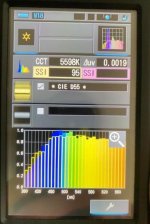
Below is my Dedolight 400hmi soft light head using a bulb that has minimal UV cut-off. It scores an SSI of 95 because of the extra UV content.
filedata/fetch?filedataid=131840
wAAACH5BAEKAAAALAAAAAABAAEAAAICRAEAOw==
IMG_6791.jpeg IMG_6792.jpeg

Below is a compilation of readings I took of my Dedolight DLH1200D focusing head. The bulb in that one has a full UV cut, and so does the front glass lens of the light. So notice the SSI score reduces to 87. But in practical terms the colour quality is no worse (just UV has been reduced).
IMG_6793.jpeg
filedata/fetch?filedataid=131841
wAAACH5BAEKAAAALAAAAAABAAEAAAICRAEAOw==


Does the ballast affect color rendering? I would have thought it was just the bulb.

The Dedolight DLH400D ballast has a boost mode that runs the 400w bulb at 575watts. In this mode the colour is a near perfect match to daylight ~5500k with a dUV of around +0.0035. I have used a Koto bulb, Osram bulb and Phillips bulb in this unit and colour scores and dUV reading have always been close to identical. Running the same 400w bulbs at 400w or below tends to introduce significantly more magenta I have found.

The selected frequency / Hz the bulb is being driven at also differs between manufacturers and some choose different frequencies for their high speed modes too. So things are bound to vary by manufacturer/ballast even when the same bulb is being used.

It's interesting to me that Prolycht has a reputation for good color but they have somewhat lower metrics than some other manufacturers. Except they have some of the best R13 numbers, if memory serves me. And maybe that's their design priority and also the priority of their customer base.

Have heard a lot of good things about the Prolycht colour science. Good news for Aputure (who just aquired Prolycht)
 

Attachments

  • image_131843.png
    image_131843.png
    48.9 KB · Views: 0
  • IMG_6787.jpeg
    IMG_6787.jpeg
    43.4 KB · Views: 0
Last edited:
^ Above post was updated for missing pictures. Was having troubles with uploads with my phone at the time of posting.
 
Back
Top