What's your LED fixture wishlist?

Thanks for all of the posts, everyone!

Sounds like the main thing is that both the cost and size become an issue if you try to get equivalent output to decent HMI sources. The new Nanlite Forza 500 (500watt) keeps a very small head with a separate ballast for around $2k. I'd be interested in seeing what the photometrics looks like for that fixture, but I guess the question is whether or not that can scale up to a Joker 800 equivalent or even a 1.2k without a huge increase in size. COB clusters seem to have limits before you just need to make them bigger, so I'm not sure it's physically possible to keep size down and get that level of output, and of course it starts to give up the small point source light characteristics.
 
Last edited:
Manufacturers should also adopt one standard for Bluetooth connectivity so all lamps could be controlled by a single app instead of having to jump around between many. Would also love to see DMX either replaced, or simplified. Gaffers Control goes some way to solve DMX issues, but seems a new protocol could further simplify it.

Couldn't agree more about the need to create a new protocol standard for bluetooth.
 
Thanks for all of the posts, everyone!

Sounds like the main thing is that both the cost and size become an issues if you try to get equivalent output to decent HMI source. The new Nanlite Forza 500 (500watt) keeps a very small head with a separate ballast for around $2k. I'd be interested in seeing what the photometrics looks like for that fixture, but I guess the question is whether or not that can scale up to a Joker 800 equivalent or even a 1.2k without a huge increase in size. COB clusters seem to have limits before you just need to make them bigger, so I'm not sure it's physically possible to keep size down and get that level of output, and of course it starts to give up the small point source light characteristics.

https://youtu.be/7fJHOIWTETk
 
LED's seem to work best for large source panel type lights and for times when you need quick changes in color or temperature. Otherwise, I have seen no indication that LED's can compete with traditional lamps on power output vs size, light control, cost, or on set noise. Even the apparent heat reduction appears to be more a result of having an onboard fan than being more efficient than an HMI light. Some day, LED's may be able to replace HMI or tungsten fresnels and PAR's, but they have a long way to go. I am not sure why people keep expecting LED's to ever be a good replacement for traditional fixtures.
 
LED's seem to work best for large source panel type lights and for times when you need quick changes in color or temperature. Otherwise, I have seen no indication that LED's can compete with traditional lamps on power output vs size, light control, cost, or on set noise. Even the apparent heat reduction appears to be more a result of having an onboard fan than being more efficient than an HMI light. Some day, LED's may be able to replace HMI or tungsten fresnels and PAR's, but they have a long way to go. I am not sure why people keep expecting LED's to ever be a good replacement for traditional fixtures.

As much as I’ve spent on LED’s over the last few years, I still consider myself a ‘tungsten guy’. A $1500 Astra still doesn’t give you skin tones as nice as a $200 Lowel.

The biggest advantages that LED’s have are:
1) Their ability to be bi/variable color so that you can change/mix/work with ambient/available light in an instant.
2) Ability to battery power decently powerful fixtures to move quickly and also use lights where you may not have before.
3) Heat generation vs. tungsten fixtures.

If you look at LED they are all short of deep red. I agree that skintone needs deep red.

I think LED do, however, have a (4) in that they seem reliable. For example HMI have colour slip over lifetime, can buzz etc - another thing to worry about on set. Also one can be more renegade with low wattage fixtures - less dicipline with uncoiling cables etc. Keeping high watts off set where possible seems a good idea

Yes and no. HMI lamps will shift over time, but as soon as you put a new lamp in, it's literally as good as new, because it's just an issue with the lamp aging, not the fixture. And actually tungsten lamps shift over time, as well, but it's not gonna be as noticeable. I have had LED's go on me* and it's not as subtle as an aging HMI lamp. It usually starts out "that looks a little off" then a week later it's "I can't use this at all" and you have to send the unit off for repair or just toss it in the trash. I've had several Litepanels go purple on me, including Sola ENG's and Astra's.


*I guess in reality, it's just a malfunctioning unit, as opposed to a true "aging issue", but it's never happened out-of-the-box, it's always been down the road.
 
As much as I’ve spent on LED’s over the last few years, I still consider myself a ‘tungsten guy’. A $1500 Astra still doesn’t give you skin tones as nice as a $200 Lowel.

The biggest advantages that LED’s have are:
1) Their ability to be bi/variable color so that you can change/mix/work with ambient/available light in an instant.
2) Ability to battery power decently powerful fixtures to move quickly and also use lights where you may not have before.
3) Heat generation vs. tungsten fixtures.

Agreed. And that #3 is perhaps an important one that may get overlooked compared to #1 & 2. Not only a lot less heat if considering "energy costs" - which don't apply much for those of us who hardly do any studio work any longer - but when considering the inverse square law.
I can put my LED's much closer to talent or whatever I'm aiming the camera at... and because of a lot less heat - at least at light source - my "source" is "bigger" because it's closer.
 
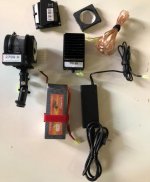
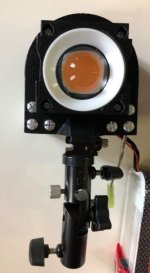
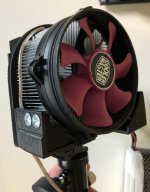
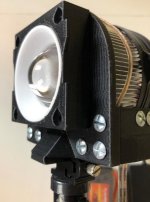
These are my DIY fresnel LED lights. They draw 96W, and have a similar output to my 650W tungsten fresnel (that I haven't used since I made these).

That's a standard CPU cooler (the fan is set at 5V instead of its usual 12V, so it's very silent), a standard flash bracket holder, and PAR20 barn doors, so you see, they are TINY. The head itself is around 11x11x11cm in total and weights less than 500g (for people using medieval metrics, that's around 4.5 inches and one pound).

I call them fresnel because I use them like a fresnel, but they use optical quality lenses instead, for improved output. Without the add-on lens the beam is around 90º (completely fills an umbrella without spilling on the sides). With one lens they go to 60º, with two they go to 40º or so. If I have to narrow any further, I use the barn doors. Additional thing that's different from usual fresnels: my lights don't have a hot spot in the center and then a gradual falloff to darkness, the illuminated area is uniformly lit, and then it goes to dark suddenly. This is good for some use cases, bad for others.

This weekend I had a shoot in a park at night, I went there on the metro with the seven girls that appear in the video. I was carrying two lights with stands and umbrellas and batteries that last >1h at full power, plus the gimbal, camera, lenses, and all accessories. That's a backpack and two bags, I can easily walk with that. Three lights starts to be unconfortable for just one person, four is only for getting to the car.

I don't remember exactly the numbers I ran, but IIRC I would make a decent profit if I sold them at $350 each. But first I'd have to certify the electronics, which is a pain that I'm not ready to go through. And I would have to find a better switch, because I've been using them for over a year and that's the only piece that ever broke, but it does it way too often.

1 - copia.jpg
1 - copia (2).jpg
1 - copia (3).jpg
1 - copia (4).jpg
IMG_9999.jpg
 
Last edited:
Back
Top