What's next for digital video cameras?

I'm trying to get it and will post the link when I do.
However I find it funny that you would not believe somebody did that while actual image degradation (coatings removed, nets on lenses, soft vintage optics ) are routinely used on sets for creative reasons. Why is breathing a tabu all of the sudden?
BTW I don't think breathing qualifies as image degradation....

Not tabu, just bizarre thing to attempt to introduce into a scene. I'd say it's because breathing isn't an aesthetic, in my opinion, as it's really just a fourth wall breaker. To me breathing is not really part of the image, but in the same category as a bad or frantic focus buzz, a camera operator bumping a doorway, or seeing some set gear in the shot. To me, breathing, when bad, can call attention to the filmmaking process (especially in a large theater where breathing can be much easier seen). I'm not talking about softening the image with nets, diffusion, or free lensing for flares and light leaks. All of that stuff is great and fine. Breathing, again in my opinion, isn't going to dictate a style to the audience but instead will likely make them notice the slight zoom effect and wonder what that was all about. It's distracting, not artistic.

Again, IMO.


We also retrieve lens data and can display the distance, f-stop and even the dof to help with pulling focus off the marks.
i/technology is found in RedZooms, FujinonZooms, Cooke Primes, Sony Primes, Anginiuex Zooms, LDS found on Zeiss lenses, etc. Metadata for cinelenses is here, and to stay.

I can see the advantages and slight speed advantage on internal motors, but I've had motors fail on me before, and having them external and replaceable on the spot makes the slightly more bulk worth it, in my opinion... especially when it's a big budget film. Being able to deal with any motor issues on the spot seems a better advantage than having more wires and motors externally. External motors can be removed, added or replaced at will. Call it paranoia, but I've not been completely sold on internal motors, yet. But I'm open to it. Maybe we just carry around two sets of lenses? haha.

Using these marvelous encoders we can expand or shrink the amount of rotation at will. Very easily- with one button in 5 seconds.
Even the spacing of the markings can be freely manipulated with merely writing some code.
all the hard expensive work- hardware R&D is already done!!!
And last but not least- you are completely free to put it anywhere- on camera, beside the lens, in the back, off camera holding it in your hand
Try that with cine lenses
I suppose you can get a $20,000 FIZ, hook up the motors, mdr, spaghetti of cables, extra power.

I do agree that FIZ units, for thier technology, is priced very high, in my opinion. I generally defend some of the pricey cine-products for their valid reasons, but FIZ units are pricey, and I'm on the fence about them. So we are in agreement about that. The technology is here... a FIZ should likely not be 20k. But I must properly admit, I don't know what it takes to design these, or what is inside. It's purely speculation.

EDIT: I know you make some gadgets... ever consider making a FIZ that can be less expensive. I imagine their price is somewhat justified outside of my knowledge, since in a capitalist society, someone surely would have done this by now, if possible. Yes?

I worked for a major cine lens reseller in the QC .
We sent half of the lenses back for correction.
and I don't even think this is done any more.
I also evaluated brand new cine lenses that my customers purchased.
Many times I went to the manufacturer and sifted through a few before picking one. The QA is not only limited to commercial still lenses.
In fact I suspect that because of much more liability the still lenses undergo much more strict procedures.
And you don't want to know what hoops I had to jump through to motivate the cine manus to let me cherry pick...
Trust me- it's much easier at Samys...

Not at liberty to say? Which cine-lenses. That term used to be one that 90% of the time was of quality. Now we have all levels of good and bad quality cine-lenses falling off of trees. If I were to guess, it sounds like you were selling some soviet glass. The only QC nightmare I've ever come across in my cine-lens experience (can't speak for CP.2's or newer lower cost cine-lenses. I'm not aware of their process. I'm more or less talking about Cookes, UltraPrimes, Masters, etc. )... but I'm on the consumer end looking up.


And yes we are talking about the advantages of electronic lenses for cine productions.
Indie, EFP (+ events), docu, nature has adopted still optics already- before we could even do it right with the smart mounts.....

For sure. They are called cine-lenses for a reason... CINEMA lenses. They are made and designed for the unique needs of cinema. I would not use cinema primes or most zooms for run-and-gun documentary, or for event videography, etc. However, I do argue that there is now a gap in the market for good style ENG 2/3" like zooms. Those were the great video lenses that could be used on documentaries, events and etc. We seem to lack that option today. Seems to be cinema zoom or photography zoom. I'd love something between.
 
Last edited:
I know I'm the minority here, but I strongly prefer pulling focus off of a monitor. I have years of experience pulling my own focus, and through that time I've developed the ability to anticipate movement and keep things pretty solid that way. With practice, it's even possible to correct in the middle of a pull that's going south. It does take knowledge of the particular lens being used and laserlike focus on the monitor, but the instant feedback is fantastic. And when I pull my own focus (whenever possible) I feel that it's very freeing as an operator, because it's putting total control in your hands. Focus is an important element of where the eye is led in a frame, and the timing an exact placement of racks while moving the camera can significantly influence the feel of a move. Again, I know that it's not standard practice, but I feel most at home working this way, and I feel it helps the coherency and end result of the work I deliver as an operator or DP.

With still lenses, I consider pulling off of a monitor to be crucial, just because the throws on each lens are much less consistent (and much shorter) than cine glass, and because of the slight play that's present in most (Canon in particular) still lenses.
 
Not at liberty to say? Which cine-lenses. That term used to be one that 90% of the time was of quality. Now we have all levels of good and bad quality cine-lenses falling off of trees. If I were to guess, it sounds like you were selling some soviet glass. The only QC nightmare I've ever come across in my cine-lens experience (can't speak for CP.2's or newer lower cost cine-lenses. I'm not aware of their process. I'm more or less talking about Cookes, UltraPrimes, Masters, etc. )... but I'm on the consumer end looking up.

I never worked for a Soviet lens reseller and never evaluated Soviet lenses for purchase. I do reworks Soviet lenses after purchase and they all need work, no exceptions. The workmanship levels in the Soviet era were just not up to our standards...
The reseller I worked for and the customers are all dealing with US cine standard equipment. Sorry I can't say more so I don't jeopardize my relationships with the factories- It has helped me a lot to be on their white list....
 
I know I'm the minority here, but I strongly prefer pulling focus off of a monitor. I have years of experience pulling my own focus, and through that time I've developed the ability to anticipate movement and keep things pretty solid that way. With practice, it's even possible to correct in the middle of a pull that's going south. It does take knowledge of the particular lens being used and laserlike focus on the monitor, but the instant feedback is fantastic. And when I pull my own focus (whenever possible) I feel that it's very freeing as an operator, because it's putting total control in your hands. Focus is an important element of where the eye is led in a frame, and the timing an exact placement of racks while moving the camera can significantly influence the feel of a move. Again, I know that it's not standard practice, but I feel most at home working this way, and I feel it helps the coherency and end result of the work I deliver as an operator or DP.

With still lenses, I consider pulling off of a monitor to be crucial, just because the throws on each lens are much less consistent (and much shorter) than cine glass, and because of the slight play that's present in most (Canon in particular) still lenses.

Hey, I'm sure you are not the minority here at DVXuser and possibly not in the industry in the future. I feel this method will, for better or for worse, be the first method people start using for the convenience and it will likely become the one they primarily hold onto. Just look at the DSLR generation. They came up using lenses with NO focus marks (photography lenses) so they will likely use what they know.

What does that mean? Who knows. I guess we'll see. This new generation of people who fall to monitors over judging distance will surely come to prove itself. For me, I like doing both. Usually gauging distance and checking myself with a monitor. It's good feedback.

Perhaps those people, after years of experience will naturally start to guage distances in their heads and without realizing it start using that ability as some of us do today, perhaps doing what I do (a combination of both), but from the other direction. I'm sure if you are a career first, you'll pick up some pretty good distance judging skills that will aid you in your work, even if you primarily use a monitor.

And with still lenses, you are again absolutely correct. It is more than crucial. It has to be! You can't have a 60* rotation with 3', 5', 10', and INF.... And be expected to pull focus! Crazyness! It's why I don't use them.
 
Last edited:
I know I'm the minority here, but I strongly prefer pulling focus off of a monitor. I have years of experience pulling my own focus, and through that time I've developed the ability to anticipate movement and keep things pretty solid that way. With practice, it's even possible to correct in the middle of a pull that's going south. It does take knowledge of the particular lens being used and laserlike focus on the monitor, but the instant feedback is fantastic. And when I pull my own focus (whenever possible) I feel that it's very freeing as an operator, because it's putting total control in your hands. Focus is an important element of where the eye is led in a frame, and the timing an exact placement of racks while moving the camera can significantly influence the feel of a move. Again, I know that it's not standard practice, but I feel most at home working this way, and I feel it helps the coherency and end result of the work I deliver as an operator or DP.

With still lenses, I consider pulling off of a monitor to be crucial, just because the throws on each lens are much less consistent (and much shorter) than cine glass, and because of the slight play that's present in most (Canon in particular) still lenses.
Thank you Stefan, I welcome the reinforcement ;)
Now you don't have to deal with the short focus throw anymore- we took care of it electronically...
300 degrees and up- your choice...:)
 
Perhaps those people, after years of experience will naturally start to guage distances in their heads and without realizing it start using that ability as some of us do today, perhaps doing what I do (a combination of both), but from the other direction. I'm sure if you are a career first, you'll pick up some pretty good distance judging skills that will aid you in your work, even if you primarily use a monitor.

Once again, this is spot on. If you're merely reacting to what you see then you're doomed to fail from the beginning. It's all about anticipating movement and leading the actor with the focus knob, essentially the same skills that you would be using pulling via traditional methods. The main difference is just in what is being stared at. You still are judging distances on the fly and pulling more by feel and muscle memory than anything else, just with the added benefit of instant feedback. My propensity for pulling off of the monitor comes from pulling my own focus while operating to be sure, though I still will pull off of a monitor if I'm on as a 1st. Thank god I'm NOT a career 1st though! I can't think of a more stressful, demanding, thankless job on set! The guys that do that day in and day out with millions of dollars on the line are absolute heroes.

Thank you Stefan, I welcome the reinforcement ;)
Now you don't have to deal with the short focus throw anymore- we took care of it electronically...
300 degrees and up- your choice...:)

I did make a post a couple of pages back echoing most of what Ryan was saying :-O

Most of the shoots I'm doing are pretty low budget (out of the last 6 features, only 3 had the budget for Ultra Primes while the rest were shot with still glass). My main hang-ups from a pragmatic standpoint are as follows:

1 Short throws (which it sounds like you've fixed. I'm dying to hear more about your product)
2 Irregular lengths. Behind-the-lens filtration is great, but not always feasible. It seems like a small quibble, but changing out 2 screw-on NDs and a CPL with each lens change gets old really quick. Matte Boxes save a ton of time on set, and are really convenient. I just don't think that screw-on filters are a viable replacement on a set with a crew.
3 Inconsistent apertures and color. f/2.8 does not look the same across all lenses from the same manufacturer, nor does the color always match precisely. It's something that can be fixed in post without much trouble, but across a feature it can add up.
4 Build Quality.

The thing that would sell me on still lenses as a cinema production tool is an electronic control system that ties into the AF motors of the lenses (but has more resolution than the USB systems I've seen which move in visible steps). That would eliminate the throw issue, as well as make the matte-box situation much more manageable by taking a follow focus out of the equation. I'm willing to live with matching exposure and color in post if I could have a lightweight, small FIZ system that uses the internal lens motors with as much resolution as a Preston. If that day is here, then please clue me in! Such a system would revolutionize the way I work with the kinds of budgets I have access to.

As an aside, I'm a huge evangelist for the advantages of IS, even in cinema. Obviously it's not a fix-all or a replacement for controlled movement and proper equipment, but there are many situations where it's a huge asset. Lighter rigs definitely benefit from IS, even on sticks. Smaller, more easily nudged sticks also would benefit from IS lenses. Small imperfections or rough spots on tracks are easily evened out with decent IS. IS enables shooting with longer lenses on the shoulder. Anything mounted to a car or vehicle can benefit greatly from IS, as can anything shot from within a moving vehicle. IS is a very under-appreciated cinema tool, and while it of course doesn't excuse sloppy technique or taking shortcuts, it can be a major boon in many situations. Many of us are far too quick to dismiss anything that falls outside of normal industry S&P. Of course we need to be mindful of the techniques that have been perfected over the last century, but we're living in a time where the industry is changing rapidly and we have the opportunity to discover new techniques to supplement established ones.
 
I did a little research and found some info on the optitron. Is it only available for Epic/Scarlet?
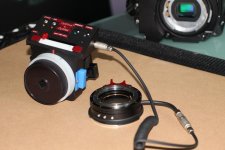
Here you go Stefan,
most of your concerns with the still lenses for motion use addressed.
The shape of the OptiTron and the functionality is our nod to the focus pullers legacy.
The next gen will depart with smaller form factor, more "digital" controls (whatever that means :))
fully wireless and independent.
and yes we'll offer external motor control as an upgrade. for the old school PL crowd.
This is a stand alone system at this point so we also offer the Sony FZ version. For the F3 as well as the F5/55 cameras.
https://www.youtube.com/watch?v=TJrgfYLhVpk
To be clear this is what I believe will be the future of the lens system -so it pertrains to this thread
 

Attachments

  • IMG_1878.jpg
    IMG_1878.jpg
    65.7 KB · Views: 0
BETTER, FASTER WORKFLOWS!

The other thing I REALLY want to see, is people making proper use of the fact that we now have FILE-based recording (and have had for some years now) - why is it still so hard to quickly customise the names of the files you're recording to state "Scene", "Shot", "Take" etc. and organise them into specific folders on-camera - So that when the files are brought into editing, the pain-in-the-arse that is ordering and organising files (both sound and video) is already taken out of the equation?

When we can speedily and simply label all of our dual-system audio files and all of our video files with the specific scene/shot/take numbers - matching them up in post becomes a breeze, the entire post-process becomes streamlined and hugely more efficient.

This can mostly happen today, and I use it on productions. All scene/take/comments and metadata are entered on the BWF file. That metadata comes in via the import. I sync to the video via timecode, and the resulting .sync clip now has the all the metadata to be used for editing.

Michael
 
The Optitron looks pretty boss, but as a freelance guy who doesn't shoot with his own cameras most of the time it doesn't really make sense for me. For really low-budget stuff I shoot on a mix of DSLRs, and for bigger-budget jobs we're renting. If this thing was compatible with a broader range of cameras I might be tempted, but as it is I wouldn't be able to use it half the time. If I owned an F5 or a Scarlet then it would be a no-brainer, but it's not really a good fit for my position right now. I'll definitely keep an eye out if I end up jumping in to a bigger camera as an owner/operator.
 
Back
Top