What's next for digital video cameras?

Let's get right to it Patrick,
Can you list the workarounds for still lenses? I think I've solved most of them, and added features that give still lenses definite edge over their cine counterparts. Features that cine lenses don't and won't include- at least in the foreseeable future.
Try to stay in the technical realm- I'm well aware of the artistic choice factor and how important it is. That's a completely separate topic.
As are the legacy, job security issues ( technically the last one is solved as well):beer:
 
Can you list the workarounds for still lenses? I think I've solved most of them, and added features that give still lenses definite edge over their cine counterparts. Features that cine lenses don't and won't include- at least in the foreseeable future

I'm curious...specifically, what "definite edge" are you referring to?
 
Let's get right to it Patrick,
Can you list the workarounds for still lenses? I think I've solved most of them, and added features that give still lenses definite edge over their cine counterparts. Features that cine lenses don't and won't include- at least in the foreseeable future.
Try to stay in the technical realm- I'm well aware of the artistic choice factor and how important it is. That's a completely separate topic.
As are the legacy, job security issues ( technically the last one is solved as well)
beer.gif


Yes, you are making a product that, in one way, can make a photography lens behave more like a cinema lens in the way of longer focus rotation via electronic control. So it's clear how you think or envision the future and why you are pursuing this topic. That said, I also think the owner/operator professional who is stuck in my aforementioned netherworld, (between cinelenses and photography lenses), might appreciate your invention should it prove to be what everyone is hoping it is. I wish you the best on that.

However, that invention of yours, as I understand it, will never be replacing the cinema lenses I and my colleagues are using currently. It wouldn't make sense. And I likely speak for the vast majority.

You know full well the list of things that are different, but I can go into them, if you'd like.

Read this first, I know you know this, but others looking at this thread can read: http://www.dvxuser.com/V6/showthread.php?273326-Article-Why-We-Need-Cinema-Lenses

1) Breathing. You've stated before you think breathing is a 'fad'. But it really isn't. Sounds like a personal compromise, but if you talk to many DP's, or go watch a lens that breaths focus rack on a 30' screen, it gets quite apparent. I don't think Arri and Zeiss spent tons of money to design the dual floating elements design in MP's simply to eradicate something nobody cares about.

2) Focus marks and accuracy. Still, just because you electronically elongate the focus throw of a photography lens, I fail to see how that is better than the well laid out focus marks of a cinema lens. MP's, Cookes, and Leica Summilux have plenty of marks (so many more than other cinema lenses) (Cp.2's are actually quite nice too), and the aforementioned three also use Cam system of focusing with allows the manufacturer to create a non-linear focus spacing, so more marks can be included on the long end, where focus marks quickly ramp together into infinity. Also these lenses don't need to be powered to be used. All manual, all mechanics typically means more reliable if properly maintained. In fact, the Leica Summilux C's take advantage of the cam system in a different way. Instead of optimizing every focal length's scale, they used a cam system (versus threaded system) to actually match all the scales so that the focus throw and witness marks are the same on every lens. That means 6', 10', 30' and infinity (and all other marks over 6') are at the same point of the focus rotation on ever lens... meaning you'd only need one scale for wireless application and etc. Pretty neat. If under 6', I believe the marks are not uniform across all lenses.

3) Similar length, front diameter, focus/iris ring location... saves time changing lenses. I just worked on three panavision shoots in a row, all using the vintage supers and ultras, and I got damn tired having four different doughnuts because of the different front diameters, and adjusting the matte-box every time since the 50mm was crazy different from the 40, as was the 75 as was the 21, etc.... The focus rings were almost all exactly the right spot, minus an odd lens here and there, so that wasn't a big deal. Now imagine photography lenses. All so very different in size. Plus, many being designed for photography applications, are tiny, and although that can be a plus sometimes (for weight), it's really not when you have to get a follow focus, matte-box and other things around the lens. Soon you can't see or even reach the lens, not less the s*%tty lack of focus marks. There is a very certain sweet spot in lens size for practical application. The consensus among my peers is something in the Leica Summilux C, Mini-S4, Ultra Prime range. The bigger S4's. 5/i's and MP's are big but we put up with it because of their positive attributes.

Here are Canon EF primes:
View attachment 65949
Screen shot 2013-01-27 at 12.09.35 PM.jpg

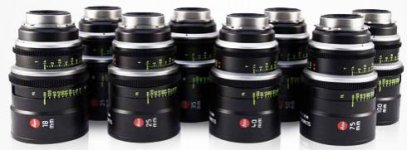
Leica Summilux C's
View attachment 65950
Screen shot 2013-01-27 at 12.11.34 PM.jpg

4) Performance wide open:
All lenses make compromises to try and attain multiple goals for their intended purposes (cine/photography/etc). Sure one could make a lens that is amazing at just one attribute, but typically lens designing is a game of compromises since many things are related or linked in optics. That said, photography lenses make compromises typically to reach their goals, and so does cinema lenses. I've found the usability of high end fast cinema lenses is greater than that of photography lenses. A Master Prime at T/1.4 is better than an L-series at F/1.4. If you aren't shooting a big feature which demands the top performance, the difference won't be a game changer for that music video going to vimeo. It won't. But that is the point of cinema lenses... to be used for cinema. Big screen application or when production demands the best. Also, I find many photography lenses, especially wides have noticeable increased distortion than the expensive cine's and also, the compromises photography lenses take often leave undesirable uneven field illumination when wide open. This is exceptionally true at FF, which is a reason why everyone who claims that FF lenses as a safe investment now might want to look closer. I'm not saying they are wrong, but if the future FF cinematography holds lenses to the standards we do now at s35mm, I think we will find 3.5 stops of vignetting in the corners of a lens wide open will be something quite undesirable. Again, not saying they are not the right way to go, just saying that covering FF does not mean they perform at desired levels at that area.

5) Image shift.
Noticed it in almost all photography lenses that had moderate to high usage. Even photography lenses that did not have it, needed Red's extra twist lock in order to get the mount stable enough to not show the shift. This, again, is important on big screens, not so much on internet or small screens. A small image shift in a lens will be 3' on a huge projection.

6) Color matching:
Yeah. It's important unless you don't care or love paying a colorist to color every shot and not just by scene. Again, more important to have full control down to details when shooting big pictures.

7) Telescoping... some photography lenses do this when focusing or zooming. Not cool for matteboxes or focus gears.

8) Durability:
We've gotten into this in the past. Cine lenses are often more robust than photography in general. Argue amongst yourselves, I understand photography lenses go through their paces, but cine lenses do get a beating.


Tons of things. In fact, some cinema lenses are better than others in some regards, and it depends on the look you want and how you are shooting. Vintage handheld? Supers would be good although they bind when clamped on, so you'd have to run LW rods. Shooting for big screen and running on dolly, techno cranes and other things? Go MP's! Running 3d rigs and want to save on weight? Go UP's!

Shoot with what you have


My point is, cinema lenses are not going anywhere, but there is a new and emerging middle market which demands more than photogrpahy lenses but not enough to really justify top shelf cine. This is where the hybrids, mods, and affordable cine lenses come into play. I think it's a good thing, but I will defend the idea that real cine lenses are anything but absolutely appropriate on bigger cine endevours.

These websites are sometimes more visited by producers and they read these posts to educate themselves, and I'll always post my opinion because I loathe the day we dont get UP's and instead settle for L-series because someone wants to save a $1 and they read online that cine lenses are overhyped and photography lenses are just fine. They aren't. Not for what I do. They are for many things, but not cinema. Not when it counts.
 
Last edited:
These websites are sometimes more visited by producers and they read these posts to educate themselves, and I'll always post my opinion because I loathe the day we dont get UP's and instead settle for L-series because someone wants to save a $1 and they read online that cine lenses are overhyped and photography lenses are just fine. They aren't. Not for what I do. They are for many things, but not cinema. Not when it counts.

Wow, talk about hitting the nail on the head. I'm still doing a lot of work with still lenses in between better-equipped shoots, and while I have zero problems when shooting with a DSLR on a small rig, they start to get in the way as soon as a follow focus/matte box/larger rig is required. My ACs HATE them, and we've all been spoiled by working with decent cine glass. The differences might seem rather small on paper, but if you're going to be working with a lens set for 12 hours a day, 6 days a week, for weeks on end, they add up to a better end product and a significantly streamlined experience on set for the camera department (and in turn the production).

Imagine that a still lens takes an additional 2 minutes to swap when you factor in adjusting the matte box, follow focus, handles, etc. Over the course of a five-week shoot we're talking about an additional 20+ hours of wasted time on set. What about the number of focus pulls that will be missed an need repeating due to the smaller focus throws? What about far larger differences in the throw from lens-to-lens? What about the time in post it'll take to fix vignetting? What about the added complexity of color matching in the grading suite? If you're using a light meter then all of your measurements are off by as much as a half-stop depending on the lens.

We haven't even talked about non-rigidity and micro-shake from the less robust lens mounts, inconsistency with flaring, telescoping, hard stops (have fun working with a remote focus system or physical marks) etc. The point is that for all the complaining that cine-glass is an overpriced indulgence, using a proper cine-lens set will save money on a long shoot. Maybe not for really inexpensive projects, but if you're shoot costs upwards of $10-15k a day then you should be shooting cine-glass for economic and time reasons unless you have a damn good reason not to.

You can get away with using an inappropriate tool for a job. You can build a perfectly nice cabinet with just a jigsaw, belt sander, and screwdriver. But just because it's possible doesn't mean that people who build cabinets all day everyday should be doing it with the wrong set of tools. If you're shooting an indie feature as a hobby with inexperienced crew, then you probably don't need cine lenses. If you're using your 7D, then you don't need cine lenses. If you're shooting with a big camera with experienced crew (whom you are actually paying a living wage) and you are paying for post, then you really need cine glass.
 
Yes, this.

I don't think we have too far to go. Once you can step outside at noon on a sunny day and hold significant useable detail in both shadows and highlights without clipping on either side, what's left? What situations would require more range? How would you ever even light a scene with ratios like that? At the end of the day a very big part of our job is still lighting design, and we've already hit a point where increased dynamic range is just shifting some of the control portion of design over to the post house where those ratios will be compressed for final delivery anyway. I welcome the increased DR, and if nothing else it's a bigger safety net that is built up under us every day, but once our DSLRs have 14 stops of DR in video mode, what else is there to chase? Is there a fantasy marketing-world in the future where a theoretical 22-stop camera has an advantage in the marketplace over a similar 20-stop camera? Unless consumer broadcast, projection, and display technology starts moving along the same path aren't we really just increasing the scope of the colorists job?
 
Yes, you are making a product that, in one way, can make a photography lens behave more like a cinema lens in the way of longer focus rotation via electronic control. So it's clear how you think or envision the future and why you are pursuing this topic. That said, I also think the owner/operator professional who is stuck in my aforementioned netherworld, (between cinelenses and photography lenses), might appreciate your invention should it prove to be what everyone is hoping it is. I wish you the best on that.

However, that invention of yours, as I understand it, will never be replacing the cinema lenses I and my colleagues are using currently. It wouldn't make sense. And I likely speak for the vast majority.

You know full well the list of things that are different, but I can go into them, if you'd like.

Read this first, I know you know this, but others looking at this thread can read: http://www.dvxuser.com/V6/showthread.php?273326-Article-Why-We-Need-Cinema-Lenses

1) Breathing. You've stated before you think breathing is a 'fad'. But it really isn't. Sounds like a personal compromise, but if you talk to many DP's, or go watch a lens that breaths focus rack on a 30' screen, it gets quite apparent. I don't think Arri and Zeiss spent tons of money to design the dual floating elements design in MP's simply to eradicate something nobody cares about.
OK not a fad, fine :)
how many productions are shot with master primes or leicas ?(and they also do breathe just much less) how about production shot with super speeds, ultra primes, S4s, CPs, lomos, illuminas, etc, etc. All the latter ones breathe. A lot . Some more than photo lenses. Yet none of the shooters seem to care much. They deal with breathing like they had for 100 years- intergrate it into the story and vision. In fact some DPs (dare I say)ADD breathing to Optimos, MPs and such because it's more natural. Funny that when I talk to seasoned DPs about it they don't seem to care, only the aspiring ones that are dying to shoot MPs are raving about it. I think it has something to to with their desire to join the elite group that can demand MPs from the producers and get them. Somehow they think that MPs on their camera gets them industry credibility. Maybe it does... I have tons or anecdotes about that, but I digress...

2) Focus marks and accuracy. Still, just because you electronically elongate the focus throw of a photography lens, I fail to see how that is better than the well laid out focus marks of a cinema lens. MP's, Cookes, and Leica Summilux have plenty of marks (so many more than other cinema lenses) (Cp.2's are actually quite nice too), and the aforementioned three also use Cam system of focusing with allows the manufacturer to create a non-linear focus spacing, so more marks can be included on the long end, where focus marks quickly ramp together into infinity. Also these lenses don't need to be powered to be used. All manual, all mechanics typically means more reliable if properly maintained. In fact, the Leica Summilux C's take advantage of the cam system in a different way. Instead of optimizing every focal length's scale, they used a cam system (versus threaded system) to actually match all the scales so that the focus throw and witness marks are the same on every lens. That means 6', 10', 30' and infinity (and all other marks over 6') are at the same point of the focus rotation on ever lens... meaning you'd only need one scale for wireless application and etc. Pretty neat. If under 6', I believe the marks are not uniform across all lenses.
Now this is a bone I pick. Legacy that's completely outdated yet very deeply entrenched in our industry. And there is a good reason for it:
For nearly 70 years the only way to see the frame through the lens was an optical view finder. Definitely not within the focus pullers reach. Therefore the focus pullers developed the "sixth sense" for judging distance , peripheral vision techniques, etc., etc.. Even when the video assist arrived in the 70's, the image was so bad that it still made sense to keep pulling focus the old ways.
Enter modern technology: full HD monitoring, on screen focus assist tools: peaking, edge highlight, 1:1 zoom plus some others I'm probably not aware off...
How is looking at some marks and watching the talent hitting marks with peripheral vision more accurate than all these tools?!!
Would anyone rather look at a real time, full res image on screen with all focus assist tools or try to guess the distance and sync it with the moving target?
I personally know a lot of experienced focus pullers that stare at a screen with remote focus in their hands and love it!! They were good before with the lens marks but now they are PERFECT. no buzzed takes anymore. They couldn't care less about the lens marks. They don't see them anymore. And they are not going back to that nightmare. As far as I'm concerned lenses could be boxes with a socket in them for the drive by wire cable. or wireless. and they will be. soon enough.
and if you want marking repeatability on the marking disc the lens encoders are 100% accurate and repeatable, FYI


3) Similar length, front diameter, focus/iris ring location... saves time changing lenses. I just worked on three panavision shoots in a row, all using the vintage supers and ultras, and I got damn tired having four different doughnuts because of the different front diameters, and adjusting the matte-box every time since the 50mm was crazy different from the 40, as was the 75 as was the 21, etc.... The focus rings were almost all exactly the right spot, minus an odd lens here and there, so that wasn't a big deal. Now imagine photography lenses. All so very different in size. Plus, many being designed for photography applications, are tiny, and although that can be a plus sometimes (for weight), it's really not when you have to get a follow focus, matte-box and other things around the lens. Soon you can't see or even reach the lens, not less the s*%tty lack of focus marks. There is a very certain sweet spot in lens size for practical application. The consensus among my peers is something in the Leica Summilux C, Mini-S4, Ultra Prime range. The bigger S4's. 5/i's and MP's are big but we put up with it because of their positive attributes.
Matte boxes will go the way of focus marks: The only three filtration types that have to be done optically are
1, 2. ND/IR in camera between the lens and the sensor- check
3. Polarizing- has to rotate. Mattebox=PITA. It may also go behind lens- much better- especially with retrofocal lenses.
Or screw on the front- check.
everything else will be done in post. Tiffen filter LUT- check, Technicolor filter LUTs- check- and this is only the beginning...
Lenses too tiny for a follow focus?? What follow focus? these are drive by wire- no follow focus, gears, motors, MDR boxes, extra power, etc..


4) Performance wide open:
All lenses make compromises to try and attain multiple goals for their intended purposes (cine/photography/etc). Sure one could make a lens that is amazing at just one attribute, but typically lens designing is a game of compromises since many things are related or linked in optics. That said, photography lenses make compromises typically to reach their goals, and so does cinema lenses. I've found the usability of high end fast cinema lenses is greater than that of photography lenses. A Master Prime at T/1.4 is better than an L-series at F/1.4. If you aren't shooting a big feature which demands the top performance, the difference won't be a game changer for that music video going to vimeo. It won't. But that is the point of cinema lenses... to be used for cinema. Big screen application or when production demands the best. Also, I find many photography lenses, especially wides have noticeable increased distortion than the expensive cine's and also, the compromises photography lenses take often leave undesirable uneven field illumination when wide open. This is exceptionally true at FF, which is a reason why everyone who claims that FF lenses as a safe investment now might want to look closer. I'm not saying they are wrong, but if the future FF cinematography holds lenses to the standards we do now at s35mm, I think we will find 3.5 stops of vignetting in the corners of a lens wide open will be something quite undesirable. Again, not saying they are not the right way to go, just saying that covering FF does not mean they perform at desired levels at that area.
I'm very well aware of the lens design process- I've been involved with(mostly cine) lens design for 25 years. And I can confidently say that , if you want to pick, 24mm f1.4 Nikkor wide open can take ANY lens in a stride- MP included. at 1/10 the price and 1/5 the weight. such is the power of economies of scale...
And have you ever considered the resolution numbers? No cine camera currently gets even remotely close to the resolution threshold of a modern lens. The sensor is the bottle neck and I absolutely guarantee that in a blind test nobody can tell cine from still image. How much full frame lenses vignette in the S35mm corners? not much, just like the cine lenses...


5) Image shift.
Noticed it in almost all photography lenses that had moderate to high usage. Even photography lenses that did not have it, needed Red's extra twist lock in order to get the mount stable enough to not show the shift. This, again, is important on big screens, not so much on internet or small screens. A small image shift in a lens will be 3' on a huge projection.
I agree with you completely. Positive locking is needed.
That's why my ProLock for the R1 was so successful back in 2009. I knew that before Red...
And our Canon ProLock -i continues with positive locking for Canon EF (unmodified) lenses.
6) Color matching:
Yeah. It's important unless you don't care or love paying a colorist to color every shot and not just by scene. Again, more important to have full control down to details when shooting big pictures.
All brands have their trademark color- at least in the newer lenses... that's not something unique to cine lenses

7) Telescoping... some photography lenses do this when focusing or zooming. Not cool for matteboxes or focus gears.
As you said: not all do . there are a lot of still lenses, the selection is vast, pick what you need...

8) Durability:
We've gotten into this in the past. Cine lenses are often more robust than photography in general. Argue amongst yourselves, I understand photography lenses go through their paces, but cine lenses do get a beating.
Yes cine lenses do but so do still lenses. If still lenses were unreliable the liability for the manus would be tremendous. Imagine the cost of warranty repairs on 10,000 lenses(quantities sold in the still lens market)- that would run any company out of business. Also cine lenses are usually very well maintained because of their value... Still lenses- not so much...


Tons of things. In fact, some cinema lenses are better than others in some regards, and it depends on the look you want and how you are shooting. Vintage handheld? Supers would be good although they bind when clamped on, so you'd have to run LW rods. Shooting for big screen and running on dolly, techno cranes and other things? Go MP's! Running 3d rigs and want to save on weight? Go UP's!
I don't see how that does not apply to still lenses :) in a lot simpler setup for a lot less...


My point is, cinema lenses are not going anywhere, but there is a new and emerging middle market which demands more than photogrpahy lenses but not enough to really justify top shelf cine. This is where the hybrids, mods, and affordable cine lenses come into play. I think it's a good thing, but I will defend the idea that real cine lenses are anything but absolutely appropriate on bigger cine en devours.
Hybrid, by definition implies a transitional product from older technology to new. Much like with hybrid cars. For car technology it's a necessary (tremendous) extra expense to apply two technologies since the new(electric) is not practical just yet.
For lenses it's absolutely not needed- why keep old expensive tech if the new one has had enough time to be developed for years by the still industry?
Why bother....

These websites are sometimes more visited by producers and they read these posts to educate themselves, and I'll always post my opinion because I loathe the day we don't get UP's and instead settle for L-series because someone wants to save a $1 and they read online that cine lenses are overhyped and photography lenses are just fine. They aren't. Not for what I do. They are for many things, but not cinema. Not when it counts.
Maybe they don't just want to save money- not a bad proposition regardless...
Maybe they need image stabilization, maybe their setup can not take the weight of a big fast cine lens, motors, mdr, extra battery on the remote head, maybe they need the lens optical profile (exif anyone) for the VFX work? cine lenses won't get them all that- still lenses will...
 
Last edited:
"1) Breathing..."


I've seen Panavision anamorphics breathe, and I really couldn't care less. They simply look amazing, and breathing is so not a part of my concern. Perhaps a lot more sins are forgivable when in anamorphic land, but I really don't think regular people give a rat's ass about breathing -- or moire for that matter. If you watch DVDs you see moire all the time from the down conversion. Who cares? If the story is worth watching, that isn't even a minor concern.
 
On the future camera front I think we (users and manufacturers) are reaching a point of criticality with "product cycles", absolutely no one wants or can really afford an 18 month obsolescence cycle on a piece of equipment that will be used professionally. It doesn't have to be this way and I think truly "modular" designs will emerge--designs where a "sensor/processor block" can be updated or upgraded without buying an entire new "camera". RED does this to an extent, but still a lot of high-ticket proprietary peripherals are needed that today are just silly. I think the Black Magic Camera is a step in this direction too, everyone can get market priced storage/media, power, even viewfinders, increasingly we just need a sensor/processor block with the correct in/outs and a lens mount interface. Run the camera from a wireless touch screen tablet.
 
I for one welcome the great dynamic range race of our time. With all the new developments in sensor technology and camera processing this shouldn't be all unrealistic..

And yet the dynamic range bottle neck useually ends up being the display device used to view all this high dynamic range footage. "Hey why does the footage from camera X with 14 stops look like crap when viewed on my monitor with 7 stops of dynamic range?"
 
"1) Breathing..."


I've seen Panavision anamorphics breathe, and I really couldn't care less. They simply look amazing, and breathing is so not a part of my concern. Perhaps a lot more sins are forgivable when in anamorphic land, but I really don't think regular people give a rat's ass about breathing -- or moire for that matter. If you watch DVDs you see moire all the time from the down conversion. Who cares? If the story is worth watching, that isn't even a minor concern.

Anamorphics are another world. The vintage ones certainly breath, have curved focus planes, all sorts of interesting distortion and issues, especially wide open. \]They are hot messes. Of course some better than others. But it's another level of complication for sure.

Optitek made some good points. I'll respond when I have the time. I never said breathing had to be completely gone or a lens was s*%t. But simply reduced. Of course there are some photography lenses that by-design don't breath very much either. My point was that more times than not, photography lenses breath more than cinema lenses, because typically photography lenses aren't designed to avoid breathing. Sure Cooke S4 lenses breath a little, but are you saying all breathing is created equal?

I've never heard of anyone adding breathing. Not even sure how you do that. Post zoom only when focus racking? I've heard of people doing very slow post zooms, but never only during focus racks to emulate breathing. Love to see an example of that.
 
Last edited:
And yet the dynamic range bottle neck useually ends up being the display device used to view all this high dynamic range footage. "Hey why does the footage from camera X with 14 stops look like crap when viewed on my monitor with 7 stops of dynamic range?"


That is the issue isn't it? We spend so much time doing everything we can to get our images correct, and then we stroll down a Best Buy aisle, or an air plane aisle, and every screen is different. Some contrasty, some cold, some warm, some green, some saturated some not. It's a ****ing nightmare.
 
Sorry is it me or this sounds a bit contradictory?
Anamorphic breathing is ok because it's anamorphic, vintage breathing is ok because it's vintage (as long as cine vintage), even contemporary, de facto industry standard (ultra primes) breathing is ok because they are UPs. Only still lens breathing is not OK.
What gives?....
 
Cinema lenses are on their way out IMO. Electronic, light weight, inexpensive lenses with features like image stabilization, metadata feedback, full frame coverage, aberration profiling, (exif?) are taking over. and they will continue their conquest...
Before you start screaming bloody murder here, this opinion is coming from a guy that made career out of working with cine lenses starting at Panavision in the 1980's .... Cheers:laugh:

Cant say ive ever met a DP who cared about Fullframe coverage, IS or Electronics in a lens.....
 
OK not a fad, fine :)
how many productions are shot with master primes or leicas ?(and they also do breathe just much less) how about production shot with super speeds, ultra primes, S4s, CPs, lomos, illuminas, etc, etc. All the latter ones breathe. A lot . Some more than photo lenses. Yet none of the shooters seem to care much.

When you say, "some more than photo lenses" you are suggesting that many of these cinema lens sets breath less than photography lenses... Should I deduce that your ranking system is 'breathes, breathes a lot, and breathes worse than a lot'? I kid a little, but it seems you are a teacher who only gives out C's, D's and F's. Some lenses breathe more than others, yes. Regarding the above list, you've grouped together a list of cinema lenses from every price range and some 20 years apart in design. So it's hard for me to directly respond and quantify the breathing of the lot. Is breathing a dealbreaker? No. It's just one of many pursuits lens designers attempt to conquer. But when breathing is really bad, it's bad. I notice, and cinematographers notice. Not all care, but many do and for good reason. Of course it's just another attribute to debunk if your goal is to dismantle the benefit of cinema lenses over photography for cinema purposes.

They deal with breathing like they had for 100 years- intergrate it into the story and vision. In fact some DPs (dare I say)ADD breathing to Optimos, MPs and such because it's more natural. Funny that when I talk to seasoned DPs about it they don't seem to care, only the aspiring ones that are dying to shoot MPs are raving about it. I think it has something to to with their desire to join the elite group that can demand MPs from the producers and get them. Somehow they think that MPs on their camera gets them industry credibility. Maybe it does... I have tons or anecdotes about that, but I digress...

Give me one example of someone adding breathing into a shot digitally. Just one. Not a digital zoom as normally added in post... but someone who added digital zoom only during a focus rack in order to exclusively emulate breathing. I am half hoping you didn't make it up, because I'd be fascinated to hear someone who went to such lengths to add breathing to a shot.

Now this is a bone I pick. Legacy that's completely outdated yet very deeply entrenched in our industry. And there is a good reason for it:
For nearly 70 years the only way to see the frame through the lens was an optical view finder. Definitely not within the focus pullers reach. Therefore the focus pullers developed the "sixth sense" for judging distance , peripheral vision techniques, etc., etc.. Even when the video assist arrived in the 70's, the image was so bad that it still made sense to keep pulling focus the old ways.
Enter modern technology: full HD monitoring, on screen focus assist tools: peaking, edge highlight, 1:1 zoom plus some others I'm probably not aware off...
How is looking at some marks and watching the talent hitting marks with peripheral vision more accurate than all these tools?!!

There is an interesting conversation on CML right now about this very matter. I am in the camp that monitors are great for double checking focus or using when inches are in question. They can save your ass on very shallow DoF shots, where an inch or two is critical. Typically a balance between judging distances/marks coupled with digital monitors are the way to go. To sum up your confusion, pulling from a monitor is mostly reactionary focusing. It's also easy to lose your place without knowing distance or marks. For instance, you don't always get to pull focus in comfortable conditions. Exteriors can be bright and hard to see a monitor due to glare. The camera can be moving or handheld, and you can not always have a remote focus rig to use and trying to walk next to a camera and pull off of an onboard monitor is not easy because of motion. There are many more situations where being able to look at an actor and say 'that guy is 9'6" away' and then setting your well calibrated lens to 9'6" will work much better than pulling from a monitor with no knowledge of distance relationships. Also, knowing distances can be helpful to the cinematographer, as the 1st AC can tell the 2nd to take notes for matching reverses, pickups, etc. The 2nd AC will keep them in his/her log book.

Going back to distances, for me, when pulling focus, I find my very accurate sense of distance judgement is helpful when pulling on long lenses. When an actor is on a telephoto lens, distance is compressed, sort to speak. Actions such as leaning forward or backward, walking forward, etc is increasingly difficult to judge on a telephoto lens when only looking at a monitor. I can tell you, watching an actor step forward 5' in real life is easier to gauge than watching an actor through a 100mm lens on a monitor. In these situations, pulling by monitor typically ends in a game of reactionary focus pulling. Guessing, hoping, and quickly correcting when things go slightly soft. It's a game I've played successfully in the past, but once I became better at judging distances, I found myself relying on those instincts much more often. To each his own, but that answers another question of how the other half lives.


Would anyone rather look at a real time, full res image on screen with all focus assist tools or try to guess the distance and sync it with the moving target?
It's not guessing. It's a fine ability to accurately judge distance. Sure you can sometimes be wrong, but I'm sure burrying your head into a monitor can lead you astray as well. It's just another way to skin a cat.

I personally know a lot of experienced focus pullers that stare at a screen with remote focus in their hands and love it!! They were good before with the lens marks but now they are PERFECT. no buzzed takes anymore. They couldn't care less about the lens marks. They don't see them anymore. And they are not going back to that nightmare. As far as I'm concerned lenses could be boxes with a socket in them for the drive by wire cable. or wireless. and they will be. soon enough.
and if you want marking repeatability on the marking disc the lens encoders are 100% accurate and repeatable, FYI

Again, to each his own. It's unusual that all the cinematographers and camera assistants you know are the complete opposite from all the ones I work with. Sometimes I wonder where all these anecdotal people are, because I thought our industry was supposed to be a small world. I guess not. This probably reads as being passive aggressive, but I truly don't know anyone who thinks a digitally controlled photography lens is an acceptable substitute for a cinema lens on a true narrative cinema film set. Again, for clarity, I am only championing the use of cine lenses for cinema use. I think some of your ideas of lenses and photography lenses in general are quite useful for other video applications.

Matte boxes will go the way of focus marks: The only three filtration types that have to be done optically are
1, 2. ND/IR in camera between the lens and the sensor- check
3. Polarizing- has to rotate. Mattebox=PITA. It may also go behind lens- much better- especially with retrofocal lenses.
Or screw on the front- check.
everything else will be done in post. Tiffen filter LUT- check, Technicolor filter LUTs- check- and this is only the beginning...
Lenses too tiny for a follow focus?? What follow focus? these are drive by wire- no follow focus, gears, motors, MDR boxes, extra power, etc..

Besides gradND's, Pola's and Diopters, I would go to say I agree with you with the exception of one thing. I'd like to see filtration used behind the lens if not in front, with some things left to post. I'm happy to see many more DIT's/Colorists being on production sets and not behind a sometimes inaccessible curtain. (for the cinematographer)

I'm very well aware of the lens design process- I've been involved with(mostly cine) lens design for 25 years. And I can confidently say that , if you want to pick, 24mm f1.4 Nikkor wide open can take ANY lens in a stride- MP included. at 1/10 the price and 1/5 the weight. such is the power of economies of scale...
And have you ever considered the resolution numbers? No cine camera currently gets even remotely close to the resolution threshold of a modern lens. The sensor is the bottle neck and I absolutely guarantee that in a blind test nobody can tell cine from still image. How much full frame lenses vignette in the S35mm corners? not much, just like the cine lenses...

Economy of scale, helps, surely... however, that's not just it. Cinema lens vs. Still lens is not just a still image taste test. It's consistency of quality and reliability. Hand built lenses tested individually to no end is different from a mass production line. There is a reason people are buying 10 copies of the same photography lens, testing the lenses and keeping the best one. People don't do that with cinema lenses unless shooting high-level studio 3D pictures. The quality control is very high.

All brands have their trademark color- at least in the newer lenses... that's not something unique to cine lenses
Was not talking about trademark color. I was talking about color matched, which like breathing, have some possible future digital corrections, but are not yet on the roadmap of large film productions.

Sorry is it me or this sounds a bit contradictory?
Anamorphic breathing is ok because it's anamorphic, vintage breathing is ok because it's vintage (as long as cine vintage), even contemporary, de facto industry standard (ultra primes) breathing is ok because they are UPs. Only still lens breathing is not OK.
What gives?....

That is not what I meant. I meant, with exception of very modern anamorphic lenses, it's expected that they breathe. Not an acception, but rather an acknowledgement. The same way I expect zooms and primes from the 1980's and before to flare easier when introduced to bright sources, it's part of their nature and I can't change that, I have no choice. But I do have a choice to seek out lenses that don't breathe. Anamorphics historically have had a long list of optical byproducts to their design. Some people like it, some don't, but that's the way they are (were).
 
Last edited:
To Optitek,

I think you have some really interesting ideas for the future, and I see some of them coming true with the assistance of computer technology, but we are nowhere near there today and this crusade to discount the importance of cinema lenses for cinema purposes is something I wholeheartedly disagree with. I work on professional sets everyday, and I experience these benefits first hand.
 
IMO, it depends what market you're looking at - and Ryan and optitek seem to be talking about two different markets. Ryan is talking about the mid-high end real cinema market, where real cinema lenses are wanted and needed. It seems optitek is talking from a low-mid budget POV, where still lenses are cheaper and give a 'good enough' image for the budget.

Cinema lenses have been designed and developed for more than a hundred years, specifically for the purpose of use on a motion picture set with motion picture cameras. Still lenses have been designed and developed for more than a hundred years, specifically for the purpose of use on a stills camera on a photographic stills photo shoot. The two disciplines, whilst not dissimilar, are not the same. The needs and wants of the shooters are not the same. Admittedly, there is some overlap especially nowadays, but that does not mean the lens needs of a professional stills photographer are the same as that of a Cinematographer and/or his camera crew on a motion picture set. You don't need to pull focus on a picture, so the lenses aren't designed with that in mind. You don't often need a large amount of accessories on your camera such as on a film set, so the lenses aren't designed with that in mind.

It's not simply a case of 'get with the times man' as they're two different applications. The fact that low-budget DSLR videography took off does not suddenly mean the lenses for that purpose are also of a standard that can be used on proper film sets.

Motion picture lenses are often big and heavy, don't contain electronics such as auto focus and iris etc. and therefore are not necessarily suitable to the stills photographer who has a different set of needs.

I've said it before - if still lenses truly were as good as cinema lenses, or could be with the help of some cheap workarounds, then productions wouldn't spend tens of thousands of dollars more renting them. Someone like Roger Deakins doesn't use Master Primes because he likes to feel prestigious - he uses them because he thinks they provide (in his opinion) the best picture, and I guess to some extent the best workflow for his crew. From what I can gather about Deakins - he doesn't seem to care about the technology, or why x does y. He cares about what the picture looks like. If the best picture he could get out of a lens was in a Canon L prime - he would use them. But if the picture out of a Canon L primes was as good as, or better, than a Master Prime - why would anyone use Master Primes?
To paraphrase Deakins himself: why use inferior products if you don't have to?

Sure, on a low budget shoot where you don't have the budget for certain luxuries - go for stills lenses. Use the workarounds. The picture is certainly not awful. But, if you have the budget and the crew, why would you use lenses that only make things harder, that you have to employ workarounds for?

And on the topic of Focus Pulling - I don't know anyone who can accurately judge distance who would prefer to use a monitor. Personally, I prefer (as Ryan mentions) using the monitor to double check if necessary. Watching the actual scene unfold allows you to accurately judge where someone is, and where they are moving to. And you can predict movement a whole lot better with your eye than on a monitor, especially on a longer lens. I can tell you both from my own experience and the experience of my colleagues - pulling focus from a monitor does not mean 'no more buzzed takes' by any means.
 
When you say, "some more than photo lenses" you are suggesting that many of these cinema lens sets breath less than photography lenses... Should I deduce that your ranking system is 'breathes, breathes a lot, and breathes worse than a lot'? I kid a little, but it seems you are a teacher who only gives out C's, D's and F's. Some lenses breathe more than others, yes. Regarding the above list, you've grouped together a list of cinema lenses from every price range and some 20 years apart in design. So it's hard for me to directly respond and quantify the breathing of the lot. Is breathing a dealbreaker? No. It's just one of many pursuits lens designers attempt to conquer. But when breathing is really bad, it's bad. I notice, and cinematographers notice. Not all care, but many do and for good reason. Of course it's just another attribute to debunk if your goal is to dismantle the benefit of cinema lenses over photography for cinema purposes.
First of all I'm not saying that still lenses don't breathe- I'm saying that it's IRRELEVANT(sorry for the caps but I wanted to get the point across this time)
Using the same logic: seems we agree that most lenses breathe.(in your "20 year span" statement) And it hasn't stopped anyone that wanted to shoot major feature with Ultra Primes. It desn't stop peeps from shooting S4s either, or CPs. I think it illustrates the low relevancy of the issue. As for "quantifying" breathing? nobody has up until present for the same reason- it's not important. The manufacturers quantify ditortion, CA, contrast (MTF) resolution but they don't breathing- why? because it does not matter.


Give me one example of someone adding breathing into a shot digitally. Just one. Not a digital zoom as normally added in post... but someone who added digital zoom only during a focus rack in order to exclusively emulate breathing. I am half hoping you didn't make it up, because I'd be fascinated to hear someone who went to such lengths to add breathing to a shot.
I'm trying to get it and will post the link when I do.
However I find it funny that you would not believe somebody did that while actual image degradation (coatings removed, nets on lenses, soft vintage optics ) are routinely used on sets for creative reasons. Why is breathing a tabu all of the sudden?
BTW I don't think breathing qualifies as image degradation....


There is an interesting conversation on CML right now about this very matter. I am in the camp that monitors are great for double checking focus or using when inches are in question. They can save your ass on very shallow DoF shots, where an inch or two is critical. Typically a balance between judging distances/marks coupled with digital monitors are the way to go. To sum up your confusion, pulling from a monitor is mostly reactionary focusing. It's also easy to lose your place without knowing distance or marks. For instance, you don't always get to pull focus in comfortable conditions. Exteriors can be bright and hard to see a monitor due to glare. The camera can be moving or handheld, and you can not always have a remote focus rig to use and trying to walk next to a camera and pull off of an onboard monitor is not easy because of motion. There are many more situations where being able to look at an actor and say 'that guy is 9'6" away' and then setting your well calibrated lens to 9'6" will work much better than pulling from a monitor with no knowledge of distance relationships. Also, knowing distances can be helpful to the cinematographer, as the 1st AC can tell the 2nd to take notes for matching reverses, pickups, etc. The 2nd AC will keep them in his/her log book.

Going back to distances, for me, when pulling focus, I find my very accurate sense of distance judgement is helpful when pulling on long lenses. When an actor is on a telephoto lens, distance is compressed, sort to speak. Actions such as leaning forward or backward, walking forward, etc is increasingly difficult to judge on a telephoto lens when only looking at a monitor. I can tell you, watching an actor step forward 5' in real life is easier to gauge than watching an actor through a 100mm lens on a monitor. In these situations, pulling by monitor typically ends in a game of reactionary focus pulling. Guessing, hoping, and quickly correcting when things go slightly soft. It's a game I've played successfully in the past, but once I became better at judging distances, I found myself relying on those instincts much more often. To each his own, but that answers another question of how the other half lives.


It's not guessing. It's a fine ability to accurately judge distance. Sure you can sometimes be wrong, but I'm sure burrying your head into a monitor can lead you astray as well. It's just another way to skin a cat.


Again, to each his own. It's unusual that all the cinematographers and camera assistants you know are the complete opposite from all the ones I work with. Sometimes I wonder where all these anecdotal people are, because I thought our industry was supposed to be a small world. I guess not. This probably reads as being passive aggressive, but I truly don't know anyone who thinks a digitally controlled photography lens is an acceptable substitute for a cinema lens on a true narrative cinema film set. Again, for clarity, I am only championing the use of cine lenses for cinema use. I think some of your ideas of lenses and photography lenses in general are quite useful for other video applications.
OK you don't want pull focus off a monitor. Fine, I'll bite. The encoders in still lenses are so incredibly precise and cosistant that once you mark your focus ring for one kind of lens it stays true for all copies of the same type.
Try that with cine lenses.
We also retrieve lens data and can display the distance, f-stop and even the dof to help with pulling focus off the marks.
Using these marvelous encoders we can expand or shrink the amount of rotation at will. Very easily- with one button in 5 seconds.
Even the spacing of the markings can be freely manipulated with merely writing some code.
all the hard expensive work- hardware R&D is already done!!!
And last but not least- you are completely free to put it anywhere- on camera, beside the lens, in the back, off camera holding it in your hand
Try that with cine lenses
I suppose you can get a $20,000 FIZ, hook up the motors, mdr, spaghetti of cables, extra power.
Then spend the precious time calibrating every time you do a lens change.
With still lenses you just plug in one cable, or even none with the wireless receiver, and voila!!!
now you tell me which one to pick!!!
See!!
Haven't even touched pulling focus off monitors!


Besides gradND's, Pola's and Diopters, I would go to say I agree with you with the exception of one thing. I'd like to see filtration used behind the lens if not in front, with some things left to post. I'm happy to see many more DIT's/Colorists being on production sets and not behind a sometimes inaccessible curtain. (for the cinematographer)
:)


Economy of scale, helps, surely... however, that's not just it. Cinema lens vs. Still lens is not just a still image taste test. It's consistency of quality and reliability. Hand built lenses tested individually to no end is different from a mass production line. There is a reason people are buying 10 copies of the same photography lens, testing the lenses and keeping the best one. People don't do that with cinema lenses unless shooting high-level studio 3D pictures. The quality control is very high.
I worked for a major cine lens reseller in the QC .
We sent half of the lenses back for correction.
and I don't even think this is done any more.
I also evaluated brand new cine lenses that my customers purchased.
Many times I went to the manufacturer and sifted through a few before picking one. The QA is not only limited to commercial still lenses.
In fact I suspect that because of much more liability the still lenses undergo much more strict procedures.
And you don't want to know what hoops I had to jump through to motivate the cine manus to let me cherry pick...
Trust me- it's much easier at Samys...


Was not talking about trademark color. I was talking about color matched, which like breathing, have some possible future digital corrections, but are not yet on the roadmap of large film productions.


That is not what I meant. I meant, with exception of very modern anamorphic lenses, it's expected that they breathe. Not an acception, but rather an acknowledgement. The same way I expect zooms and primes from the 1980's and before to flare easier when introduced to bright sources, it's part of their nature and I can't change that, I have no choice. But I do have a choice to seek out lenses that don't breathe. Anamorphics historically have had a long list of optical byproducts to their design. Some people like it, some don't, but that's the way they are (were).
And yes we are talking about the advantages of electronic lenses for cine productions.
Indie, EFP (+ events), docu, nature has adopted still optics already- before we could even do it right with the smart mounts.....
 
Back
Top