What was Zeffirelli 'color'

In my youth, I recall being impressed with Zeffirelli's rendition of "Romeo and Juliet"(1968) in terms of color. I recall it being 'pastel', rather than the harder more saturated color of most films of the era. (or so it seemed...).

Then I saw a DVD of "Brother Sun, Sister Moon"(1973), which I also liked.

Anyway, a few years ago I watched DVD of these films... and the color was horrible, along with some pretty 'grainy' renditions. I have chalked that up to these films not being 'standard classics', so there was no 'digitally remastered from original negatives', or the like.

But the question is, what film did Zeffirelli use, and what if any 'special processing', and other technical specs if any are around? Since he shot in Europe was this Agfa or the like, I don't know if they made (or still made) movie film in the era...

Or was it the whole thing, film+filters+processing?
 
Film specs seem to indicate it was done in Technicolor... But maybe a historian can provide more info. I looked at the trailer. Looks almost like color reversal film. Reminds me a lot of the early Bond films in terms of color look. Particularly From Russia With Love.
 
Last edited:
It was shot in Technicolor. Technicolor is known for the pastel like quality of the colors. It was also the dominate technique of acquiring color in those days. You are probably right about video transfers not doing it justice... it's hard to get talented people to commit their valuable time on old 'classics' which won't make money. Chances are it was telecined by some 23 year old intern in 1992. Sucks I know. Hasn't the criterion collection acquired this film by now? I figure they would do it right... but who knows where or in what condition that negative is in.

Edit: as far as cinematography practices, I've never seen this film in a theater... I watched it on a VHS tape in highschool about 7 years ago. Who knows what those crazy italians did. :P

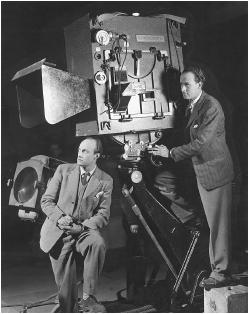
As far as film manufacturer, the Technicolor films of that period are three strip process... which means a blue, red, and green sensitive film were all run simultaneously through the camera. The light is split through a prism and colored filters only allow certain colored light to pass through to certain film negatives... hence you get three black and white films all with different tonalities. The films were then processed/dyed to their intended colors, and hence when the colors are combined, create the other colors in the spectrum and a complete image. So as I don't know who made the film... but it seems to me that you could have probably have used a standard BnW emulsion, and using the Technicolor process simply have one of the three tonalities to each stock, process normal, dye the prints with the corresponding color, and optically combine them for the full picture.
 
Last edited:
It was shot in Technicolor. Technicolor is known for the pastel like quality of the colors. It was also the dominate technique of acquiring color in those days. You are probably right about video transfers not doing it justice... it's hard to get talented people to commit their valuable time on old 'classics' which won't make money. Chances are it was telecined by some 23 year old intern in 1992. Sucks I know. Hasn't the criterion collection acquired this film by now? I figure they would do it right... but who knows where or in what condition that negative is in.


Thanks guys, I must have missed the 'technicolor'...

I wonder if I could take 3 basic monochrome 'reasonable' resolution survailence cameras, use a beam splitter on a single lens, to send the image through filters for R, G, and B to each of the 3 cameras...

Then in FCP (or Premiere) layer the three strips, each 'color cast' appropriately...
 
That is a really cool idea... but the trouble you'll find is getting a three way beam splitter... (as far as I know those are hard to find... maybe I'm wrong.)

Edit: I guess it's not that hard considering a quick google search showed me many 'dichroic prisms' which do these things for CCD cameras all day long. :P Where do you think I could find one? In an old CCD camera? I'm guessing the prisms are larger in larger sensor cameras, right? I kinda want to try this now. I might buy an old 2/3" camera (S-VHS or beta cam days) and steal the prism.

The cool thing with the three strip process is that it used a two way beam splitter! The 'red and blue' intended film negatives were shot in tandem with each other (running through the same gate) while the green negative was alone. The Red and blue gate would have a magenta filter to allow both bands of light to pass, while the green simply had green.

What I find absolutely amazing and beautiful about this fact, is that it foreshadowed our digital CMOS technology perfectly! Think about the bayer pattern. Alternating red, green, red, green and blue, green, blue, green... making 1/4 of the photosites blue, 1/4 red, and 1/2 green. As far as I know, since the blue and red intended film emulsions were run through the same gate, it would make sense to me that they both accepted and shared half the light (1/4 each kinda), while the green got the other half. Cool huh?
 
Last edited:
What I find absolutely amazing and beautiful about this fact, is that it foreshadowed our digital CMOS technology perfectly! Think about the bayer pattern. Alternating red, green, red, green and blue, green, blue, green... making 1/4 of the photosites blue, 1/4 red, and 1/2 green. As far as I know, since the blue and red intended film emulsions were run through the same gate, it would make sense to me that they both accepted and shared half the light (1/4 each kinda), while the green got the other half. Cool huh?

Did it have rolling shutter issues?

;)
 
Hahaha. It had these issues:

sjff_04_img1451.jpg


:shocked:
 
Technicolor is still a functioning lab in Hollywood.

The Technicolor 3-strip process ended in the early 1950's with the increased quality of single strip color films by Kodak and Agfa. Since Romeo and Juliette was shot in Italy, it's quite possible that it had Agfa camera stock and it was processed at a Technicolor lab in Europe. Agfa stock is very popular in Europe.
 
Back
Top