What type of lights used in this video by MSNBC

Those Led's will be my next purchase, I have been an avid tungsten user because of better color rendition and the cheaper led's ($300 range) I have used in the past have not produced as good skin tones.

I've been using the 1X1 daylight LED heads exclusively for talking head and interview setups for years. You have to spend almost $1K. to get a head that isn't excessively blue and/or green. They're much easier to use than tungsten not having to correct them when you have windows or ambient daylight in the shots.
 
This is NOT beauty lighting. Beauty lighting relates BOTH to the placement of the light in relations to the lens AND that of where the subject is looking. In the examples above where someone posted those screen-grabs - this IS beauty lighting because the models are looking in the lens. Here we have a standard boring 1/3 of the frame interview setup with badly places lights.
 
This is NOT beauty lighting. Beauty lighting relates BOTH to the placement of the light in relations to the lens AND that of where the subject is looking.

Patryk of Tupelo Productions has spoken. And thus it is.

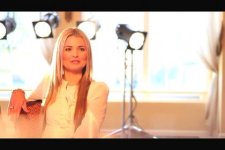
I characterize the following as beauty lighting even though the subject is not looking at the lens...

vlcsnap-2016-11-02-16h25m44s29.jpg

Nice work, Patryk. Although it's a shame you didn't spot that single hair sticking up on the top of her head and have someone tend to that. Attention to detail, my man.
 
Patryk of Tupelo Productions has spoken. And thus it is.

I characterize the following as beauty lighting even though the subject is not looking at the lens...

View attachment 118269

Nice work, Patryk. Although it's a shame you didn't spot that single hair sticking up on the top of her head and have someone tend to that. Attention to detail, my man.

This is NOT beauty lighting either! This is the effect of the producer last minute deciding not to have the person look in the lens but rather deliver standard interview. If they were to stick to the original plan it would be beauty lighting. Thankfully here we have all those silly flares and foreground elements that save the shot from otherwise "wrong" lighting set-up.
 
This is NOT beauty lighting either! This is the effect of the producer last minute deciding not to have the person look in the lens but rather deliver standard interview. If they were to stick to the original plan it would be beauty lighting. Thankfully here we have all those silly flares and foreground elements that save the shot from otherwise "wrong" lighting set-up.


This is NOT beauty lighting either! This is the effect of the producer last minute deciding not to have the person look in the lens but rather deliver standard interview. If they were to stick to the original plan it would be beauty lighting. Thankfully here we have all those silly flares and foreground elements that save the shot from otherwise "wrong" lighting set-up.

For a youngin' with only 13 years of experience you sure are...well, I won't go there.

MY understanding of "beauty lighting", and I could well be wrong, is that it is lighting in which the key light is placed in line with the face. The looking direction of the subject in relation to the camera is inconsequential. It is the relationship of the key light to the face that matters. A defining characteristic of "beauty lighting", as I have always understood it, is a nose shadow tucked tightly up under the nose or, when a broad source is used, no nose shadow at all.

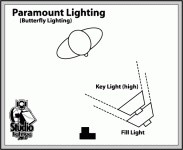
"BUTTERFLY LIGHT aka "beauty lighting"

"This type of lighting is also called “Paramount Lighting” because it was popular back in the 1930s in Hollywood. And the reason is called “Butterfly light” is because the light is positioned right in front the subject but at a steep angle facing down, therefore creating a shadow right underneath the subject’s nose that resembles a butterfly. It is considered a beauty lighting set up, mostly for women, and also it works best with people with pronounced cheekbones and a lean figure as slight shadows are created right below the cheekbones. Also remember you may position a bounce board below the subject as a fill. This will give a beautiful glow to the subject’s face."

http://www.picturecorrect.com/tips/portrait-photography-lighting-the-5-classical-types/

"beauty lighting" / "butterfly lighting" is Frontal lighting. The key is positioned so that the subject is facing the key. It matters not where the subject's eyeline. Beauty lighting refers to the relationship of the key light and the face of the subject. With "butterfly lighting" a hard source is used thus producing the namesake "butterfly" nose shadow. With "beauty lighting" a soft source is used and there is little to no nose shadow at all. In both the key is positioned in line with the subject's face:

paramountlighting.gif

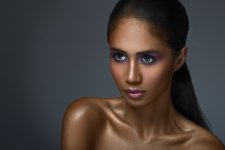
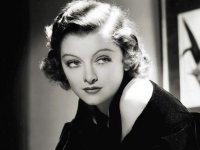
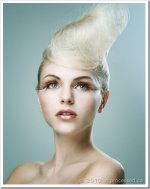
examples of "beauty lighting" / "glamour lighting"...

Main-Image-Dark-Skin-Beauty-Shot.jpg

beauty1.jpg

beauty2.jpg

Subject's eyes looking left, looking up, looking down, closed- it doesn't matter. In my humble opinion it is still beauty lighting if the key is directly in line with the face. Be the person facing the lens or facing an interviewer. I would differentiate between "butterfly lighting" and "beauty lighting" in that "beauty lighting is more shadowless and "flat". That said, some would consider butterfly lighting a type of beauty lighting. Again, both being frontal lighting. Frontal being the crucial element.

Oh, and back when I was your age I was also cocksure about everything and also thought all my opinions were ultimate truths. :)
 
Last edited:
Well, all a matter of opinion but it is 'the' standard beauty look as so often seen in adverts for cosmetics.

A very popular light modifier for fashion beauty shots is the Mola "beauty dish" light, which is NOT an evenly lit soft light. The key feature of the Mola light modifier is that it creates "rings" of brighter / harder light within a softer diffuse circle of light. So you get a combination of hard and soft light coming out of it which creates a "crisp" looking soft light effect.

Sample Mola Shots

When I used to shoot model tests I would take the diffuser out of my soft-boxes so you would get a bright circle of light in the center of the soft-box front diffuser panel, which would combine with the overall softer light from the front diffuser. The result was not as nice as shooting with a Mola light, but it does give you that mix of harder "crisper" light combined with the softer light.


The samples reveal, in the reflections in the eyes, the technique in the diagram I provided- an under-light positioned below the key. That is what I did in the setup I mentioned early on in this thread. I used a block lite panel on a low stand, positioned low in front of the interviewer. The idea is to fill in the chin shadows. Something not done in classic "glamour" / butterfly lighting.

Softish, flat, frontal lighting with a low frontal fill and heavy hair light, no nose shadow or at least no lateral nose shadow- that is what I consider to be "beauty lighting".

As far as the lighting on Melania Trump being "bad" or "badly placed", I don't know about that. Obviously the OP found it to his liking. Having done more of these cross shooting interview setups than I can count and executed them with only a 3-man crew, I am aware of the difficulty in executing them. Keeping the key lights out of the lenses of the two cross-shooting cameras is difficult, flying the key lights on boom arms is not easy and is also a major liability, and having everything placed so that a lateral two-shot clean of any stands can be obtained isn't easy. Only last week I had to construct such a setup all alone and I was only given about an hour to do it. I didn't even have anyone there with me to sit in for checking the lighting. I had to light ghosts. When the A camera and the Sound Op returned along with the Producer, interviewer, and interviewee , everyone just plopped into place and the expectation that was it would all be satisfactory enough to roll camera right away. I was lucky to get a couple of minutes before we rolled in order to attend to a backlight that was too strong.
 
My fault is not being precise with language - the eye, where the subject is temporarily looking while the snapshot is taken - doesn't matter. What matters is where the subject is "looking" with their face continuously. Thus the fact that in the few examples you posted some people face the viewer even though their eyes wonder - doesn't matter. What matters is that in an interview situation the interviewee is usually facing the person asking the question. ONLY when the interviewee is lit from THAT position - where the interviewer is sitting (or nearby) - can it be considered beauty lighting.
 
Something about this discussion that is raising hackles all over the place! From the violent dislikes of the reverse master in the original clip, to mudslinging over the term beauty lighting...maybe this is the "Christine" of dvxuser threads; born bad...
 
My fault is not being precise with language - the eye, where the subject is temporarily looking while the snapshot is taken - doesn't matter. What matters is where the subject is "looking" with their face continuously. Thus the fact that in the few examples you posted some people face the viewer even though their eyes wonder - doesn't matter. What matters is that in an interview situation the interviewee is usually facing the person asking the question. ONLY when the interviewee is lit from THAT position - where the interviewer is sitting (or nearby) - can it be considered beauty lighting.

I would like to see a reference besides yourself that states that beauty lighting means that the key originates from where the subject is generally facing, i.e. behind the interviewer. In pretty much every reference I know of the common understanding is that beauty light comes from the direction of the camera. It doesn't matter where the subject faces, although in much of fashion photography the subject faces the camera. The question is from where does the light originate, and that is from behind and usually a bit above the camera lens.
 
Something about this discussion that is raising hackles all over the place! From the violent dislikes of the reverse master in the original clip, to mudslinging over the term beauty lighting...maybe this is the "Christine" of dvxuser threads; born bad...


I find the discussion - cue Arte Johnson - very interesteenk.

But, adherence to decorum would also be appreciated.

As a side note - Matt Allard on Newsshooter was reviewing a new 1x1 LED panel that produces ~ 24,000 lux at 1 meter and he says/writes that, with that type of power, you can bounce it off walls or ceiling rather easily.

FWIW, I did a shoot last weekend with my two Aputure Lightstorm LS 1S panels. One shot in a tiny bedroom, not even enough room for a Chimera, very tight. Bounced my LS 1S off of the ceiling, provided beautiful fill for a cloudy window light key, shot looks totally polished when in reality, it was a :10 fix with bounce. Love when I can just supplement natural lighting that already looks good, it just needs some help. The LS 1S are my new favorite lighting tool. They are so useful and so much better than my old LED panels.
 
LED's have gone through the roof. Three years ago, the YouTubers were still doing the Home Depot DIY lights, with an occasional sprinkling of the fluorescent systems. Now, one can shoot a feature film with an A7SII and $500 worth of LED's.
 
I would guess you are probably right about trying to make her look distant and cold. I think they also tried to ruffle her feathers. They should have had enough time to set up, so any flaws are either intentional or due to operator error. Hard to tell what was going on without being there. You would think that they would send their top people considering the amount of exposure offered by this interview. Overall not too bad of a production.
 
I would guess you are probably right about trying to make her look distant and cold. I think they also tried to ruffle her feathers. They should have had enough time to set up, so any flaws are either intentional or due to operator error. Hard to tell what was going on without being there. You would think that they would send their top people considering the amount of exposure offered by this interview. Overall not too bad of a production.

I have never experienced any TV news producer requesting me to make a subject look bad. Not even when the subject was a stone cold murderer. I have never heard of any of the cameramen I know being instructed to light a subject poorly when shooting for national new networks. Sorry, but I find that speculation ridiculous. And I find it particularly silly since Melania Trump looks damn good in the interview. The notion that she looks ugly or even looks poorly and was intentionally lit poorly with editorial intent motivated by some political bias, that's crazy talk.

I've shot extensively for MSNBC, CNBC, CNN, Fox News, PBS News, BBC News, Headline News Network, NBC News, CBS News, ABC News, etc. and not once did a Producer ever instruct or even suggest in any manner that I light a subject to make them look bad or look less than their best.
 
This guy (Newman ..... Newman!!!) says he did screw up shots/lighting because of the people he had disdain for.

PS. Had it not been for the Nazi stooges like Alfried Krupp, the Germans could have/should have won the war.
 
Back
Top