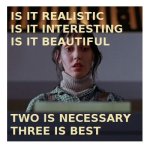
What is Great Cinematography... Really.

With this "cinematography is not meant to be notices" mantra you guys are walking a very specific - and narrow - path - but it's one of many paths. The same is true of the edit or direction. Yes, sometimes there is nothing else in the film but the story so you do your best to deliver adequate images that say nothing, but sometimes the images NEED to be noticed - often images ask not to exist as some prosaic illustration of the story but rather as punctuation point - a sentence where you skip question mark or an exclamation point changes meaning. This Hollywood notion of what cinematography (or editing, or direction) should be and how it shouldn't be noticed creates a very boring body of work.

you don't really get it: if the story dictates it, the point of focus will shift to the beauty of the image. But that doesn't mean that the viewer will be conscious of this. In stead of THINKING "this is a nice picture" he will FEEL it.

The whole point isn't that it shouldn't get noticed. But it is important that it doesn't distract the viewer from the story. If it become distracting, that means it has failed imo.

If you're shooting a movie like koyaanisqatsi, of course you'll have to shoot a lot of wonderful pictures, because that's what the story needs: it wants to show you the world, sometimes very beautifully sometime the opposite..
 
the whole point is that the picture has to be what the message needs it to be.

we are talking about storytelling here. This isn't a basic art form. Basic art is dance or painting or stuff like that. Those are things also a child (someone free from imprints, free from experience, free from culture) can appreciate: the bold beauty and excitement of certain images, things, materials, ...

But this is story telling. This is rather some sort of black magick in stead of art. Story telling is manipulation. It is a very powerful and dangerous thing. The church used it to put fear in people. It was used to describe 'the Gods' in ancient times. But that's another topic.

The idea is that we are talking about cinema. We are talking about a medium of which its prime function is to 'manipulate' people. (don't see manipulate as being something negative only) manipulation can be positive as well: it can help people with their problems etc. But it could also make people afraid - because the audiovisual impact is so strong on our psyche.

The main thing about cinema is that it is always communicating something about ourselves and the world we live in. Always showing us situations/people from different perspectives. Different world views, all sorts of opinions, fantasies and so on...

So when I say that in cinema, the image has the be what the message needs it to be, I think I am right.


If you want beautiful images without a message. Go to an art/fashion magazine.. But a flick with just beautiful images and no message is not a flick.
 
you don't really get it: if the story dictates it, the point of focus will shift to the beauty of the image. But that doesn't mean that the viewer will be conscious of this. In stead of THINKING "this is a nice picture" he will FEEL it.

The whole point isn't that it shouldn't get noticed. But it is important that it doesn't distract the viewer from the story. If it become distracting, that means it has failed imo.

If you're shooting a movie like koyaanisqatsi, of course you'll have to shoot a lot of wonderful pictures, because that's what the story needs: it wants to show you the world, sometimes very beautifully sometime the opposite..

You are limiting ourself with this concept that films are about stories. In my book everyone who talks like that is a neophyte in their understanding of the medium. Story is one of many, many aspects of what films can be about. There is a a whole plethora of films that want you to notice the image - not on feeling level but on intelectual level.
 
give me an example. And no video art, that's not cinema.

Kubrick's "Barry Lyndon" (through image you understand stiffens and social rigidness of the society)
Truffaut's "Jules and Jim" (through dynamic camera moves and unique editing you get the energy and madness of the relationship)
All Godard (all his images exist as something else other than story teling)
Wajda's "Promised Land" (many of the shots are direct imitations of famous paintings giving another meaning to those paintings)
Almost all Antonioni (simple stories raised to metaphysics by specific framing)

on and on...

I see your point that an image can also be an intellectual thing, but in none of your examples are the images intellectual to the exclusion of emotion.

I haven't read the whole thread so I don't know exactly where this debate is coming from. I'm just arguing for the hell of it, I suppose.
 
Kubrick's "Barry Lyndon" (through image you understand stiffens and social rigidness of the society)
Truffaut's "Jules and Jim" (through dynamic camera moves and unique editing you get the energy and madness of the relationship)
All Godard (all his images exist as something else other than story teling)
Wajda's "Promised Land" (many of the shots are direct imitations of famous paintings giving another meaning to those paintings)
Almost all Antonioni (simple stories raised to metaphysics by specific framing)

on and on...

I see what you mean now, but you are approaching it from a different perspective which is why we misunderstand each other.

Barry Lyndon is hyperrealistic photography with a lot of pastel colours, which was needed for the story.
Truffaut uses the techniques to express the madness of the relationship = important for the story, not for the image on its own.
Godard is a nutcase (imo). I think he rather just wanted to break the rules because that's who he is in stead of actually being a merit to cinema. Yeah I know sounds highly pretentious of me, but it's just an opinion; I'm allowed to have one right? :D A bout d'souffle kinda makes me sick lol
Promised Land I haven't seen yet and I'm not knowledgeable enough about Antonioni to give an opinion.

Point is. In cinema the image is subjected to the story, not the other way around. Because if you turn it around, the image becomes more important than the story..

There is always that gruesome Dali flick (I think) that might imply that the images stand on their own (since the script consisted of 1 page of utter blatherings) but still, behind those pictures lie hidden issues of the human psyche.. and that's the message: to show this to people and make them knowledgeable about it. It is always to communicate something.
And sometimes that needs beautiful pictures, but sometimes it doesn't.

Another example:
http://www.flandersimage.com/browse-films/detail/blue-bird

This film is shot entirely in blue and you are captivated by the image and the blues even slightly disturbed and uneasy by it.. Well the reason why they did it, isn't to make something highly stylistic/pretentious.. it serves the purpose to dislocate the audience. The story plays out on the plains of Africa.. But everyone has seen Africa on TV countless times. Everyone knows what it looks like. But the story needed an alien environment.. You see, again: picture subjected to story.


here's the trailer:

https://www.youtube.com/watch?v=RK7qRw_qe6g
 
Last edited:
Once again, many, many,many,many times the films do not start with the story. Story is an after though. You can presume that Kubrick had this Barry Lyndon story in his mind and THEN chose the images to tell it OR that he wanted to show images of 1700s, the rigidness of the society, wanted to see a world lit with candlelight, wanted to bring period paintings to life so he THEN chose a story to encompass it. Yeah, sure there is a story and without that story the film would be a collection of fantastic mood moments but that doesn't mean that "story is the king" because many many stories of 1700s could be told with the same images and have similar impact.
 
another way of looking at it is that stories vary in their level of "plot" if you will. Barry Lyndon does tell a slight story, but its a loosely constructed tale of one mans long journey(s) ,and alot of the joy of the movie comes from soaking in the images, the mood, atmosphere (Barry Lyndon is one of my fave movies, its transcendent). Some stories focus on character and/or atmosphere more so than plot. Kubrick liked these types of episodic stories (2001, etc), because they give you the breathing room to make the movie sometimes be "about" the image and not just have it there just to serve the plot.
 
Kubrick would probably kill himself if he heard you people talk about his films like that.

Kubrick is a fine example of CINEMA. He uses his own visual language, not the typical Hollywood one.
That includes:

- his own composition/framing language / blocking of the scenes
- his own lighting
- his own editing
- etc..

These kinds of movies take the first 15 minutes for the audience to adapt and get comfortable with the new storytelling style.

The reason why you think that it is about the image is because in Barry Lindon for example, he used a lot of wide shots on short'ish lenses because it gives you a much greater perspective on the decor and the art department's work: so that you actually feel as if you're standing there with those people in history. Not because he wants it to look like a poo pooing painting that has come to life. These types of long wide shots lets the audience immerse itself into the vibe of that time. None of those bulls*%t hollywood shallow depth of field Close ups/talking heads.

Of course a lot of the composition is done with classic painting composition in mind, that aspect is true;
But this movie is like a poem; the best way to tell it is through these painting like images because it just fits. But this movie wasn't made just to be able to make those images. These images were made because of the kind of story.

The reason why you THINK it is about the image is because it is so different from the other movies; because Kubrick (and others) refuse to work with the general, popular film grammar.

Kubrick is first and fur most a storyteller. The rest is subjected to that story.
And if he were to rise from the dead, right now; he would probably say the same thing.

And of course, certain stories benefit from beautiful, painting like images and others don't. That's the whole point. If a movie is more about the images, it is because it SERVES the story. Not the other way round.

AGAIN: Barry Lindon is a poem. The only way to tell a poem for the audience to understand and feel it, is through meditative/poetic shots. Because that is the plot: to move the audience not in terms of the "AMUSING PLOT" but in the sense of something more, something more abstract, more fixated on FEELING, ...

Patryk, what you don't understand is that STORY isn't necessarily about a good, amusing plot.. story is also poetry, meditation, transcendance, etc...
Story is everything a human can experience in life. Every thing, every occasion, every thought, every feeling that is EXPRESSABLE. That's story.
 
Last edited:
Patryk, what you don't understand is that STORY isn't necessarily about a good, amusing plot.. story is also poetry, meditation, transcendance, etc...
Story is everything a human can experience in life. Every thing, every occasion, every thought, every feeling that is EXPRESSABLE. That's story.

Your definition of the word "story" is so broad it borderlines on being meaningless. It's fine, but for me i need more strict definitions as this is the craft i do for living. Because a film can be a mundane story OR a poem OR a transcendental experience doesn't mean i should be using one word to describe those experiences. There is a reason why language evolved to included various words. In essence everything, including my shoe can be called a "hammer" because you can nail a nail to the wall using its sole but when i'm building a house while talking to the carpenter i want to make sure that we are as specific on what hammer is.
 
Kubrick would probably kill himself if he heard you people talk about his films like that.

quotes from Stanley Kubrick:
about the visual:

"I tried to create a VISUAL EXPERIENCE, one that bypasses verbalized pigeonholing and directly penetrates the subconscious with an emotional and philosophic content"....

"a certain degree of ambiguity is valuable, because it allows the audience to "fill in" the VISUAL EXPERIENCE themselves.

about atmosphere and de-emphasizing plot:

"forget the narrative. All you need for a movie is 6-8 non-submersible units"

"A film is - or should be - MORE LIKE MUSIC THAN FICTION. It should be a progression of moods and feelings. The theme, what's behind the emotion, the meaning, all that comes later"

about film grammar:

"The most instructive book on film aesthetics I came across was Pudovkin's Film Technique, which simply explained that editing was the aspect of film art form which was completely unique, and which separated it from all other art forms. The ability to show a simple action like a man cutting wheat from a number of angles in a brief moment, to be able to see it in a special way not possible except through film -- that this is what it was all about. This is obvious, of course, but it's so important it cannot be too strongly stressed. Pudovkin gives many clear examples of how good film editing enhances a scene, and I would recommend his book to anyone seriously interested in film technique. "

I could keep going, but I have to go make some bad movies to learn to make good movies, because....


"If you can talk brilliantly about a problem, it can create the consoling illusion that it has been mastered"..


attached an old FB pic of mine.
 

Attachments

  • 386980_4828728129174_191991317_n.jpg
    386980_4828728129174_191991317_n.jpg
    32.4 KB · Views: 0
Last edited:
Well yes Patryk, that is exactly what story is; esp. in terms of film making. Story is that what is trying to be expressed. I feel I have been very clear about my definition. In pretty much every post I used the words message and expression.

nyceaste; ok so what is your point? Where exactly does Kubrick say that the image is more important than the message? Because this is what the discussion has been about. The narrative is the story, but the story isn't the narrative per se.

"If you can talk brilliantly about a problem, it can create the consoling illusion that it has been mastered" -> that's a good quote.

That stuff about the film grammar is very interesting.
But I don't understand why the editing. IMO editing is just the timing of the cuts in relation to what you want to express. Basically the way you show something is the job of the director, composing a good shot list and a rough edit in his mind. A great director is able to do this. Of course, there aren't that many great directors of course.
For instance the Coens: before the movie is even shot, they know pretty much every frame by heart.
 
nyceaste; ok so what is your point? Where exactly does Kubrick say that the image is more important than the message?....
But I don't understand why the editing.... before the movie is even shot, they know pretty much every frame by heart.


dude the quotes say it right there- Kubrick aims to create primarily visual experiences using minimal plots, although he's probably overstating this a bit, I mean he's still obviously telling stories, but they are for the most part loosely, episodically structured-- perhaps not as much his early movies; Paths Of Glory plays like a straight tragedy.

and yes, when Pudovkin says editing, he means pre-editing.
 
This topic brings to mind another line from Kubrick (talking about cinematography in narrative films) when he said, "You don't photograph the reality, you photograph the photograph of the reality." There's art (and/or artifice) involved in the process and when there's that, it inevitably comes down to subjectivity and your own taste, not external criteria. When someone says they thought the cinematography in a certain film was great, I take it to mean they liked how it was photographed based on their personal taste. I may not share their taste.

And on the points raised above about the merits of cinematography which doesn't draw attention to itself, it might just add that while I too admire and appreciate this approach I also rather like excessive in-your-face cinematography if the material warrants it. I'm thinking of someone like Robert Richardson, whose work on Scorsese's 'Bringing out the Dead' and numerous earlier Oliver Stone films was the opposite of restrained.
 
Back
Top