What if you could Build Your Own Camera like a Computer?

At the end of the day, all a camera is...is a computer with buttons and a sensor. Maybe one day video cameras will be like building a computer. You could pick your own camera shell like you would a computer case, buy your own mount (EF, PL, Nikon, etc.), customize the whole thing and then pick the sensor you want. You then just put it all together. If something goes wrong, you replace that part that went bad. Or you go through some company like Dell who puts your camera together for you. Companies like Sony, Red, Blackmagic then start selling sensors, camera cases, and modular add-on parts to a much larger consumer ecosystem. Just pick the sensor you want.


If I was a billionaire I would do this. :cheesy:
 
Last edited:
While I like the idea of self servicing, I'd be very wary of taking a home-built camera on a professional job. There's a basic level of reliability and dependability that I need to know my primary tool on-set has. Plus production environments are tough on everything, people and equipment - so having gear that is meticulously built to last matters.
 
While I like the idea of self servicing, I'd be very wary of taking a home-built camera on a professional job. There's a basic level of reliability and dependability that I need to know my primary tool on-set has. Plus production environments are tough on everything, people and equipment - so having gear that is meticulously built to last matters.

Sure, but a skilled builder could account for this.

But then, the question becomes one of "why bother?" when the expense would probably exceed factory-built.
 
While I like the idea of self servicing, I'd be very wary of taking a home-built camera on a professional job. There's a basic level of reliability and dependability that I need to know my primary tool on-set has. Plus production environments are tough on everything, people and equipment - so having gear that is meticulously built to last matters.

But I see this in a modular sense -- you would be assembling modules, each of which has been 'meticulously built to last'. The same way you would build a computer. Every component you put into your computer build is manufactured to specific tolerances -- motherboard, RAM, graphics card, sound card, power supply, etc. Why wouldn't it work the same way for a camera build? Housing, internal electronics (a.k.a. "motherboard"), lens assembly, LCD screen, controls, etc. Certainly seems like it should work. I'm not sure that many of us want such vastly different things that it would be worth doing, though. Still, seems like a valid enough idea.
 
Modular devices tend to be bulkier and heavier than all-in-one machines because the design must account for interchanging the parts, and the places where things plug in (think expansion slots on a computer) have to be sized for the largest type of unit someone may want to attach there. Plus, the connectors and cabling contribute additional bulk and lower reliability. These are the reasons there are way fewer homebrew laptop computers than desktop machines, and it's why the various interchangeable camera heads/dockable VCRs that were marketed back in the '80s and '90s didn't really catch on. Most people bought the pieces and permanently docked them, but never used it as an opportunity to upgrade later, winding up with a heavier and less reliable unit than they could have had as an all-in-one.

There's probably a niche for this kind of thing -- perhaps more in industrial environments than for program production -- but I don't see it catching on as a significant part of the market.

- Greg

However, a great many filmmakers do build their own custom editing PC's. Gamers do it too. This way they can customize a machine to suit their specific needs, when an off-the-shelf PC just won't fit. I'm not so sure doing the same would be worth the effort when it comes to camcorders, but it's certainly something to consider.
 
However, a great many filmmakers do build their own custom editing PC's. Gamers do it too. This way they can customize a machine to suit their specific needs, when an off-the-shelf PC just won't fit. I'm not so sure doing the same would be worth the effort when it comes to camcorders, but it's certainly something to consider.

And I should have added that I have used homebrew computers exclusively since the early '90s, and a couple of hand-soldered Heathkits before that. I've built close to a hundred systems altogether. I run three desktops built from parts currently. With a couple of exceptions over the years, I think they have been more reliable than commercial machines. But size, weight and ergonomics aren't issues with those computers, while they are critical in a camcorder. My computers also live fairly pampered and stationary lives at my house and office.

- Greg
 
go4gbfjfontnmrjxlygz.jpg

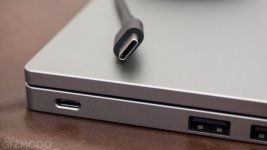
I am for an all-in-one, but a decent modular ecosystem can now be made with the jack known as Thunderbolt 3.

- about the size of the little USB jack on your phone (only it's reversible, yay!)
- carries 40 gigabits per second, enough for . . . well, anything really
- up to 100 watts of power


I could imagine something the size and shape of the Micro Cinema camera, with about four or five Thunderbolt 3 jacks, one for:

- screen
- XLR adapter
- battery
- SSD drive

Advantages:

- Since the jack carries power, the whole outfit (screen, XLRs, camera, recorder) could all be powered by a single battery (think Sony NP or BP series)
- Since the jack is an open standard, you would not be limited the accessories of one manufacturer. For example, you could literally just plug in an external USB-C hard drive (Thunderbolt 3 and USB-C use the same jack and are almost the same thing, just one carries 40 and one carries just 10 Gbps)
 
Last edited:
But if you make it to a known standard that is open to anyone, you can't lock your customers into your special ecosystem. That's the whole game, to lock people into your system so you can keep them buying only your stuff. Look at still camera lens mounts, only one that is shared by a couple manufacturers is the MFT mount. You have to get up into PL until you see this kind of continuity again.
 
If I was a billionaire I would do this. :cheesy:

If I was a billionaire I'd just buy a couple Arris, Reds, Canons, Sony's, Panasonics, Black Magic, Go pro.....
Or I'd just produce and direct and hire Deakins, Lubezki, or Richardson.

What made the modular PC possible was that it started out modular and there was a standard invented by IBM that took over the PC market, making it easy to clone. So we'd have to start with a standard camera interface and go from there. Someone would have to start cloning a camera and we'd be off to the races. So if someone started cloning Reds, off we go.

But, unlike PCs, there is no one package that suits our needs. There are too many variants of camera types to settle on one package. That's why Black Magic has so many different camera formats. They are addressing so many needs. But if anyone was close to being the modular model, it would be Black Magic. They may actually get us a close to that model as possible.
 
Last edited:
Back
Top