Hi everyone,
I read forum a lot, but never posted any comment
So please don't take this thread for a spam or adverting as I'm not selling anything here...
I'm currently developing (W.I.P)) an affordable professional wireless follow focus for indie filmmakers and wonder which feature you guys think the "IDEAL" follow focus should have ?
Or, if you already have one, which additional features you would like to add to it ?
The very first prototype that I've developed in 2015 (NOT the one on the picture) was made for a friend, who is independent filmmaker (using DSLR) and couldn't afford to buy such expensive gear as a professional wireless follow focus.
Renting for more that 5 month of shooting, wasn't an option, either.
It was good for the production, while it produced some noise because I build the driver with servo motor.
It was OK for my friend, because he used external micro, so the noise was not an issue for him.
However, as I wanted create really professional Follow Focus, which will be as good as the market leaders products, and even better, I continued development.
This is why, I would like to hear from you guys, what do you think should the "ideal" follow focus be like ? Which features it should have ? Which feature or what you don't like on your follow focus that you've tried.
In the mean time I will give you a description of current prototype.
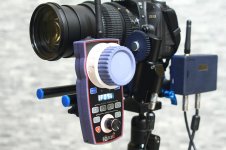
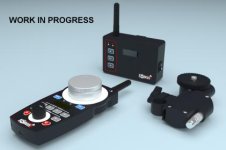
At this moment, the latest prototype is 2 channels (Focus + Zoom) and consist of:
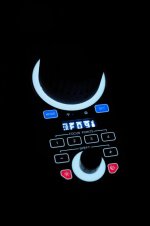
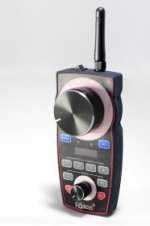
Wireless Remote Controller (0.08° precision) 12.5x6x3cm
I'm planning to add REC button to start/stop recording on RED cameras (and all other possible brands)
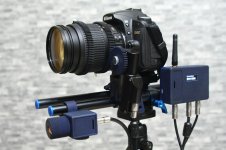
Main Unit 9x6x2.8cm:
Thumb Controller (wired) 3x3x6cm:
the actual prototype have only one thumb controller for Focus, but I'm planning to add another controller for Zoom (or Iris)
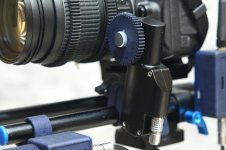
Motor Drivers 9x6x2.2cm:
Motor driver is extremely silent and very powerful.
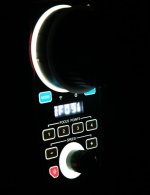
Here are some concept images and actual prototype pictures for your reference
Regards,
Khamzat
I read forum a lot, but never posted any comment
So please don't take this thread for a spam or adverting as I'm not selling anything here...
I'm currently developing (W.I.P)) an affordable professional wireless follow focus for indie filmmakers and wonder which feature you guys think the "IDEAL" follow focus should have ?
Or, if you already have one, which additional features you would like to add to it ?
The very first prototype that I've developed in 2015 (NOT the one on the picture) was made for a friend, who is independent filmmaker (using DSLR) and couldn't afford to buy such expensive gear as a professional wireless follow focus.
Renting for more that 5 month of shooting, wasn't an option, either.
It was good for the production, while it produced some noise because I build the driver with servo motor.
It was OK for my friend, because he used external micro, so the noise was not an issue for him.
However, as I wanted create really professional Follow Focus, which will be as good as the market leaders products, and even better, I continued development.
This is why, I would like to hear from you guys, what do you think should the "ideal" follow focus be like ? Which features it should have ? Which feature or what you don't like on your follow focus that you've tried.
In the mean time I will give you a description of current prototype.
At this moment, the latest prototype is 2 channels (Focus + Zoom) and consist of:
- Wireless Remote Controller
- Main Unit
- Focus and Zoom Motors Drivers
- Thumb Controller
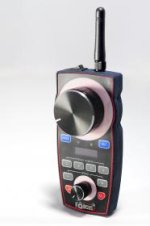
Wireless Remote Controller (0.08° precision) 12.5x6x3cm
- +350m , 10channels 433/915mHz wireless encrypted transmission
- OLED display for easy setup and configuration
- Membrane switch keypad (water splash proof)
- Removable Focus marking ring
- Backlight (buttons and knobs marking ring)
- Automatic (lens) limits configuration
- Manual (lens) limits configuration
- Automatic mode with 4 focus points which could be saved / called by user
- Manual mode (Focus and Zoom) knobs
- Channel switching (with automatic encryption key change) this may be useful in crowded areas with lot of RF signals
- Speed adjustment
- Motors spin direction flip (Clock wise / Counter Clock Wise)
- Sleep mode
- Battery level indicator
- Controller us powered by rechargeable (trough USB port) 1000mAh Li-Po battery which is can run for 3-4 shooting days from one charge, without the backlight and 14-18 hours with enabled backlight.
- Focus knob uses 12bit magnetic angle sensor with 0.08° angle precision, for extremely smooth control.
I'm planning to add REC button to start/stop recording on RED cameras (and all other possible brands)
Main Unit 9x6x2.8cm:
- OLED display for easy setup and configuration
- +350m , 10channels 433/915mHz wireless encrypted transmission
- LEMO type professional high quality connectors
- (will have) Membrane switch keypad (water splash proof)
- Main Unit is powered trough D-TAP to LEMO power cable (12-30V) .
Thumb Controller (wired) 3x3x6cm:
- (will have) Membrane switch keypad (water splash proof) with Focus Points and REC button to start/stop recording on RED cameras (and all other possible brands)
- Main Unit is powered trough D-TAP to LEMO power cable (12-30V) .
- 12bit magnetic angle sensor with 0.08° angle precision, for extremely smooth control.
- Final version will have Aircraft grade aluminum body with military Type III anodizing finish.
the actual prototype have only one thumb controller for Focus, but I'm planning to add another controller for Zoom (or Iris)
Motor Drivers 9x6x2.2cm:
- Aircraft grade aluminum body with military Type III black anodizing finish.
- LEMO type professional high quality connector
- 12bit magnetic angle sensor with 0.08° angle precision, for extremely smooth control.
- High power and extremely silent Faulhaber motor
- Custom made gears (SS+Brass) delivering 1.8Nm torque
- Interchangeable lens gears (0.8, 0.6 pitch...)
Motor driver is extremely silent and very powerful.
Here are some concept images and actual prototype pictures for your reference
Regards,
Khamzat
Attachments
Last edited: