Wedding Videographer Sued For Use of Commercial Music

Status
Not open for further replies.
Agreed 100%. FilmGuy, if you really believe what you have been saying, go propose it to the record labels. Let us know how it goes, this "it only helps them" philosophy.

Love to see how you make out with this.

Ok, I know I said last comment before, but I'll take the bait... to Doc/David:

Apple approached the record companies for YEARS before they finally changed and went with digital distribution via iTunes, fearing they would lose money. Numbers and data have shown they have made a ton MORE money and lost significantly less from piracy by moving to digital music where you could buy just one track instead of a whole album. TV Production companies feared for years (and continue to fear, being slow to move) on the idea of bypassing cable/commercials to move to web-based subscriptions like Netflix, Hulu, and iTunes - but the pace is accelerating as they discover this is a profitable model that works. Software companies for years loaded PC games with DRM, and are finally realizing it hasn't stopped piracy: the biggest anti-piracy initiative has been Valve's Steam platform, which gets rid of the restrictions of DRM. A single player only game (Elder Scrolls V) became the single fastest selling PC game on steam ever, even though it's extremely easy to pirate. PC Piracy has actually decreased in recent years as DRM is left out/minimized.

The point is: you are asserting I would approach them and they wouldn't listen. Hence I am wrong. Well guess what? Apple was right, Valve was right, Hulu was right, Netflix was right, etc. And they didn't listen to them either, for years and years, and they are big players with big money - especially Apple. Take-away: just because a big company does things a certain way or doesn't listen, doesn't mean they are right. Referencing the early mentioned Steve Jobs quote - you have the mindset that because "big suits" do it a certain way, they must be right, afterall, that's how they got there. It's a limited world view and it shows a mindset of "the world is the way it is for a reason, and we go with the flow." I don't have that mindset, and frankly no greater thinker or innovator in history has.

I genuinely believe what I am saying, and of couse they wouldn't listen to me, let alone give me the time of day to propose the idea. They didn't listen to Apple, and some record companies still didn't get onboard with iTunes until 5-6 years after launch! HA! These big companies are run by a bunch of old men who are slow to adapt to new technologies and a new generation, thinking they should do things like they've always done, looking to the past alone for guidance instead of using the past as a reference as they step forward into the future.

But that's cute that you're trying to imply that because they wouldn't listen to me, I must be wrong ;)

You have no clue about music business and what it takes financially to get any band/artist to the top charts. And the level of investment a label puts to bear behind an artist. And they should provide that commodity at an extremely low cost because someone disagrees with the business model.

Actually, I do. And the short simple answer to what it takes: EXPOSURE.

And it's an extremely low cost to an individual, but that doesn't mean it's an extremely low profit. Look at the app store 0.99 apps - people make millions. A million dollars can be raised by one person, or by a million people. The net is the same - the difference is you have a million times more exposure.

I am trying to keep a straight face while I am typing this, because you really should do some research before suggesting something like that. Exposure does not re-imburse those that fronted all the investment, and labels are not charities.

Umm. Besides recording and equipment costs, you realize of course that the investment labels put forth is paying for... exposure? right? So, yes, exposure does reimburse investors, because exposure is what labels PAY for because it's what leads to music sales and concert tickets and BIG commercial deals. You also seem to be forgetting that the massive shift in music over the next 10+ years will involve cutting out the big record labels more and more. The middleman. They exist to get artists to fans. Thanks to internet radio, twitter, youtube, facebook, iTunes, low budget/high quality music videos and music recording capabilities, and the concept of "going viral" the record labels will become ever less necessary... much to artists delight.


If you want to continue discussion, you can PM me. We've hijacked this thread and it's turned into an argument instead of a productive conversation. I really have stated my take and backed it up logically, and the way I see it we've begun going in circles or getting personal. This has always been a hot topic of discussion and I'm pretty sure there's numerous other threads on DVXuser regarding the argument. If anyone truly has something new or fresh to bring, that'd be fun. If not, let's move on. If you have something new, intelligent, and fresh to add, or want to discuss my main point (re: record labels), I'll respond here.
 
Last edited:
Considering that Johann Pachelbel died in 1706 and the Bridal Chorus (Treulich Geführt by Richard Wagner) was written in 1850, neither has an active copyright and the score for each is in the Public Domain. So, no... no wedding should be busted for playing either of those. The exceptions would be use of a recorded version (that would thus be property of the performing musician and his/her publisher), or use of a contemporary arrangement (in which case the sheet music would be copyrighted).
True, of course. And of course in saying "every time a wedding plays..." I was referring to playing a recording.

And as far as the labels, nobody's demanding, or even insisting, they offer a new model.

It's been suggested that it might be a better, and more lucrative, less litigious, alternative to the current system.

Nobody demanded CDs replace vinyl, and nobody insisted mp3s replace CDs. But considering how long it took record companies to catch onto the iTunes/ single song ala carte model, maybe they should be open to new ideas- especially if it's a win/win, earn/earn model.

Perhaps filmguy, or someone else, will surprise us someday... then maybe we can solve world hunger next...

Gonna move on- carry on DVXers...
icon14.png


Edit- (and my final/final post) filmguy, I just read your post on iTunes, etc. Great minds (well, similar minds?) think alike!!!

Alex- I'll check out Vimeo Music, thanks.

Deepfocus- go cover some news, there's nothing to see here... move along!!! :laugh:
 
Last edited:
We make that comparison because it's accurate. It IS physical theft. Just because it's a song and not a Ferrari changes nothing. YOU DON'T OWN IT. YOU DON'T OWN THE RIGHTS TO IT. So you CANNOT do whatever you want with it. Period.


I don't know if anyone has said that. Not me. Giving the artist credit changes nothing. You've still stolen the work.

groveChuck...


Except WE don't get to tell the owners of ANY creative property -- music, videos, photos, whatever -- what they can and can't do with it. If they WANT to do that, then great. If they don't want to, that's their right.

What ever happened to the one final thought... one last thought of your previous arguments? Let it go, man.
 
Cosimo, this is a very touchy subject. One he feels passionately about. He has just as much right to voice his opinion as you do. But add to the conversation, not single out a member.

M'kay?
 
Copyright holders frequently refer to copyright infringement as "theft". In copyright law, infringement does not refer to actual theft, but an instance where a person exercises one of the exclusive rights of the copyright holder without authorization. Courts have distinguished between copyright infringement and theft, holding, for instance, in the United States Supreme Court case Dowling v. United States (1985) that bootleg phonorecords did not constitute stolen property and that "...interference with copyright does not easily equate with theft, conversion, or fraud.

IP infringement and theft have more commonalities than differences. There is of course, an inarguable legal distinction between infringement and theft (larceny) just as there is an inarguable legal distinction between all the other forms of theft mentioned in the Dowling V U.S quote. Legally speaking fraud is not theft either, it's fraud. I don't think people equate infringement with theft in the legal sense just as they don't literally equate internet piracy with the peg legs and muskets variety. When people call copyright infringement theft, they are speaking colloquially -- and there's absolutely nothing wrong with that. Indeed, there is a long lived historical precedent for it.

Here is an excerpt from the supreme court ruling in MGM V. Grokster: "deliberate unlawful copying is no less an unlawful taking of property than garden-variety theft." - Justice Breyer (and undersigned by several others)

That was relatively recent example but it's far from the only one. There are numerous historical examples of judges and philosophers and economists and lawmakers and presidents referring to infringement as theft. It's not even the only example of a supreme court justice doing it. People have been calling infringement theft for hundreds of years. The term "Piracy" with regard to what we would now call copyright infringement, can be traced back more than 350 years.

So obviously, not everyone agrees with your ironically "black and white" opinion that the comparison is "apples and oranges". History is positively teeming with people that disagree with you. And of course there are plenty of us who still do. I expect that in another hundred years people will still be arguing over it.

It's clear to me that most backlash or arguments against copyright infringement come from the experience of having one's work ripped off. I have had it done to me. I know the feeling. Let's talk logically though, not emotionally, and remember what the actual discussion is about.

Ok, lets talk logically. Given that deprivation is not a legal requirement for all forms of theft (e.g. theft of services), the "partially deprived" rather than "wholly deprived" distinction mentioned in Dowling is not the argumentative capstone that you think it is. With either infringement or theft, the antagonist is the one who wrongly appropriates something someone else owns without permission or payment. In each case, the victim is the property owner whose property rights have been violated. Both learned men of the highest standing and the lowliest street urchins strumming for spare change have been calling unauthorized use of their work "stealing/theft/piracy/etc/etc/etc" for hundreds upon hundreds of years, it's not some new phenomenon orchestrated by lobbyists as is commonly insinuated. Finally, it might surprise you to learn where exactly criminal copyright infringement is codified in U.S. law. Rather than spoil it for you, I'll just give you the link: http://www.law.cornell.edu/uscode/html/uscode18/usc_sup_01_18_10_I_20_113.html

:Drogar-BigGrin(DBG)
 
Last edited:
+1 Filmguy123. I like your style. Valid points and some people only want to live in a black and white world, no grey. Did you know "J" Walking is illeagal? It's a moral thing if you don't cross at the crosswalk. I would call that a "grey" area. LOL

Until it is truly enforced, it's stillgoing to happen. I see both sides of the arguement and both sides have some vaild points. The music industry does need to evolve. Most DJ's do NOT pay into any ASCAP/BMI licensing, legit or not. Radio Stations do, but IP infrigement is running rampant and it will continue until it is majorly enforced or until the industry gets with the times and finds alternatives to capitalizie on the small stuff that slips through the cracks every second of every day. I don't endorse infringement. But on the same note, if it were truly enforced, for the average person, it would be illeagal to record your kid's choir performance or drama performance (and it may be, I dunno, I'm not a lawyer), cover bands would be outlawed, most events would not be able to happen because costs would be astronomical. Singing a song as you walk down the street would be illeagal because it's a"public performance". It's just all one big mess.

Sorry, after having to read all of that, I felt I had to weigh in :)
 
Arroway,

Thanks for the thoughtful, intelligent, and rational response! This is new and fresh, so I'll throw a couple of thoughts back your way.

FIRST

Infringement may have more commonalities than differences with theft, but I'm not attempting to distinguish the two quantitively but rather qualitatively. It only takes one difference to be completely different; so I'm more worried about the quality of whatever differences there are - as you mentioned, larceny being the largest. While it may be a matter of semantics to most people, the devil is always in the details. For example "let's eat grandma" VS "let's eat, grandma." - punctuation saves lives ;) So when someone speaks colloquially it's important to distinguish if there is error in what they are communicating - and it's been clearly stated that some people view infringement and physical theft as the SAME thing. It's not.

SECOND

Keep in mind, my points very clearly revolve around the "Malum in Se" portion of infringement. I have zero doubt that infringement is illegal. I'm not trying to argue the law code. No qualms there. So the quote by Justice Breyer is one I fully agree with - It is just as "UNLAWFUL" as garden-variety theft. But that's not the question. The question is, is it just as "WRONG" as garden-variety theft?

I assert that this is a highly GRAY area, and thus I stand firmly to my assertions about some people being very "Black & White" regarding the morality of the issue, trying to deduce it being no different than physical theft. There are major differences, and with copyright infringement in particular, there are so many varieties and variables that's it's important to be highly specific in describing the circumstance. I know from experience that this frustrates and some people, and they call "foul" and deduce the morality to A/B scenarios. This appears righteous on the surface, but my point is that if you take a closer look it's inaccurate and a shortcut to the real issues.

Regarding history teeming with people that disagree with me, it's also teeming with people that agree with me.

THIRD

Deprivation IS a requirement for all forms of theft… DEPENDING on how you look at if. Theft of services, for example, while not defined as larceny, is still depriving someone: it deprives someone of the potential profit they would have received if you had paid for the service, or arguably wear and tear you have put on any equipment used, or the time performed on the service. So yes, even legally I would argue that (even if not explicitly stated) deprivation is a requirement to what has been considered theft.

But remember, that's not my point - my point isn't what the law says. My point is the Malum in Se side of things - what is actually morally wrong. I would argue that MORALLY, deprivation (in some form) is a requirement for something to be considered theft. And copyright infringement CERTAINLY DOES DEPRIVE PEOPLE!! Absolutely. For example:

* Loss of potential profits
* Loss of credit
* Defaming or degrading the image of IP by misappropriate use

SOOO…

My point is that this PARTICULARLY BREED of Copyright Infringement (major music in small indie productions) is such a gray issue is for a few reasons:

* A strong case can be made that there is no deprivation of potential profits. Point in case: have you ever seen an indie production with a major song and thought "I wonder if they got licensed or used this song unlicensed?" NO. You always *know* when you hear a major song in any indie production that it is unlicensed. Why? Because it is, for all practical purposes, impossible to obtain the licensing. If major music licensing was even remotely affordable or feasible, the MORAL (not legal) argument against this sort of infringement would be MUCH stronger. Search your heart, for you know it to be true.

* Other cases for deprivation in this particular scenario are insanely weak. For example, let's say you have a song on a wedding video on YouTube and someone finds it. They loop the YouTube video OVER AND OVER and OVER again just to hear the song. You have now inadvertently played part in depriving the artist and record label of a sale, right? True, this is possible. Of course, the sort of cheapskate who would only listen to a song over and over while sitting at their computer and listening to it at a lower nitrate instead of paying $0.99 probably wouldn't have bought the song anyway. This sounds like an extremely frualie person or a teenager with no money. Beyond that, if they were that determined to avoid paying, there are so many other viable ways to obtain the song (bit torrent, you tubing a video of the song that someone posted with just lyrics, burning a friends CD, recording off the radio, etc.)

* There is VERY RARELY loss of credit. I covered this (actually, I covered everything, albeit briefly) in my first post. Let's be real. Have you ever watched a wedding video and heard a major song, let's say The Beatles - I Want to Hold Your Hand, or Coldplay - Fix You, and thought "Wow. This videographer is so talented. Not only did he make this beautiful video, he also wrote, composed, sang, and recorded this wonderful song!!" Give me a break. EVERYONE asks when they hear a song they like in a video, "great song! who sings that??" My point is, even if credit is not explicitly given, it is IMPLIED. And most of the time, indie producers explicitly credit the song either in the video or in the credits.

* Defaming/degrading the work: I believe this is the biggest objection in allowing music to be used by indie's. They are afraid people will associate their valuable music with crappy videos. I mentioned this an earlier post. I think it can be sufficiently demonstrated that this a weak argument, and is inconsistent with other advertising practices and concerns that were long ago abandoned. There is some validity here, but I think this could be solved in a much better way than an-all ban (which is effectively what the high use fees are) on indie's using music. So does this make it MORALLY wrong? I think that's gray. I suppose if your work really really sucks, or your syncing beautiful love songs to porn, yeah I could see that being cause for concern... again, that's why it's such a highly variable thing in terms of morality. I think the logistics of this could be solved by record labels, and that potential risks would be outweighed by the potential massive profits/exposure. But I would argue strongly that generally speaking, even if you have a sub-par video, a major artists musical work has not been degraded. I've seen plenty of bad videos and thought the song was awesome, and went and sought it out. I'm not alone.

IN CLOSING

I could go on, but I think that's enough to get at least the basic thought across. I thought you brought up some great points and I wanted to respond as well as clarify. There are some very noteworthy differences in the morality of copyright infringement VS physical theft (and in previous posts, brought up the legality only to say that even the law has to distinguish that it's different - to point out to some people claiming it was the same). I do believe it's apples to oranges, to a certain extent in legal terms and to a much larger extent in moral terms. While I realize the law does it best to codify morality, the current climate and breadth of copyright infringement can hardly be summed up in A/B morality.

My two assertions:

1.) I strongly question the assertions brought against small indie videographers using major music label songs that they are immoral, have an entitlement attitude, or are hurting record companies or artists. I even assert that they may be HELPING THEM. I do not assert that this makes it legally "OK" or assert that it makes it morally "RIGHT" - but I do NOT think that something has to be totally morally RIGHT to *not* be considered morally wrong; hence, a "gray issue", a middle-zone. The issue is so much more complicated than that, and in the previous 10+ posts the thought process has been beat to death. Note that with this, I do not question whether they are breaking the law code (yup, they are!), and I do not attempt to make a broad statement on ALL copyright infringement, but do wish to point out that each scenario should be fully considered in all of it's idiosyncratic detail. I also assert (implicitly, and now state explicitly) that not all breaking of legal code/law can be considered immoral.

2.) I assert the record labels are slow to adapt and see the future and new trends. It's been historically demonstrated (gone over in detail in previous posts) and can be logically demonstrated in the present. I assert they would be wise to re-examine their practices and open things up, for numerous reasons listed in previous posts and in a manner detailed in previous posts.

I'll respond to anything sufficiently intelligent/FRESH in regards to #1 for the sake of productive conversation, but am really most interested in #2.
 
Last edited:
Thanks Kit, and yes, good points. Totally agree. It's everywhere. I think I tipped a homeless guy playing a copyrighted Christmas song publicly on the street downtown the other day. DANG IT, we're probably both going to hell now.
 
The artist seldom sees a lot of money - here in Germany live performing bands even have to pay royalities and dues, for performing their own songs in public and never get a cent back. They even sued kindergartens here for singing Christmas songs in front of an audience. The GEMA here (like BMI and ASCAP) doesn´t even hold the rights on those old traditionals, but they don´t have to prove that ether, to sue you. Just saying it is so, is all it takes. It´s the duty of the performer to prove that they don´t hold the rights.

Then you have the record companies and they have nothing to do with music at all.
They are parasitic money making machines.
Making money on the back of an hard working artist by buying his rights (cheap) and selling them over and over with a big profit margin, leaving some bread crumbs for the guy that actually have done all the work.

Nothing wrong with that, but be prepared to sell your soul as an artist.

Then you buy a CD from them.
For some reason it isn´t the same like buying a painting or a statue.

You can sit the statue in your garden and everyone passing by can see it.
For free. They don´t charge you for every guy walking by your house and looking at the statue.
Also you don´t have to pay royalties, if all your customers can look at the painting that hangs in your office.
You can even have the statue in your indie or wedding film perfectly legal, without paying anything.

So why is this so different with music? You paid for the CD.
Your fiends can listen to it for free in your home or car.

Is it because you are making money with that wedding film?
No, it would be illegal to use that music even if you do it for free, as a favor for your brothers wedding.

So making money with it, seems not to be the point.
Reason is, it´s a totally rotten system, made to prey the artists and milk the rest of us.

I know what I´m talking about. I played in a band (many moons ago) and we made a record (not the most successful one, but it sold, nevertheless).
I never saw a cent. It all went to cover the "expenses" of the record company, from recording to pressing, distribution, profit and the new Mercedes of the boss.

I prefer to buy music directly from the artists and cut the man in the middle.
I do that since years and it´s a win-win situation.
You might not get the top 10 tracks that way, but there are a gazillion great bands out there that are happy to supply what you need.
Some even see it as a promotion and give their tracks for free.

my ct2

Frank
 
Last edited:
Great post Frank.

This oft-referenced article is from the early '90s, and originally appeared in Maximum Rock 'n' Roll magazine. While some of the information and figures listed here are dated, it is still a useful and informative article.
 
Then you buy a CD from them.
For some reason it isn´t the same like buying a painting or a statue.

You can sit the statue in your garden and everyone passing by can see it.
For free. They don´t charge you for every guy walking by your house and looking at the statue.

You aren't duplicating the statue when people walk by and look at it.

You aren't copying the CD when friends happen to be at your house or in your car and hear it playing.

You are copying the data on the CD when you use the tracks in a movie...
 
If you can convince the copyright OWNERS (not the artists) of the value of this 'free publicity', such that they are willing to let you use the song you want, then you're golden.

But if you can't convince them, but use the song anyway, then you've stolen it and deserve to be punished by law.

Do you really understand the implications of that? This isn't just a situation where you hope the copyright owner never finds out, because if he does he will sue you. No, this is much more serious. Read the FCC Warning at the beginning of movies -- a warning also to be found on CDs of music. The fact is NOBODY has to file a lawsuit against you. If someone is mad at you for any reason, all they have to do is call the FBI and report that you are distributing copyrighted material. Then the FBI will come confiscate your computers and haul you away. You will be tried in a federal court, and if found guilty you will be subject to a 5 year stretch in a federal prison, plus a $250,000 fine -- for EACH infraction.

If anyone is willing to take that chance, that's their business. But don't come to me trying to rationlize their theft.

I believe in obeying the law. Period. If the law is unjust, then work to change it. But until such time as it is changed, it should be obeyed as it stands.
 
This oft-referenced article is from the early '90s, and originally appeared in Maximum Rock 'n' Roll magazine.
Great article by Albini, Scott.

I started this thread just as a simple state of the biz post (and I don't even do weddings).

This has turned into a very thought-provoking topic, many valid points made- legally, morally, technically, economically.

Yes, the law is clear, but for many, the underlying issues and reasons, not so clear.

Thanks everybody for such intelligent, passionate, even well researched posts!
 
Yeah, this thread has gone off in a quite a few different directions.

Then you have the record companies and they have nothing to do with music at all.
They are parasitic money making machines.
Making money on the back of an hard working artist by buying his rights

^ Wrong or right, I too have little sympathy for the record companies. And I don't know exactly what state the music industry is in right now, but I don't think it's very good from what I've read. :Drogar-BigGrin(DBG)

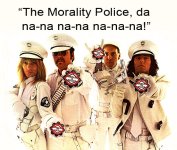
Sifting through this thread, I have a song going though my head:

morality.jpg

That's my 2c.

Yes, the law is clear, but for many, the underlying issues and reasons, not so clear.

Right, like whycome Youtube "condones" using copyrighted material? (to some extent)

For a while, they were stripping the audio off videos & sending you a nasty email. Now, they're just kinda like "WTF, go ahead and use it." It may not be available in Germany or whatever. It's a very grey area right now. Tell me, if it's "wrong", why does YouTube, Vimeo, etc let it continue?
 
Deep, Youtube does not condone it, they just cannot police every posting. They look to users/viewers to report any violations. Any violation reported, they pull down, as once they are notified of the violation, they become accessories after the fact if they don't take steps to correct the violation.

And here, we should not condone it either. You will notice, when someone does it, there are people that will point it out and and make a stink. As we should. This is a site about artists and content creation, not about using another artists work without permission. Content creation is not content copying. It's about creating an aural and visual environment for your viewers. If you take someone elses work without permission, it only cheapens what content you actually created. Why is there such a stink about someone stealing footage from another artist, but audio........not so bad. Should I be allowed to use footage from Scorsese's work and and benefit from it without paying for what it is worth? Why is it any different with audio?

Maybe there are those that don't agree with me. But both as an artist and a content creator, I will not waver from my stance on this (I used to write Techno under the name Vyekodin, and I got ripped off once). And, yes, I look at those that rip off other artists/ copyright holders (despite how much they make because of that copyright) as not serious about their craft. They opt for the easy way out, and are willing to stand on the backs of others to make themselves look good. And that's exactly what you are doing if you steal someone's work.

Music and rights are too easy to obtain for serious film-makers, or even hobbyist film-makers. But if you want something that is "hot" on the charts, then you have to pay for it, and yes it may be a lot. But the reason you want it is because it IS hot, and by using it, you are attempting to cash in on the popularity/established exposure of that song. So, it's not the song/artist that will benefit from the exposure, it's your work you are wanting more exposure for. So, now we are back to the laws of supply and demand. They have the supply and you have the demand.

Look I can get rights to music, just by asking. But I love Indie music, where FilmGuy is right. Exposure does help those artists, and they would bend over backwards for that exposure. A top chart artist, on the otherhand, already has exposure, and nothing a small Indie Production or a wedding vid adds will help that exposure further than what they already have. But rather the reverse is more the case. It's the person wanting to use the music that wants the exposure that music brings. Let's be honest, exactly what new exposure can you or anyone else bring to the table that someone like Eminem, Beyonce, Cold Play, or any other top chart artist doesn't already have? Seriously, do you really think they NEED your "exposure" to get their work out there?

So in part, I do agree with the "exposure" is valuable, but only when related to an artist who does not have that exposure already. But I still would not consider using their work without expressed permission. Plus, by getting that permission, I have opened a whole new exposure for myself. The band/artist will have their own fan base that will now seek to see the work I created with the artist's help. If I steal that work, one word from the band, and I now have those that will talk negatively about my content, without even seeing it.
 
Last edited:
Here is another thought for everyone to consider:

Would you think it was okay to use footage from famous film-makers and movies in your own project and not expect to pay for that usage? Even "claim" it was your work except having it buried in the fine credits. Even if they were not famous, but indie guys like the majority of us here. I could research many posts of your work here, rip your work off your film posts/links, and put it together in a way that is "original", call it my own. Sound ethical? I would enjoy taking the first 3 Star Wars films (SW, ESB, ROTJ), and creating a whole new story out of them.

If you would find that to be un-ethical, why would it be okay to do the same with any form of audio? If you did not create/record it, or received the rights to use it, there is no difference, than if I took a bunch of clips from someone else's films, edited them together, laid my own audio in, then called it my own work. I daresay, everyone of you saying it's okay to commandeer music for your own project would rip me a new one and call me a thief for it.

And rightfully so. But because of the technological ease to do it, audio is held to a much lower standard with regard to Copyright Infringement, apparently.
 
Last edited:
Status
Not open for further replies.
Back
Top