vignetting with nikon lenses

Yea, my wide angled lense does vignette more than my 50mm.

i put my camera on a tripod and locked it down, put my 50mm on, zoomed in to fill the screen with the GG and zoomed in as far as i had to to get rid of the vignetting at f/2.8.

then i added my wide angled lense, zoomed in to fill the screen with teh GG and zoomed in as far as i had to to get rid of the vignetting at f/2.8.

after doing so, looking at both clips, they look exactly the same! i had to zoom in so far with my wide lens that it pretty much looks just like my 50mm!

what is going on!? it seems like buying a wide angled lens is irrelevant, and i don't understand why any person would want to buy a wide angled lens for a letus adaptor, because it's going to look exactly like the 50mm!

i just feel so confused and frustrated at this thing. it seems like using a letus adaptor is only good if i just use a 50mm prime. every other lens now just seems like a waste of time because they're all going to either look like the 50mm when i zoom past the vignetting, or i could just zoom in on the GG further to make it look like a 200mm lens

this obviously can not be right, i feel like i'm the only person in the world who has figured this out, so i have to be wrong

Your wide lens WILL look like a 50 by the time you zoom into academy size framing. You are used to 35mm full frame sizes, which is NOT going to get you the same look.

a wide angle 24 or 28mm Full Frame lens is going to end up being about a 40-50mm lens in "academy frame" size. This is something you just need to learn.

You also are using the cheapest of the adapter line, which is not meant to be at the same quality as the more professional side of the adapters Letus makes.

There is nothing wrong with this. It is normal. Also you are showing footage from an extremely DARK room. You need LOTS of light with these kind of adapters. The vignetting will go away when you are in a brighter situation such as outdoors.

The problem you're having with everything having to zoom into your 50mm range is that your apatures and lenses arent matched. if you have an F2.8 lens, your vignetting will be more dramatic than if you had an F1.8 lens. So F stop really matters here. You cannot expect results to be the same from lenses that were never meant to match together.

You need to understand the physics of lenses for you to realize that all of this is normal and you need to learn how to pick the right wide angle lens. A 24mm F1.8 lens will have little vignetting when zooming into the academy size. You will then be left with something around a 35mm lens in FF view.

I think the one most important thing you dont understand is that Academy size in Motion Picture use is completely different than Full Frame size in 35mm stills. Threre is a huge difference.

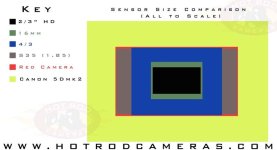
A 50mm lens in Full frame photography is no where near a 50mm lens for Motion Picture use. The film gate size is much smaller in motion pictures, dramatically increasing the apparent focal length of the lenses you are using.

I suggest you google the differences to understand more. Below is a chart showing you the huge difference.

The yellow area is the Full frame size of what photography uses. The GRAY inside is Academy size framing. MUCH smaller.
 

Attachments

  • sensor-size-chart-web2.jpg
    sensor-size-chart-web2.jpg
    43.7 KB · Views: 0
ok, so basically, when i use a lens on a video camera using an adaptor, i need to zoom in past the vignetting, so my 28mm actually becomes something around a 50mm

and my 50mm becomes something around a 65 or 70mm

then why does everyone say for using 35mm adaptors on cameras, to start off using a 50mm? shouldn't people be getting a 28 wide angled so that it can look like a 50mm?

also, why does the vignetting only happen when using the lenses on a 35mm adaptor for video cameras, and not when i use them on a SLR, like my Nikon FE?

it seems like if it vignettes on my camera because the aperture is closed down, that it should be giving me the same effect when i'm using my SLR camera
 
Heres another better explanation...

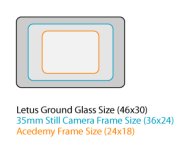
The Ground Glass on the Letus Adapters are not sized to a full frame, they are even LARGER than a FF in 35mm stills.

So when you zoom in just past so that you see the black edges gone from the adapters square, that is not full frame, that is way beyond full frame size. Zooming in more you'll get full frame, and further more you'll get academy.

see info here: http://wiki.letusdirect.com/other-info/academy-frame

Also see the attached photo below to show you what the Letus GG size really is, its HUGE way bigger than it should be.
 

Attachments

  • letus-frame-size.jpg
    letus-frame-size.jpg
    31.3 KB · Views: 0
ok, so basically, when i use a lens on a video camera using an adaptor, i need to zoom in past the vignetting, so my 28mm actually becomes something around a 50mm

and my 50mm becomes something around a 65 or 70mm

then why does everyone say for using 35mm adaptors on cameras, to start off using a 50mm? shouldn't people be getting a 28 wide angled so that it can look like a 50mm?

also, why does the vignetting only happen when using the lenses on a 35mm adaptor for video cameras, and not when i use them on a SLR, like my Nikon FE?

it seems like if it vignettes on my camera because the aperture is closed down, that it should be giving me the same effect when i'm using my SLR camera

Because a 50mm lens is the cheapest lens you can find with a huge aperture such as F1.2 or F1.4 or F1.8. Its more expensive and harder to find a 35mm F1.4

These adapters are very light hungry and require you to have the widest aperture possible.

It depends on the SLR you are talking about, if you are using a DLSR than most likely you are seeing a 1.2-1.6 x crop factor, which means you are still not seeing the lens at its normal intended size. And in fact these lenses will vignette on a full frame just like they would in any other situation. It depends on the lighting with in your photography
 
so according to those dimentions, if i zoom in 50% to fully show just the GG on the letus, and the letus GG is 46 wide, and acedemy is 24 wide, i need to zoom in about 50% of that, so in the end, i'll need to zoom in to about 75% on my camera to get the Acedemy Frame Size. does that sound about right?

also, does that chart above with the Letus Ground Glass Size apply for all the Letus Adaptors? I have the Letus Mini. i just want to find out if that chart applies to me or not

You are right about the zooming, most likely around 70% or more to get academy size.

I am unsure of the size of the GG in the mini, this is something you may have to ask around to find. But for the entire line of Letus Adapters that I have used, this is correct. The mini is the only one I have not personally used. The catch is, either way you'd have to zoom into that 70% mark anyway.

Just because the ground glass isn't that size, doesn't mean you don't have to zoom in the same amount as you would if the GG was that size. It has nothing to do with the size of the GG. It has to do with the amount of zooming in. The GG being bigger only means you see more of the vignetted area you don't use anyway.

So no matter what, you still should be zooming in more. The lenses you are using are still projecting the same image.

in other words, if you had to zoom in with your camera on a letus extreme, you'd still have to zoom in the same amount with the letus mini... to get that same academy size. But I can see where that would get confusing. Ask around to see if someone can better explain the mini's gg size to you.
 
Giuseppe - you are the man. Nice explanations!


but if i zoom past the vignette, i don't understand how that solves the problem, because then i have two bigger problems. i would have zoomed in further on the GG on my adaptor, so the grain is now more noticeable, and i've also zoomed in further so it no longer looks like i'm using a 50mm, it looks like i'm using a more zoomed in mm lens, like a 70mm or something (if that number lens exists)

how would zooming in more on my GG make no change in field of view?

i'm sorry, i'm not trying to sound like i'm attacking or anything cause i'm not, i'm just extremely confused

I challenge you to really look at the grain differences between the two zoom options. I highly doubt you are going to notice the difference, unless you have weak batteries or stop past f4 or turn your shutter speed past 1/60.

As for the field of view question, re-read my post. Look for the part that mentions a 35mm lens instead of the 50mm.


Jason
 
Back
Top