Veydra Mini Prime Micro 4/3 Mount Cinema Lenses On Kickstarter

Thomas, they've said that they will be posting more samples over the next week(?).

Just to underline the point... you won't have long to wait.

And if you are in the L.A. area you are welcome to stop by Hot Rod Cameras on Black Friday (11/28) to test the prototype 4-lens set from 10:AM to 6:PM.

You are welcome to bring any MFT camera/lens to shoot a comparison test, or we are happy to provide a GH4 and what we have on the demo lens shelf, just bring a compatible SD card and you can keep the results.

Even more information coming in the next couple weeks.
 
It'll be an interesting choice.

Compares very well to the Voigtlander at f2. Not so much at f0.95. Definitely more cine-friendly than the CVs.

Personally I like the CV's, own the 17.5 and 25, am looking forward to the 10.5 and saving up for the 42.5 - that f0.95 is just too good when it fits the scene - but again... more good choices is never a bad thing.
 
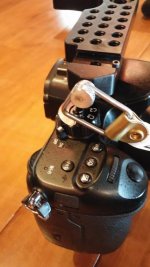
From my previous post about testing Veydra lenses this coming Friday. On Friday we will also have the first public unveiling of the brand NEW Hot Rod Cameras Kung Fu Cinema System, which is 100% compatible with Veydra lenses as well as PL mount lenses, Panavision mount lenses, Metabones Lens Adapters and others. We've gone a step further to make it modular and compatible with 15mm lightweight/15mm Studio and 19mm Arri Studio baseplates.

It's kind of quiet as it's a Sunday but today, an early Black Friday instant rebate was issued by Panasonic and beginning today there is a instant rebate on the GH4 which drops the price to $1497. Hot Rod Cameras is actually doing the biggest value discount (in the world) on the GH4 through Black Friday by bundling in an expensive no fault 3-year warranty, for free. If you were considering a small investment in a GH4, (maybe just in order to use the Veydra lenses!) well it just got cheaper, and there won't ever be a better deal than this.

Here's a tease of the Kung Fu Cinema System, which among it's many features, has an integrate tape hook for camera assistants. There's another thread here where we have been discussing the long development of the Kung Fu Cinema System and taking suggestions on how to make it better. I personally believe there's a lot of people who will use Veydra lenses with the GH4 and the Kung Fu Cinema System.

KFCS1.jpg
 
This looks great, I will be following it closely for when I'm ready to buy some cine primes.

Looking at the photos of the lenses I just realized something that I had never noticed about cine primes before. Do most of them have non-linear iris rings (i.e. different distances between T-stop marks)? A quick look at various cine primes on google image search seems to indicate so. Is there any advantage or disadvantage to that? I'm used to manual still photo lenses that usually have the same distance between stop marks.

It is unusual that cinema primes (these days) would be made with a non-linear iris, but it's not unheard of. To this day I scratch my head and wonder why Zeiss, of all companies, picked non-linear iris assemblies for the CP.2's... the contracting iris scale makes it difficult to add 1/3 stop increments on the lenses, which is actually sadly unfortunate as those marks are actually needed more when working with a non-linear iris.

Remember, just like a focus scale, when someone tells you to split stops on a non linear iris, you don't just split the difference. It contracts as you close down, so a 2.8-4 split would be somewhere past the equidistant position between the two stops, more toward the 4. I don't think some realize that, but good news is they are only missing their exposure my a fraction of a stop.

I noticed the Veydra's went that route. I'm assuming it is to keep costs down? I'm interested in checking these out. I'm just reading about them now and am a little late to the party.
 
Rokinon Cine lenses are stills lenses with gears and declicked. These are true cinema lenses designed and built for cinema use with pulling focus in mind. The have a 300 degree range. These are not rehoused stills lenses from what I can see.

Now that I have had a second to catch up with this thread and the articles, I have to say that clearly some wonderful thought was put into these lenses, such as use with professional accessories, speed on lens changes, convenience of use on set, and much more...But I would kindly give my opinion, as a professional who splits his time shooting and ACing, that although focusing was perhaps in mind, the end result is decent at best, but far from ideal for a focus puller who is used to cinema lenses.

If I were to switch gears and talk strictly about pulling focus (and temporarily ignoring the other advantages and benefits of these lenses,) it is in my immediate opinion upon looking at these lenses from my computer that they would appear to be better to pull focus with than photography lenses, but still fall short of most, if not all, entry level Cinema lenses. These unfortunately might be the poorest marked cinema lenses, if you are someone who pulls focus off judging distances and marks.

The advantages of cinema lenses with accurate and well spaced witness marks would be for an assistant to be able to pull focus based on distance. Not only utilizing measured distances from marks and the environment but also from the experience and skill of judging distances on the fly. The witness marks on the Veydra lenses, in my opinion, look to be few and cramped. As far as any lenses that are built to be cinema lenses go, these appear to possibly be the most difficult to pull. They also lack an actual witness mark line giving the exact mark of the distance...If anyone remembers the original three-set of F3 Sony Primes when they were released, it was a similar situation. Engraving each lens with accurate witness marks is less cost effective to the manufacturer, thus they didn't do it. To my knowledge, the only two sets of cinema lenses to have ignored an actual witness line, would be the F3 Sony Primes and these m4/3 lenses.

Now by this time, I'm looking like a genuine stone thrower and world class nay-sayer. I'm going to list all the amazing things these lenses appear to have gotten right, right after this post. I promise.

I am just making the observation that these lenses were made for the benefit of many reasons, and the end result had focus pulling as mildly one. Yes, these will be better to pull focus with than an autofocus, fly-by-wire lens and better than manual photography lenses, but does this mean the witness marks will be usable to a focus puller?

My feeling is that it is dangerously difficult to pull with these off distance alone, or maybe at all.


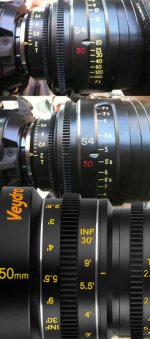
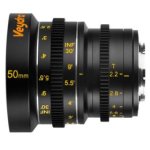
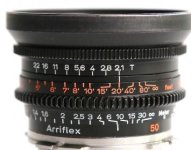
Cooke S4 vs Veydra. Immediately we should recognize that just ONE Cooke S4 lens costs about as much as 5 complete sets of Veydra lenses. Clearly the S4 is going to be the most ideal cinema lens for a focus puller (arguably) and this comparison is simply to demonstrate what is typical of a cinema lens that actually prioritizes focus pulling among other aspects of optical quality. Here I put two photos of a 50mm Cooke S4 next to the Veydra 50mm. Note the S4 is fatter, so it's girth does have more space for marks. I am posting this to demonstrate the ratio of where the marks fall compared to barrel rotation.

veydra focus.jpg

The Cooke S4 goes from infinity focus to 3' in what appears to be over 200 degrees (of 300 total) rotation, giving 22 witness mark distances along the way. In fact, I had to insert two photographs of the same focus scale in order to show it. The Veydra goes from infinity to 3' in approx 90 degrees and with five approximately marked distances along the way.


The Cooke had the advantage for two big reasons. First the designers of the lens made the focusing system cam-driven versus helical. Cam-driven simply means they had more control in spacing the witness marks so that they didn't compress as badly in the far end and spread out so much on the close end. The second reason the Cooke had an advantage was the aforementioned girth of the lens. The front diameter of the Cooke lens is 110mm, while the Veydra is 80mm.

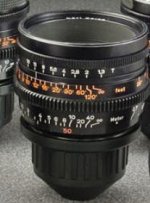
For another comparison, lets compare the Veydra cinema lens to a cinema lens that is in it's size class, a 50mm Zeiss SuperSpeed Mk II

Screen Shot 2014-11-24 at 1.33.38 AM.jpgScreen Shot 2014-11-24 at 2.31.43 AM.jpgVeydra-50mm.jpg

The picture makes it difficult to see, but clearly the Zeiss superspeed, even if counting only to the 4'-5' witness mark last viewable in the photograph, it already has about 19+ witness marks and ten of them with engraved distances. The barrel rotation from infinity to 3' looks to be shy of 120*, by estimation.

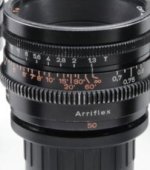
Here is a photo of a Zeiss Standard Speed prime, also 80mm front.

Screen Shot 2014-11-24 at 2.36.18 AM.jpg

It too has about the same markings as the SSm2 and pretty similar barrel rotation.
It should also be noted that the Supers and Standards are not cam-driven, but I believe traditional 'helical focus' driven, as I would assume the Veydra's are. The Supers are 360 rotation, also to be fair.

The ill-received, no-witness-mark-lined 1st generation Sony F3 PL primes had similar engravings to the Veydra's... although it did have two more distances engraved on the barrel between infinity and 3'. This is probably the lens that is closest to Veydra in price point too. These were $2k/lens at the time.
Screen Shot 2014-11-24 at 1.55.59 AM.jpg


With comparisons out of the way, one can hopefully see how although the Veydra lenses are far-and-away a better option mechanically (yet to be determined optically) than most, if not all, photography lenses, they do not quite approach what a typical focus puller would be expecting when pulling focus with cinema lenses. I hope my write-up does not seem like I'm trying to knock these off a pedestal or rain on their parade. I'm simply making a professional analysis. If they want to be called cinema lenses, which they are, I hope I'm not drawing the m4/3 community's ire when I properly score them based off of typical cinema lens criteria/expectations.

That said, we must admit these were made with priorities higher than focus pulling. It appears the extra manufacturing costs it would have required to actually engrave a usable number focus distances accompanied by accurate focus marks/lines was not worth it to them. I suppose it's a balance between optical precision and cost.

You can't argue much about this because of the resulting (and absolutely incredible price).... but I wanted to clarify that prioritizing the focus puller was likely in the mind but out of reach for the purse strings.

Again, I'll reiterate that if you pull completely off a monitor and don't even look at the marks, which is not how I work, you'll probably not notice or care about the marks in any regard.
 
Last edited:
Ok! Now for the positive things!

I do support these guys and their mission. I guess it was just the focus puller in me that had to clarify that these really weren't made for pulling focus as well as you normally find in any basic cinema lens set. If so, they'd have more than five general marks between INF and 3' on a 50mm T/2.2 lens!

Anyway, what they got right


1) They filled a need. I own S35mm cinema lenses and I own 16mm cinema lenses. I can tell you unfortunately my Cooke, Schneider and Angie 16mm zooms will not cover m4/3! My S35mm Cinema primes and zooms will, but they are built for larger sensors, so they are expensive, larger in size, heavier in weight, and they don't go as wide in focal length as the smaller m4/3 sensors dictate. Anything below a 16-18mm in S35mm is considered a specialty lens and is often not required as much, and is more expensive when it is. These lenses filled a rare gap not often seen in our industry.

2) They did their basic homework. I can't speak to the optics quality, but I can tell there was a real effort put into the housing design; if nothing more than simply researching and listening to the industry. Most try slapping a geared ring on and calling it a cinema lens, versus a cine-modded lens, which is what most really are. They also pulled in some reputable and good people on the Stateside (again can't comment on the Chinese side) such as Duclos and Illya from Hotrod. It's always smart to consult experts when embarking on a big project.

3) The matching front diameter seems like a simple concept and maybe an unimportant one, but on a cinema set, a matching front diameter means less time switching donuts, clip-on backs, or bellow step-down/up rings. Saves time, space and energy. AC's can love you for that.

4) A common threaded front. Although cinema style productions typically use screw on filters for rare instances where the MB cannot be used (small spaces, stunts, very highspeed car mounts , etc) it is nice the Veydra people thought to incorporate a common threaded size. You won't believe it but I was on a job using Summilux-C's and we needed screw in filters for a specific purpose. I knew the lenses had threaded fronts and I called EVERYONE in town asking what size. Nobody knew. Finally, I think someone at BandPro had to look it up, as he didn't know off hand. It was 92.5mm I was told. I was also told that apparently they (Leica) were going to make special screw-on round filters for the Summilux-C's but never did. I was told by Bandpro to stop looking because nobody makes that size, nor a stepdown.

For an amazing company to put so much excellent though into their lenses (upon which they charge $25,000/lens!) you'd think they'd not been total egg-heads and chosen a front filter size that actually is manufactured.

5) The near matching length of the lens, paired with matching gear placement is important as it require less maneuvering of the MB, FF, and other accessories upon a lens change. This is a great feature that is also found on many modern cinema lens sets.

6) The focal length decisions are also a detail not lost on these guys. They did the right thing by going wider focal lengths. As mentioned, S35mm lenses under 18mm tend to be specialty. They are harder to make thus more expensive to buy. There aren't as many of them out there. By going wider with these lenses, they are giving the m4/3 people the ability to capture the same FoV as their larger sensor brothers, and if you ever need a really telephoto lens, you can just get a S35mm lens. Finding a telephoto S35mm lens, like a 100, is much easier than finding a good wide S35mm lens, like a 12mm!


Overall, I think the lenses seem to exemplify the characteristics of mechanical build cinema lenses have that help move the camera department along in a logistical sense. They look to be built solid, for robust set abuse, and they seem to be made to help the AC's move faster and smarter. Gotta love that.


Besides the focus pulling concerns the only other thing I can point out as a negative is the non-linear iris and consequently the lack of 1/3 stop marks. It's a little disappointing, but not completely unheard of for entry level cinema style lenses, the CP.2's being the example that comes to mind.
 
Last edited:
According to Matt Duclos's blog, the 25mm, 35mm, and 50mm will cover Super 35, yet another reason for the combination of m43 mount and S35 sensor, like in the JVC GY-LS300.

S35 has a diagonal of 28.55mm. Duclos says that the 25 and 35 cover 31mm and the 50 covers 33mm. The 16mm only covers 26mm, and the 12mm's coverage is unknown.

I'm very interested to test these. On MD's blog, was the l/mm data based off of a m4/3 frame? What were the corners he was speaking of?
 
The origin of the glass and coatings scare me a bit but I have seen great examples of both from the same general location...
Can't wait to see some tests with other glass of known quality... ;-)

Cheers
 
The origin of the glass and coatings scare me a bit but I have seen great examples of both from the same general location...
Can't wait to see some tests with other glass of known quality... ;-)

Cheers

Well I've just put my money down.

I'm working on the basis that people we know of with hard earned reputations to lose have put their name to it, the lenses have mechanics at least as good as you could expect for the price. Honestly if the optical quality is half what we're being told I will probably still be happy with them. If I want better lenses I'll rent but these hit the sweet spot for ownership. I never thought I'd ever be able to justify owning cine primes, maybe a cine zoom one day.

The clincher though was laying out all my gear and going big picture. I spent thousands and thousands over several years to cobble together my mongrel table of equipment. What I noticed with it all laid out is how many adapters and multiples I have due to the piecemeal way I have raised my collection. I have lenses of various systems, different screw on filter sizes and the like. Things like matte boxes and follow focuses work well with some combinations and badly with others. And while it has worked for me, it's often a compromise in terms of ergonomics, ease of use and downtime. At my level and budget not such an issue but in the heat of battle, no less annoying than it would be for a pro.

For a while I've been murmuring about getting a Rokinon/Samyang set in Nikon mount and being done with it. At the Kickstarter price the Veydra is basically the same cost (maybe cheaper) but with cine mechanics and most importantly uniform form factor. In terms of system they will be less flexible than the Nikon mount but this leads into the parallel decision I have made in choosing to buy these. I am going to commit to the MFT system. I am going to do one thing and try to do it well. I am going to try take the effort I've put into collecting gear, spend less time on ebay looking for bargains and turn that effort to generating output. I am going to try and spend less time testing gear. I am going to rationalise and streamline it to the one system. I may have to buy a few new bits to suit, if necessary some big ticket items like a new follow focus and/or matte box next year. But then that's it. And I will be able to get rid of half of it.

I tell you, the world looks a bit different now I made that decision. Especially since I resisted the MFT format for the longest time. I think this will likely save me significant dollars in the long run and not just from not needing adapters and multiple format accessories now. For a start the market is driving MFT for independents. That is the system so much innovative gear is targeting. A number of important manufacturers such as blackmagic, olympus and panasonic are fully invested in it. It's generally cheaper, lighter with a smaller footprint. I'm feeling really positive about this shift in thinking and I think it is going to take away most of my habitual procrastinations and excuses.

It might all be pie in the sky but I'm feeling as positive as I've felt in months right now. Not so much for the lenses themselves (which is still a somewhat scary amount to pay as a lump sum) but for the rationalisation and reassessment I was forced to undertake in considering my purchase.

So why did I write all this? Well rather than just saying "I'm getting my set nyah-nyah-nyah, look at all your broke asses with no Veydras! bwahahaha" I know a lot of people are having unhinged conversations with themselves right now about whether they can justify a shiny new toy or 5 (especially this close to christmas). Hopefully the way I came to my decision might help someone else to reach a yay or nay and feel good about their decision.
 
The origin of the glass and coatings scare me a bit but I have seen great examples of both from the same general location...
Can't wait to see some tests with other glass of known quality... ;-)

Cheers
There is a DVinfo article on this featuring interview of Ryan Avery, the promoter of this project. http://www.dvinfo.net/article/acquisition/micro-43/new-glass-veydra-cine-primes-for-micro-43.html

He says "In order to hit the incredibly affordable price, we did not use any aspherical elements but rather paid close attention to coatings and the spherical elements used".

There is no free lunch. You get what you pay. So don't expect these lenses to be as good as other good cinema glass which cost much more.


I am going to commit to the MFT system. I am going to do one thing and try to do it well. I am going to try take the effort I've put into collecting gear, spend less time on ebay looking for bargains and turn that effort to generating output. I am going to try and spend less time testing gear. I am going to rationalise and streamline it to the one system.

Well done. The mental tax of complicated gear is often overlooked.
 
Just to add a few cents to the discussion...

Ryan- There are a few features 'not final' about the lenses showm and my understanding is that the distance engravings shown are 'not final'... So hopefully they will improve.

Also, in regards to the lack of engraved witness marks- it is mostly due to do with the fact that MFT cameras are not shimmable, rather than expense. If you really only use one camera, the V-channel on the focus ring will allow owners to set their own semi-permanent marks, and keep them accurate. Also, Hot Rod Cameras can offers a permanent engraving service for those who want engravings for their camera and don't want to mark/paint them themselves.

We just received the prototype Veydra set this afternoon and I as of yet haven't seen this version of the prototype, so I'm going to investigate the adjustable focus scale for infinity, which should be fun.

As for "no aspheric elements" in the Veydras- a lot of extremely high quality glass do not use aspheric elements including the brand new $100K+ set of Leica Cine Summicrons. There's more than one way to get from A to B, and aspheric lens elements is just one way.

The product shots of the Veydra lenses are really nice, but I think that the actual diminutive stature has been lost with all the close up photos, tomorrow I'll post some pics that give a nice point of reference.

I have some questions myself because I haven't seen final-final lenses yet, but I don't think anyone will be disappointed from an optical or mechanical standpoint for an MFT lens. While the longer focal length Veydra lenses may cover 35mm, I don't think people should be thinking of them as 35mm size lenses as there's a fair bit of drop off when you get much outside (M)FT image circle. If the lenses that deliver are like the prototypes (and I don't have any reason to doubt that they will be) then the Veydra lenses are very, very good (M)FT format lenses, optically and mechanically superior to some other popular lenses.

I was actually just informed that Hot Rod Cameras only has a limited number of Veydra Mini-Prime lenses available at the Kickstarter price left (I believe it's only 3x sets!), and once those are gone the prices go back up to the standard rate. If you were thinking of picking up a set at the Kickstarter price for a small deposit through Hot Rod Camera, I would recommend doing so immediately, I'm not sure if we will make it through tomorrow or even Black Friday, let alone the rest of the Kickstarter campaign!
 
...As for "no aspheric elements" in the Veydras- a lot of extremely high quality glass do not use aspheric elements including the brand new $100K+ set of Leica Cine Summicrons. There's more than one way to get from A to B, and aspheric lens elements is just one way.

The product shots of the Veydra lenses are really nice, but I think that the actual diminutive stature has been lost with all the close up photos, tomorrow I'll post some pics that give a nice point of reference.....

Thanks for the info. about the aspheric elements Illya.

And yes I think the product shots are Beautiful but some people may be in for a surprise upon seeing
the actual size of m4/3 lenses. The actual lens dimension measurements should be posted on the kickstarter.

But in the BMPCC test video the comparison to the 1.5 Rokinon 50mm T1.5 lens at 2:40 to me sure looks like
the Rokinon is sharper and has less flare. Anybody else have opinion on this..?

http://vimeo.com/112756842

Other thing is...well...umm... what if Black Magic and Panasonic never make another m4/3 sensor...?..then what...?
 
Just to add a few cents to the discussion...

Ryan- There are a few features 'not final' about the lenses showm and my understanding is that the distance engravings shown are 'not final'... So hopefully they will improve.
If my lengthy ramblings haven't already beaten the point home, improved markings would be a tremendous improvement to the aspect of usability to a focus puller who does not pull by monitor. And yes there are work arounds too.

Also, in regards to the lack of engraved witness marks- it is mostly due to do with the fact that MFT cameras are not shimmable, rather than expense. If you really only use one camera, the V-channel on the focus ring will allow owners to set their own semi-permanent marks, and keep them accurate. Also, Hot Rod Cameras can offers a permanent engraving service for those who want engravings for their camera and don't want to mark/paint them themselves.

An interesting point. My assumption (that the lack of witness lines was based off of price) was because for general/assembly, unless you take the time to custom engrave each lens, I was under the impression that mass stamping focus barrels with precise marks/lines would be a QC nightmare when lenses did not quite match up. Hence, by eliminating the exact line, any slight discrepencies don't appear off. This understanding came from discussions with people on why the Sony PL F3 set (original) also neglected to include exact witness lines to accompany the distance engravings. It was cost because getting the lenses to line up accurately with witness lines meant either each lens had to be custom engraved or the lenses would fail QC more often.

You make an excellent point about the mount not being shimmable... another reason I tend to question native m4/3 and EF mount cinema lenses. Although adapters have the possibility to create small play and introduce image shifting, I often find that the shimmable mount adapters are handy for this reason. I did a job not too long ago where we used a GH4 and Cooke S4's as B camera to an Arri Amira. Although we had a high quality adapter that was pre-shimmed in the factory for use on a GH4, it was still a little off from our GH4. Luckily, it came with a shim-pack and I installed the thinnest shim during prep, and all the marks aligned.

Are m4/3 mounts just not manufactured to tight enough specs?

What creative way could we overcome this?

It seems rather important if accurate and permanent marks were to ever be desired.

Just thinking out of fantasy land, (not really recommending this) but solutions to this issue might include:

1) Having the mounts of the lenses designed to be shimmed, like CP.2's.

2) Maybe the lenses could have backfocus adjustment ring, like ENG lenses, to accomplish the same thing.

3) The dream would be to have a professional m4/3 camera manufacturer create an adjusting sensor block like RED cameras can adjust flange distance. Then you simply need mutually accurate calibrated lenses.


We just received the prototype Veydra set this afternoon and I as of yet haven't seen this version of the prototype, so I'm going to investigate the adjustable focus scale for infinity, which should be fun.

As for "no aspheric elements" in the Veydras- a lot of extremely high quality glass do not use aspheric elements including the brand new $100K+ set of Leica Cine Summicrons. There's more than one way to get from A to B, and aspheric lens elements is just one way.

Yes! Agree 100%. Lots of aspherical assumptions going around and I don't think people realize that many good lens designs in top-shelf cinema lenses are not aspherical. Zeiss Ultra Primes, Cooke S4's, Cooke 5/i's and Summicron-C's to name a few of the most notable and impressive lens sets that do not have any aspherical elements.

Also, for those reading who do not know much about this stuff, it should be noted that 'aspherical' is referring to a particular type of design for a lens element. Not the entire lens design. In fact, a prime lens with aspherical elements will typically have about 10-14 elements and only one or two of those will be aspherical. The rest are non-aspherical elements. These lenses with aspherical elements are still referred to as spherical lenses as a whole, as "non-spherical" is a term for lens designs such as anamorphic. So a non-spherical lens is something different, like anamorphic. Spherical lenses can have, but don't need to have aspherical elements, which will only be one or two of the 10-14 elements on average. :)


There are also aspherical lens sets that are optically better than those mentioned above, and there are aspherical lens sets that are optically worse than those mentioned above, so it's safe to say apsherical doesn't always equal better and apsherical also doesn't mean cinema. Aspherical is found in Master Primes, and also in photography lenses. It's a very cool method to help reduce chromatic aberrations, especially in wider lenses, but not a immediate guarantee of overall quality.


I have some questions myself because I haven't seen final-final lenses yet, but I don't think anyone will be disappointed from an optical or mechanical standpoint for an MFT lens. While the longer focal length Veydra lenses may cover 35mm, I don't think people should be thinking of them as 35mm size lenses as there's a fair bit of drop off when you get much outside (M)FT image circle. If the lenses that deliver are like the prototypes (and I don't have any reason to doubt that they will be) then the Veydra lenses are very, very good (M)FT format lenses, optically and mechanically superior to some other popular lenses.

Agree 100%. These lenses are custom made for m4/3 and that was the intentional purpose of their development. Although Duclos's findings show the image circle of longer lengths do technically cover s35mm, I think betting on or hoping for these lenses to cover s35mm (and cover it well,) is missing the point completely. hahaha.

If Duclos's l/mm data from center to corner was based on a m4/3 frame, I would speculate the same as you in regards to further deterioration outside the intended image circle area. Key word, intended. :)
 
Last edited:
So where does this glass come from? It's a mod from which lenses? What's the multiple factor? I plan do use these with the Black Magic Pocket
 
I was actually just informed that Hot Rod Cameras only has a limited number of Veydra Mini-Prime lenses available at the Kickstarter price left (I believe it's only 3x sets!), and once those are gone the prices go back up to the standard rate.

Does anyone have data on how often the street prices end up being the prices they think they are? Last time I bought something on Kickstarter, it ended up being the same price as when it hit the market & then a little cheaper 3-6mo later.
 
Back
Top