

Patryk_Rebisz
Veteran
I wrote a post on my blog reviewing various follow focus units for work with photo lenses (meaning work with DSLRs):
http://patrykrebisz.wordpress.com/2011/01/23/follow-focus-and-if-you-need-one/
You even wondered why a chunk of metal with some gear box would cost $1k+? Here is why.
If anyone has experience shooting with DSLR, or shooting HDV (or any other highly compressed format) one wonders at the crispness of images coming out of those cameras. At the same time if anyone knows just little bit about mathematics one’s jaw drops when faced with impossible numbers of compression ratios that the footage coming out from those cameras has to go through to be recorded on the media. Still, numbers aside, visually the images look superb and one discovers that “good enough” is indeed good enough!
With similar philosophy one starts approaching other parts of the equation of making images. If one piece of the gear is good enough why should I spend big money to get expensive gear if there are plenty of options available for much smaller amount and if much cheaper cameras deliver satisfying image then potentially that peripheral gear shall do the same. Unfortunately that is not the case when it comes to follow focus units.
Good enough (meaning here cheap enough) is simply not adequate. Maybe it’s because it’s so much easier to judge the performance of the peripherals… The footage either is in focus or it’s not. You either hit the marks or you do not.
If you have a follow focus that is of poor quality, nine out of ten times, most likely you will get better result without using one.
Any assistant cameraman will tell you that a follow focus is an essential gear to achieve focus on the subject while the subject is moving in relations to the camera, but… Photo lenses working in the film world have a few properties that have no significance on them taking breathtaking sharp pictures but are not so great when dealing with films… Their focusing ring barely moves when going from say 6 feet to 4 feet (or any other distance for that matter) thus to pull the focus on such a move you will have to move the barrel of the lens by millimeters. Thus it should not be surprising that the quality of the follow focus has to be extra ordinary to allow any possibility of hitting the focus marks.
At first many are put off by the price tag of the pro follow focus units, after all it’s nothing but a 90 degree gear box with a focusing wheel on one end and the gear to turn the lens at another, but that simplified perception (and I must admit I was of that view at some point) quickly changes when one starts playing with various follow focus units in the field.
Truth is if you are using photo lenses none of the sub $1k units deliver. They simply do not allow one to hit the marks.
So if that is the case what makes the $1k + follow focuses so great?
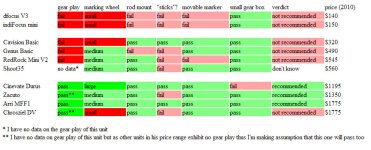
Great follow focus has little gear play, meaning when the marking wheel is moved it engages the leans gear right away.
FF should have a large marking wheel to make the difference between millimeter focus pulls more apparent.
FF should not “stick”to the lens barrel when being tightened on the rods as it forces too much tension on the lens.
FF should have as few adjustments screws as possible to speed up the lens changes.
FF should have movable marker for those difficult camera placements.
And here is the rund down of popular follow focus units:
http://patrykrebisz.wordpress.com/2011/01/23/follow-focus-and-if-you-need-one/
You even wondered why a chunk of metal with some gear box would cost $1k+? Here is why.
If anyone has experience shooting with DSLR, or shooting HDV (or any other highly compressed format) one wonders at the crispness of images coming out of those cameras. At the same time if anyone knows just little bit about mathematics one’s jaw drops when faced with impossible numbers of compression ratios that the footage coming out from those cameras has to go through to be recorded on the media. Still, numbers aside, visually the images look superb and one discovers that “good enough” is indeed good enough!
With similar philosophy one starts approaching other parts of the equation of making images. If one piece of the gear is good enough why should I spend big money to get expensive gear if there are plenty of options available for much smaller amount and if much cheaper cameras deliver satisfying image then potentially that peripheral gear shall do the same. Unfortunately that is not the case when it comes to follow focus units.
Good enough (meaning here cheap enough) is simply not adequate. Maybe it’s because it’s so much easier to judge the performance of the peripherals… The footage either is in focus or it’s not. You either hit the marks or you do not.
If you have a follow focus that is of poor quality, nine out of ten times, most likely you will get better result without using one.
Any assistant cameraman will tell you that a follow focus is an essential gear to achieve focus on the subject while the subject is moving in relations to the camera, but… Photo lenses working in the film world have a few properties that have no significance on them taking breathtaking sharp pictures but are not so great when dealing with films… Their focusing ring barely moves when going from say 6 feet to 4 feet (or any other distance for that matter) thus to pull the focus on such a move you will have to move the barrel of the lens by millimeters. Thus it should not be surprising that the quality of the follow focus has to be extra ordinary to allow any possibility of hitting the focus marks.
At first many are put off by the price tag of the pro follow focus units, after all it’s nothing but a 90 degree gear box with a focusing wheel on one end and the gear to turn the lens at another, but that simplified perception (and I must admit I was of that view at some point) quickly changes when one starts playing with various follow focus units in the field.
Truth is if you are using photo lenses none of the sub $1k units deliver. They simply do not allow one to hit the marks.
So if that is the case what makes the $1k + follow focuses so great?
Great follow focus has little gear play, meaning when the marking wheel is moved it engages the leans gear right away.
FF should have a large marking wheel to make the difference between millimeter focus pulls more apparent.
FF should not “stick”to the lens barrel when being tightened on the rods as it forces too much tension on the lens.
FF should have as few adjustments screws as possible to speed up the lens changes.
FF should have movable marker for those difficult camera placements.
And here is the rund down of popular follow focus units: