Using "ING"

There are many 'individual cases', just as there are many successful professional athletes who have unusual techniques..which doesn't put the lie to the proven, effective ways coaches train young players...

Exceptions will always abound, but they don't discredit the learned advice of skilled teachers and practicioners. Nonetheless, one can go it their own way if they choose. Most who do so without a firm grasp of the 'rules' they are breaking will have considerably greater difficulty succeeding than if they did...

Embrace it, or not, as you wish...
 
But what is this rule against the present progressive? And most importantly, why? Who are these people who advise against it? What are their credentials? Where did they come to this conclusion? Did they experience a particular case in which a student's script didn't sell over it?

I don't think anyone is encouraging nonconformity here. It's just that this 'rule' feels like arbitrary hearsay and not very writerly.
 
I call B.S. on this supposed stigma. Maybe, if anything, gurus use it to scare newb writers into paying for their 'expertise', but I can't see why this would mean anything to the people who would actually buy the script.

A great script will transcend most formatting 'issues', for sure. But it's better to do in the most coherent way, all else being equal, no?

The 'ing' thing (ahem) is not in itself a big deal, for sure. It's a very small one...
 
Like I said - a small deal. "John is walking to the door" pretty much gets the idea across. "John walks to the door" is better, but like you said, no one's otherwise good script is going to hit the Hollywood trash can over the first version...
 
But what is this rule against the present progressive? And most importantly, why? Who are these people who advise against it? What are their credentials?

It comes up quite often in books on screenwriting, like "The Screenwriter's Bible" by David Trottier, a particularly well regarded and popular 'beginner's' book, and in several others I've read. The 'rule' makes sense to me, so I use it. Many others do too. Not a dealbreaker though, just good advice IMO...
 

Interesting. The thought that came to mind for me in the example he cited as a 'permissible' way of using 'ing':

"Bob is scrubbing the ketchup out of his hair when he hears a SCREAM."

...is something of an exception I think; the more important event/action (hearing a scream) is embedded in an ongoing one (scrubbing...), so it would seem to fit the 'ing' usage better than "Bob is scrubbing the ketchup out of his hair" (period) would. I think it's the latter that most of these guys object to, however mildly so...
 
I totally agree. And it could be an interesting research project for some MFA screenwriting student or such to do some forensic research on. Where did such a ridiculous "rule" come from. I just pulled up North by Northwest just for the frack of it, and honestly I randomly flicked forward to a page and looked at the first action narrative, and this is what it was:

[scrippet]
Linger leads him over to a table where Dr. Cross, a pleasant young physician, is waiting with medical kit.
[/scrippet]

Nuf said. Fits perfectly with what has been discussed here, and yes there is an ING verb usage. It is not passive, it is active in spite of an ING verb tense.

Passive (which is what you want to avoid) would have been

[scrippet]
He was lead over to a table by Linger where there was waiting a pleasant young physician, Dr. Cross, with medical kit.
[/scrippet]


...What is this "no -ing" rule people are citing here? It definitely isn't passive voice. Show me a list of this consensus. What are their credentials? Where are they getting this feedback from? And why, as writers (presumably), would they do away with something so useful? What development exec or producer goes around counting present progressive verbs? Who rejects a great script on that basis? I call B.S. on this supposed stigma. Maybe, if anything, gurus use it to scare newb writers into paying for their 'expertise', but I can't see why this would mean anything to the people who would actually buy the script.
 
And of course all this naval gazing should be done during the rewrite. Clear your head of this nonsense for the draft, creativity doesn't need blockers. Keep right brain and left brain processes separate! :)
 
The thing is to make sure your description isn't passive and dull... often "ing" indicates passive. Part of the job is to USE YOUR BRAIN.

- Bill
 
I worked hard to learn the super-streamlined minimal "zen" approach, but after I did, I started noticing that I was writing stuff that might make it --harder-- for the reader to understand, like haikus or something, so it does defeat itself if you overdo it.

first work on purging yourself of "its" and "ly" and "ing" and all that other stuff and then later on find the middle ground somewhere, in the constant learning and improvement process that is being a writer ...

<grabs a rifle and goes out to hunt buffalo>
 
Last edited:
I'm a bit confused. I hear constantly about not using ING in scripts, but I went through the academy awards scripts for 2012, good portion use it. Some regularly. Is that a perk of success or am I misunderstanding the rules.

That's your answer. If the academy awards scripts use it, then you can use it too!
 
When referencing scripts for well-known movies, make sure you're reading the actual script. A great deal of what's out there is actually transcripts of the movies, not the original screenwriter's script. If it reads exactly like the movie, I'd bet it's a transcript -- since quite often bits of dialogue, even entire scenes, are left on the cutting room floor.
 
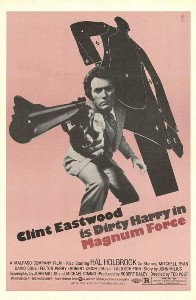
I don't have a problem with 'sweat beading...'... since it 'reads fast'... as for scabbard... only Clint's 44 Magnum would probably be held in a 'scabbard'... holsters for ordinary mortals' guns... I mean fire arms...

Magnum_Force.jpg

Actually, a scabbard (when referring to a gun) is a 'holster' for a rifle or shotgun http://www.ebay.com/bhp/shotgun-scabbard
...otherwise it's all about the knife/sword! :happy:
 
Back
Top