I was just wondering if anyone had tried hooking up truck batteries to an invertor to power their lights. I want to get a shot of a car driving through an empty rural road at night so I want to beef up the headlights by throwing a 1k par into the mix. I don't want to deal with the generator noise though, so thought about the possibility of using batteries.

Navigation
Install the app
How to install the app on iOS
Follow along with the video below to see how to install our site as a web app on your home screen.
Note: This feature may not be available in some browsers.
More options
You are using an out of date browser. It may not display this or other websites correctly.
You should upgrade or use an alternative browser.
You should upgrade or use an alternative browser.
truck/car batteries to power lights
- Thread starter Soldier
- Start date
morgan_moore
Major Contributor
Did you have an inverter in mind?
Typical inverters are maybe 500 watts (but Id only go 300W on a 500w inverter)
i guess for 1k you may need a couple of truck batts at least
Running some LCD panels is a different question, they run off 12v (no inverter losses) an may be used with car batts with good effect
I wonder if you could source some 12v DC tungsten lights (like car spotlights/foglamps?)
Maybe there are inverters suited for this purpose but my guess is running a 1k will be a challenge

Paul Hudson
Vacuum Tube Member
You can get 1000 watt inverters, no problem. Just make sure you keep the vehicle running they are hooked up to. They will drain the battery very fast.
Eileen Ryan
Member
I was just wondering if anyone had tried hooking up truck batteries to an invertor to power their lights. I want to get a shot of a car driving through an empty rural road at night so I want to beef up the headlights by throwing a 1k par into the mix. I don't want to deal with the generator noise though, so thought about the possibility of using batteries.
You have to be really careful powering lights off of inverters through the lighter socket. Car lighter sockets are only capable of handling a couple of hundred Watts at most. If you want to run a 1k, a better alternative is a "Battverter" - which is a Battery/Inverter system. A "Battverter" system consists of a 12V DC power source (usually Marine Cells or motorcycle batteries), a DC-to–AC True Sine Wave Power Inverter, and a Battery Charger. Wire these components into a compact Anvil Road Case and you can put it on the floor in the back of the car. Here are some production stills that show you two Battverter systems we built to run kinos to light the inside of an airport shuttle bus for the feature "Shuttle." The first is a 750W "Batt-Verter" rig wired into in Calzone case and mounted on a Exo-skeletal pipe rig that also held Kino Flos.

(Exo-skeletal pipe rig on shuttle to rig lights and mount 750W batt-verter on front (covered for rain protection)
To maximize the running time on the batteries, we made up a lightweight "jumper cable" that we attached to the leads of the bus's battery. That way the engine alternator charged the batteries as they were being discharged by the lights. If you were to likewise tie a BattVerter into the car engine, you can greatly extend the life of the batteries so that you never run out of power.

(750W "Batt-Verter" Rig wired into in Calzone case and tied into the Shuttle’s alternator)
The production stills below show you a more elaborate 1800W Battverter system that we built to run 16 - 4’ kinos tubes inside the airport shuttle bus. Use this link - http://www.screenlightandgrip.com/html/shuttlemailintro.html - for details on how we wired it into the shuttle bus.

(1800W "Batt-Verter" Rig wired into the back of Shuttle)
Keep in mind that when voltage goes down, amperage goes up. All wire that carries 12V DC has to be sized accordingly. For instance to supply 12 volts to the 1800W inverter used on the shuttle bus required that we run 2 ought feeder to the buses' alternator. Also be sure that the alternator is large enough to take the load without burning out. On our 1800W rig we were able to run four 4' 4 Bank Kinos.

(Custom 1800W BattVerter powers 16 - 4' Kino Flo single tubes rigged in the interior and on the exterior of an Airport Shuttle)
Finally, You have to be really careful when choosing a DC-to-AC inverter for film production because there are three basic types of inverters and not all of them are suitable for all types of motion picture lights. For more information on what type of inverters to use with different type of lights I would suggest you read an article available online at http://www.screenlightandgrip.com/html/emailnewsletter_generators.html about portable generators. Since inverter generators use the same three types of inverters, the information in the article is applicable to stand alone DC-to-AC inverters designed for use with batteries as well.
Eileen Ryan, Gaffer
Paul Hudson
Vacuum Tube Member
RV manufactures have used inverters for years without the complicated rig above. Yes, it is nice. Is it needed, no. Should you run 1000 watts through your cig. lighter, absolutely not. These have to be hooked directly to the battery and fused for safety.
Last edited:
j1clark@ucsd.edu
Veteran
RV manufactures have used inverters for years without the complicated rig above. Yes, it is nice. Is it need, no. Should you run 1000 watts through your cig. lighter, absolutely not. These have to be hooked directly to the battery and fused for safety.
People can get away with a lot of things. The rig as shown in the BTS shots, to me looks like it would work guaranteed... My recommendations for this sort of thing is to start with an inverter that has about 2x the desired power, because during startup, most things draw far more than their steady state draw. Add to that various power robbing effects of non-linear loads, add that to non sinewave inverter output...
As for 'gauge' of wire required... you'd be surprised at how many people think that something the size of ordinary 'house' wiring will 'work'... when they are drawing significant current to power X Watts from their battery via an inverter...

john threat
Carbonite Member
I have done it tons of times, I have a 1500 watt continous inverter wired behind the dash of my jeep. Safe, wire with the right gauge wire always, otherwise the wire will burn and quick.
I also have a portable generator, honda 2000i that's quiet and works well. I wouldn't use it to drive high speed and power things. Gas sloshing around in a generator isn't a good idea I think.
I also have a portable generator, honda 2000i that's quiet and works well. I wouldn't use it to drive high speed and power things. Gas sloshing around in a generator isn't a good idea I think.
that's silly.If you need lights from a battery, use bulbs running at battery's voltage.
in that case, 12V bulbs from cars are easy to find in many colors, even in HMI version.
12V light bulbs can go as high as 250W or even 500W (i used to have 2x250W in my divers backpack lamp)
in that case, 12V bulbs from cars are easy to find in many colors, even in HMI version.
12V light bulbs can go as high as 250W or even 500W (i used to have 2x250W in my divers backpack lamp)
A 1000 watt or 1500 watt inverter is normally only rated at that high wattage for peak.
It will not take a steady draw at that wattage but perhaps for only a few seconds at that high of a wattage.
Check the specs. on the inverter most will say peak wattage or peak draw.
Your better off to run low wattage draw LED panels on inverters.
I do it a lot.
It will not take a steady draw at that wattage but perhaps for only a few seconds at that high of a wattage.
Check the specs. on the inverter most will say peak wattage or peak draw.
Your better off to run low wattage draw LED panels on inverters.
I do it a lot.
I have done it tons of times, I have a 1500 watt continous inverter wired behind the dash of my jeep. Safe, wire with the right gauge wire always, otherwise the wire will burn and quick.
I also have a portable generator, honda 2000i that's quiet and works well. I wouldn't use it to drive high speed and power things. Gas sloshing around in a generator isn't a good idea I think.
If you are using a large inverter to power a 1kw light, you don’t want to wire it directly into the car because it will drain the car battery very quickly and then you are dead in the water. The problem with car batteries is that they are designed to provide high amperage for a short period of time to crank the engine. They are not designed to sustain a continuous load. As pictured in the example of the rig we built for the movie Shuttle that Eileen posted above, you should use deep cycle marine cells to power the light. To extend the time you will get on the marine cells, you should tie them into the car’s alternator so that the alternator charges the marine cells while it is running. Simply jumping them onto the car’s battery is sufficient. As others have mentioned above, you want to make sure to use the right size cable and put the right size fuse in-line. You also want to make sure the car’s alternator is rated for the load, otherwise it will burn out; and you DO NOT WANT TO PUT THE MARINE CELLS IN A TIGHTLY CLOSED CAR. As batteries charge they generate Hydrogen Gas that will build up if the car is tightly sealed. Put the batteries in the trunk with the hood open a crack.
If you don’t want to tie batteries into the car’s alternator, you should consider using a small portable generator. But, you don’t want to use a generator, like the Honda EU2000 that John mentions, that has a gravity feed for fuel. As John points outs, the fuel will slosh around and cause the generator to run erratically. I would suggest you go to U-Haul and rent a small utility trailer and hitch, and tow a generator that has an electric fuel pump like the Honda EU6500is Inverter Generator. The fuel pump will assure a continuous feed of gas. The Honda is so quiet that you will not notice it over the noise of the car engine and it will provide enough power to put a 1kw Par on each side to spread the head lights and use kinos or LEDs to light talent inside the car.
If you have any questions about using inverters or generators, I would suggest you read an article I wrote on the use of portable generators in motion picture production. Harry Box, author of “The Set Lighting Technician’s Handbook” has cited my article in the just released Fourth Edition of the handbook. In addition, he has established a link to it from the companion website for the Fourth Edition of the Handbook, called “Box Book Extras.”

If you haven't yet read the article, or looked at it in a while, it is worth reading. I have greatly expanded it to be the definitive resource on portable power generation for motion picture production. Of the article Harry Box states:
"Great work!... this is the kind of thing I think very few technician's ever get to see, and as a result many people have absolutely no idea why things stop working."
"Following the prescriptions contained in this article enables the operation of bigger lights, or more smaller lights, on portable generators than has ever been possible before."
"Following the prescriptions contained in this article enables the operation of bigger lights, or more smaller lights, on portable generators than has ever been possible before."
The “Box Book Extras,” site is also worth checking out because it includes other source material used for the handbook, articles by Harry Box published in other periodicals, related websites, a list of production oriented i-phone apps, as well as more in depth discussion of topics touched upon in the handbook. You can log onto the Box Book Extras site at http://booksite.focalpress.com/box/setlighting/ with our pass-code "setlighting." Use this link for my news letter article on the use of portable gas generators in motion picture production.
Guy Holt, Gaffer, SceenLight & Grip, Lighting and Grip Rental & Sales in Boston.
Since I've worked with inverters for years, make sure you use a TRUE sinewave inverter with anything that has magnetic ballasts or power transformers. "Modified" sinewave inverters are essentially square(ish) waveforms that play havoc with anything running on magnetics. You'll get anything from noise and hash to burning out transformers as they weren't designed to withstand the periods of DC that will be running through their coils. They'll also run HOT until they die too.
Electronic ballasts/powersupplies and regular tungsten are just fine on "modified" sine.
Electronic ballasts/powersupplies and regular tungsten are just fine on "modified" sine.
Electronic ballasts/powersupplies and regular tungsten are just fine on "modified" sine.
As Svart says, tungsten lights will work just fine on “modified” sinewave inverters. But, with electronic ballasts/power supplies of Kinos and HMIs you have to be careful when choosing a DC-to-AC inverter for film production. As Svart implies, there are three basic types of inverters and not all of them are suitable for production applications. For example, Kino Flo on their website recommends a pure sine wave inverter. “Inexpensive saw tooth or near sine wave inverters”, they say,”may not work” (http://www.kinoflo.com/FYI/FAQs.htm#2.) For this reason it is important to understand the different types of inverters that are out there and when they will work.
The recommendations I will make in this post are based upon extensive research I have done on the use of portable gas generators in motion picture production. For this research, I ran a series of tests in order to analyze the interaction of the different type of portable generators with the prevalent light sources available today. Since inverter generators use the same three types of inverters, the findings of my research are applicable to stand alone DC-to-AC inverters designed for use with batteries as well. The results of my tests are cited in the recently released 4th edition of the "Set Lighting Technicianís Handbook." I have also compiled the results in an article for my company newsletter and it is available on our website.
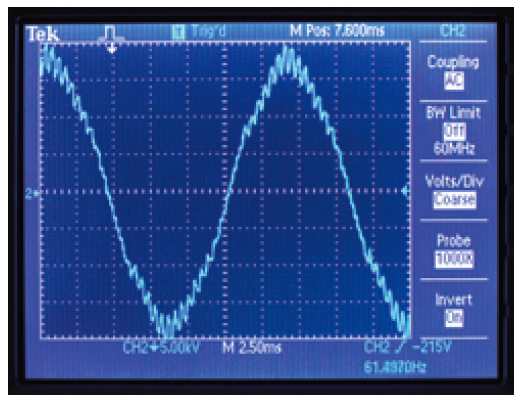
Waveform of power output by conventional generator. Note the frequency error and noticeable distortion (ILLUSTRATION COURTESY OF KIRK KLEINSCHMIDT]
To understand how the application is the same it may help to review why inverters are used in generators in the first place. Even though a conventional generator makes a pretty decent AC power sine wave, it is considered “dirty” power. Measured on an oscilloscope (pictured above), its’ sine wave appears jagged. Those small spikes in the sine wave indicate harmonic distortion that can cause problems for sophisticated electronics, like video cameras, monitors, computers, hard drives, and electronic ballasts, that need a clean sine wave to operate. With the increasing use of personal computers and microprocessor-controlled recording equipment in motion picture production, there is a greater demand for clean, reliable power on sets.

Step 1: Rectifier Bridge converts multi-phase AC power to rectified sine wave. Step 2: rectified sine wave is flattened to DC. Step 3: micro processor switching alternates wave polarity creating a modified square wave. (ILLUSTRATION COURTESY OF HARRY BOX]
Inverter generators meet this demand for cleaner power by adding an additional step that completely processes the “dirty” AC power from the generator’s alternator. An inverter module takes the raw power produced by the generator's alternator and passes it through a microprocessor controlled multi-step process to condition it. In the process the inverter cleans and stabilizes the power.
The three types of inverters are, "true sine wave", "modified square wave" (also known as "modified sine wave"), and "square wave." One might wonder why there are so many types of inverters. As John De Armond, explains in his informative article "The “Hows” and “Whys” of Inverters and Inverter Generators" the primary reason is cost. To paraphrase John's article, to make a nice sine wave from DC power (whether generator power or battery power) is expensive. There is a trade-off between cost and waveform purity. An approximation of a sine wave may be created by outputting one or more stepped square waves with the amplitudes chosen to approximate a sine (a "modified square wave" inverter). The more steps, the more like a sine wave the output (a "true sine wave" inverter). However, each of the voltage steps requires its own voltage supply, its own transistor switch, plus the necessary control circuitry. The bottom line is that the more steps, the more expensive the inverter. The two go hand in hand.
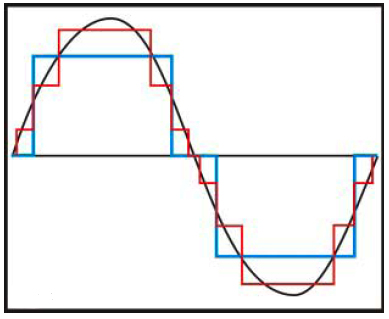
Ideal Sine Wave (black), Single Step Square Wave (blue), Three Step Square Wave (red)( ILLUSTRATION COURTESY OF JOHN DE ARMOND)
Take a look at the figure above. The black trace is a pure AC sine wave. The blue wave is a single step approximation or square wave. The red wave is a three step wave or simple modified square wave. As is intuitive, the three step wave produces a closer approximation of a sine wave and thus will satisfactorily operate more devices than the single step one. The trade-off is cost and complexity

Switch sequence of three step output stage of a modified square wave inverter. ( ILLUSTRATION COURTESY OF JOHN DE ARMOND)
The figure above is a line drawing of a typical three step output stage of a simple modified square wave inverter. The voltages V1 through V3 are increasingly higher DC voltages. A microprocessor generates this pseudo sine wave by sequentially switching S1 through S3 on, S3 through S1 off, S4 through S6 on, S6 through S4 off. It repeats this 60 times a second. Where each of the voltage steps requires its own voltage supply, its own transistor switch, plus the necessary control circuitry, one can intuit that the more steps in the modified square wave, the more complicated and thus more expensive the inverter. Where it is less expensive to make a modified square wave that will satisfactorily operate most construction equipment and RV appliances, than it is to make a true sine wave there is not the cost/benefit return to warrant the incorporation of more switches in inverters manufactured for these markets. This is why there are still three types of inverters available on the market to this day for use with batteries and built into generators.
Square wave (SW) inverters will run simple things like tools with universal motors with no problem, but not much else. For this reason, SW inverters are now found only in the construction trades, where they offer the benefit of being cheaper. For the reasons detailed below, SW inverters have no application in motion picture production.
“Modified Sine Wave”, “Psuedo Sine Wave”, and “Cycloconverter” are all sales terms used for a modified square wave type of AC power generated by inverters with more switching capacity. Modified square wave (MSW) inverters are low in cost and will satisfactorily operate almost all common household appliances and power tools. For this reason, MSW inverters are the most prevalent and the ones typically used in the economy RV/Residential Standby and Industrial lines of inverter generators. Unfortunately, they also are not suitable for use in motion picture production except for the powering of quartz lights. Since I am out of space, I will have to explain in my next post why MSW Battery Inverters and Inverter Generators are not suitable for HD digital cinema productions.
Guy Holt, Gaffer, SceenLight & Grip, Lighting and Grip Rental & Sales in Boston.
I will have to explain in my next post why MSW Battery Inverters and Inverter Generators are not suitable for HD digital cinema productions.
Continued from above.
MSW Battery Inverters and Inverter Generators are not suitable for HD digital cinema productions because a modified square wave will cause sensitive electronic equipment (computers, hard drives, video cameras) to overheat, and will cause electronic HMI and Fluorescent light ballasts to kick harmonic noise back into the power stream. Furthermore, electrical components that depend on the peak value of the voltage waveform to operate effectively (the diode-capacitor power supplies in computers, hard drives, and electronic HMI ballasts, as well as the bridge rectifiers of battery chargers) will not operate effectively on a modified square wave. In his article "The “Hows” and “Whys” of Inverters and Inverter Generators," John De Armond explains why using the example of a battery charger powered by a rudimentary MSW inverter generator - a Honda EX350.
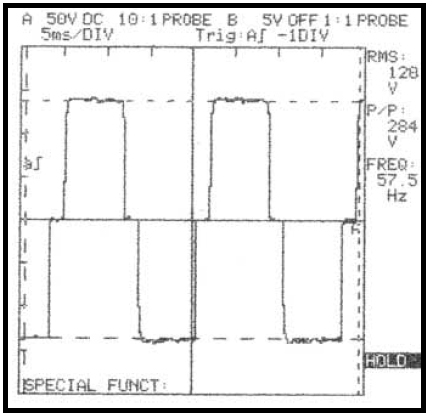
Output waveform of a Honda EX350 square wave inverter generator ( ILLUSTRATION COURTESY OF JOHN DE ARMOND)
The illustration above is of an oscilloscope shot of the modified square wave of a Honda EX350 inverter generator. The output of a MSW battery inverter would be almost identical. Notice the Root Mean Square (RMS) voltage indication (on the right side) is 120 volts even though the peak voltage is only 142 volts. A true sine wave with a RMS voltage of 120 would have a peak voltage of 169 volts (120 x 1.414 = 169 volts.) This difference in peak voltages is what makes MSW inverters unsuitable for motion picture production applications. This becomes apparent when we compare the operation of a battery charger on the true sine wave of grid power to its operation on a modified square wave of an MSW inverter.
A battery charger typically consists of a step down transformer, a rectifier and support electronics like charge control circuitry. On each half-cycle of the 60 hz line voltage, the voltage first increases and then decreases in the shape of a sine. The transformer secondary of the battery charger follows this voltage. Connected to the secondary is the rectifier that converts the AC to DC for battery charging. Only when the instantaneous AC voltage exceeds the battery voltage plus the 0.7 voltage drop of the rectifier does current flow to charge the batteries. Photo 5 illustrates this effect. The two lines at “1” and “2” mark on the voltage sine wave where the rectifier starts conducting and causing current to flow.

( ILLUSTRATION COURTESY OF JOHN DE ARMOND)
Problems arise when a charger of this type is powered by a modified square wave regardless if it is generated by a battery inverter or inverter generator. Recall from the first photo above that the peak voltage of a modified square wave does not rise as high as a sine wave (142 volts verses the 169 volts of a true sine wave.) The horizontal line in the photo above shows about where the modified square wave would reach. In this particular case, the modified square wave would never reach a voltage sufficient to make the rectifier conduct and so the battery would never charge even though power is connected, the LED indicators light up, and a true RMS voltmeter would indicate about 120 volts. Problems also arise when a modified square wave is used to power the electronic ballasts of HMI and fluorescent lights. This becomes apparent when we compare the power waveform induced by the operation of a Quartz Incandescent Light (an Arri 300) to that of a fluorescent fixture that uses Compact Fluorescent Lamps (CFL) operating on MSW inverter (the same Honda EX350.).
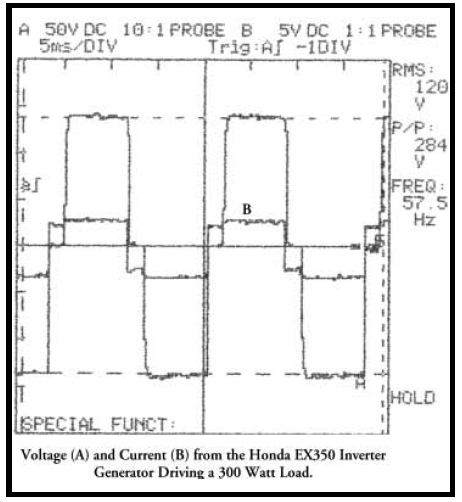
Voltage and the current output waveforms of a Honda EX350 square wave inverter generator powering 300W incandescent light ( ILLUSTRATION COURTESY OF JOHN DE ARMOND)
The illustration above is of a scope shot of both the voltage and the current output of the Honda EX350 generator driving a 300 watt Quartz Incandescent light (a resistive load.) As you see, a modified square wave works well for a resistive load like an incandescent light. The current waveform rises and falls with the voltage waveform (they are in phase) and the inherent distortion of the modified square wave does not induce distortion of the current. Things get a whole lot more interesting when we connect a Compact Fluorescent Lamp (CFL) to the modified square wave. As you can see in illustration below the fluorescent lamp creates all kinds of current oscillation that slightly distorts the voltage waveform (creates a spike).

Voltage and the current output waveforms of a Honda EX350 square wave inverter generator powering fluorescent light ( ILLUSTRATION COURTESY OF JOHN DE ARMOND)
Electronic ballasts (both fluorescent & HMI) utilize solid state electronic components (rectifiers, capacitors, and IGBTS) that use only portions of the power waveform - they place all their load on the peak values of the voltage waveform. These devices then return the unused portions to the distribution system as a harmonic current. These harmonic currents stack on top of one another in the distribution system creating harmonic distortion that pulls the voltage and current out of phase. Under certain conditions, these harmonic currents that are kicked back into the power stream by the electronics of the ballast can cause a distortion of the voltage waveform (the spike in the waveform above) that manifests itself as a noticeable audio buzz or equipment to malfunction. For a detailed explanation for why harmonic currents cause voltage waveform distortion see my article on the use of portable generators in motion picture production available on our website.
Fluorescent lights are a good choice for operation on battery inverters in the limited sense that they use a quarter of the power of a comparable tungsten light. However, the ballasts of the many fluorescent fixtures, like the Kino Flo fixtures that use the T-12 tubes (the Single, Double, and 4 Bank Fixtures, the Wall-o-Lite, Flathead 80, and the Image 20, 40, & 80 fixtures) and fluorescent fixtures that use Compact Fluorescent Lamps (CFLs) return harmonic currents into the power stream. For this reason, Kino Flo cautions users, on their website: "Kino Flo ballasts ... will draw double the current on the neutral from what is being drawn on the two hot legs. On large installations it may be necessary to double your neutral run so as not to exceed your cable capacity."( FAQ "Why is the neutral drawing more than the hot leg" at http://www.kinoflo.com/FYI/FAQs.htm#2) For a detailed explanation for why harmonic currents cause unusually high neutral returns see my article on the use of portable generators in motion picture production available on our website.
When you plug a single 4' - 4 Bank Kino into a wall outlet you need not be concerned about harmonic currents causing voltage waveform distortion. The impedance of the electrical path from the power plant is so low, the distortion of the original voltage waveform so small (1-3%), and the plant capacity so large in comparison to the load of the one light, that the inherently noisy load of the 4'- 4 Bank Kino will not affect the voltage at the distribution bus. Since I am out of space, I will have to explain in my next post how it is a different situation when plugging fluorescent fixtures into the inherently distorted voltage waveform of MSW inverters or conventional portable generators.
Guy Holt, Gaffer, SceenLight & Grip, Lighting and Grip Rental & Sales in Boston.
I will have to explain in my next post how it is a different situation when plugging fluorescent fixtures into the inherently distorted voltage waveform of MSW inverters or conventional portable generators.
Cont. from above
When you plug a single 4' - 4 Bank Kino into a wall outlet you need not be concerned about harmonic currents causing voltage waveform distortion. It is, however, an all together different situation when plugging fluorescent fixtures into the inherently distorted voltage waveform of MSW inverters (as seen above) or conventional portable generators (as we will see below.) If we compare the oscilloscope shots below of the voltage waveform induced at the power bus by a Kino Flo Wall-0-Lite (with 10 - 4' T-12 Tubes) operating on grid power (left), power generated by a conventional generator (middle), and power generated by a Pulse Width Modulated (PWM) Inverter generator to the same power sources without a load, we see clearly that the degree of voltage waveform distortion caused by the return of harmonic currents by the Kino Flo T-12 ballasts is directly proportional to the degree of distortion of the inherent power waveform.

Left: Grid Power w/ no load and a THD of less then 3%. Center: Conventional Generator w/ no load and a THD of 17-19%. Right: Inverter Generator w/ no load and a THD of 2.5%.
The fact that the original supply voltage waveform of conventional generators is appreciably distorted (a THD of 17-19%) to begin with (see middle frame above) causes harmonic currents returned by an electronic Kino ballasts to induce significant waveform distortion of the voltage in the distribution system. The magnitude of current and voltage waveform distortion depends upon the quality of the original applied power waveform and the relative size of the electronic load with respect to the source impedance and capacity of the power system. That is, the amount of voltage distortion increases as distortion of the applied waveform increases and the percentage of electronic ballasts taking up the total capacity of the power system increases.

Left: Grid Power w/ Kino Flo Wall-o-Lite. Center: Conventional AVR Power w/ Kino Flo Wall-o-Lite. Right: Inverter Power w/ Kino Flo Wall-o-Lite.
This is evident in the oscilloscope shots below of an Arri 1200 HMI Par Plus with standard Arri electronic ballasts. The adverse effects of the severe voltage waveform distortion exhibited in the power of the conventional generator below, can take the form of overheating and failing equipment, efficiency losses, and circuit breaker trips. This is because, as we saw above, circuits that depend on the peak value of the voltage waveform to operate effectively (the diode-capacitor power supplies in computers, hard drives, and electronic ballasts), will work sporadically, if at all, on a squared off wave form whether it is created by harmonic currents distorting the voltage waveform (above) or created by the switching of a MSW battery inverter. Common symptoms are computers locking up and other operational malfunctions that are unexplainable.
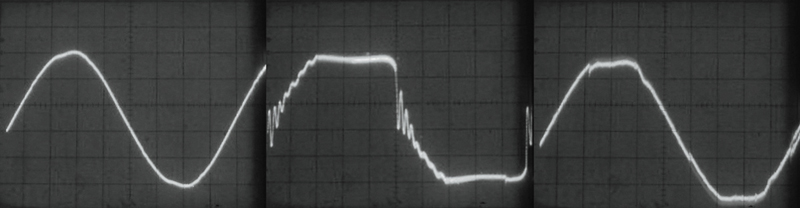
Left: Grid Power w/ 1.2Kw Arri non-PFC Elec. Ballast. Center: Conventional AVR Power w/ 1.2Kw Arri non-PFC Elec. Ballast. Right: Inverter Power w/ 1.2Kw Arri non-PFC Elec. Ballast.
On top of that, the excess part of the wave (the shaded area in the diagram below) must be dissipated somehow. This comes in the form of heat. The bigger the current draw from the unit, the more it produces excess heat within the unit that was not factored for in its' original design. Extended exposure to square wave power supplies, and the heat it generates, may eventually cause premature component level failures within the unit. Harmonic distortion of the magnitude above can also create ground loops and radio frequency (RF) interference. For a detailed explanation for why this is, see my article on the use of portable generators in motion picture production available on our website.
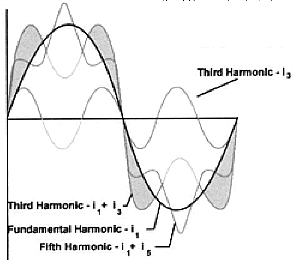
Unuseable portion of distorted waveform (shaded) dissipated in heat.
For these reasons, audio/video production equipment, computers, electronic ballasts, and battery chargers require a nearly pure (low distortion) true sine wave input. If these devices are to be run from a battery inverter or an inverter generator, then the inverter must supply a sine wave or something pretty close to it. As discussed at the outset, inverters of this sophistication are appreciatively more expensive - from 2 to 3 times - because of the number of and prohibitive cost of high power electronic switch devices and components required. However, recent rapid developments in the field of IGBT (Insulated Gate Bipolar Transistors) electronics and miniaturization/mass production of microprocessor based digital control systems have reached the stage that Pulse Width Modulation inverter modules are now economically viable and affordable. Since I am out of space, I will have to explain the benefits of Pulse Width Modulation in my next post.
Guy Holt, Gaffer, SceenLight & Grip, Lighting and Grip Rental & Sales in Boston.
I will have to explain the benefits of Pulse Width Modulation in my next post.
Cont. from above
Pulse Width Modulation (PWM) inverters provide a more sinusoidal current and for that reason are commonly called True Sine Wave inverters. PWM inverters use extremely fast micro-processor control modules to switch Insulated Gate Bipolar Transistors (IGBTs) at extremely high speeds to produce AC power with a "true" sine wave (with full width and amplitude) from DC power (whether from batteries or the rectifier bridge of an inverter generator.)

Pulse Width Modulated (PWM) Voltage Steps(ILLUSTRATION COURTESY OF SIEMENS CORP)
In the case of "True Sine Wave" inverter generators, the PWM inverter module consists of a converter, DC link, control logic, and an inverter. The converter section consists of a fixed diode bridge rectifier which converts the more than 300 three phase AC sine waves generated by the multi-pole core of the generator's alternator to high voltage DC power. AC Output is then generated from the high voltage DC by the inverter section with voltage and frequency set by a PWM control logic. A highspeed microprocessor switches IGBTs on and off several thousand times a second according to the PWM control logic to create a variable voltage and frequency.

Waveform of power output of PWM inverter generator. Note there no discernable distortion or frequency error. (ILLUSTRATION COURTESY OF KIRK KLEINSCHMIDT]
The "true" sine wave that PWM inverters deliver is more suitable for computers, solid-state equipment with built-in computer functions or microcomputer-controlled functions. Not as cheap as MSW inverters, generator manufacturers only put PWM inverter modules in their deluxe or Super Quiet product lines. For instance, the Honda super quiet EU series of generators employ Pulse Width Modulation (PWM) inverter modules with a waveform distortion factor of less than 2.5% - which is considerably better than conventional generators and quite often better than what you get out of the wall outlet.
Even though "True Sine Wave battery" inverters generate clean stable power, they have limited application in motion picture lighting because they are only capable of limited power output (1800W max.) If you need more than 1800 Watts you have no alternative but to use a generator. I would suggest the Honda EU6500is inverter generator. The Honda is so quiet that all you have to do to record clean sound is move the generator around the corner of a building or operate it out of a van or truck.
If you have any questions about using inverters or generators, I would suggest you read an article I wrote on the use of portable generators in motion picture production. Harry Box, author of “The Set Lighting Technician’s Handbook” has cited my article in the just released Fourth Edition of the handbook. In addition, he has established a link to it from the companion website for the Fourth Edition of the Handbook, called “Box Book Extras.”
If you haven't yet read the article, or looked at it in a while, it is worth reading. I have greatly expanded it to be the definitive resource on portable power generation for motion picture production. Of the article Harry Box states:
"Great work!... this is the kind of thing I think very few technician's ever get to see, and as a result many people have absolutely no idea why things stop working."
"Following the prescriptions contained in this article enables the operation of bigger lights, or more smaller lights, on portable generators than has ever been possible before."
"Following the prescriptions contained in this article enables the operation of bigger lights, or more smaller lights, on portable generators than has ever been possible before."
The “Box Book Extras,” site is also worth checking out because it includes other source material used for the handbook, articles by Harry Box published in other periodicals, related websites, a list of production oriented i-phone apps, as well as more in depth discussion of topics touched upon in the handbook. You can log onto the Box Book Extras site at http://booksite.focalpress.com/box/setlighting/ with our pass-code "setlighting." Use this link for my news letter article on the use of portable gas generators in motion picture production.
Guy Holt, Gaffer, SceenLight & Grip, Lighting and Grip Rental & Sales in Boston.