translating film audio with musical audio

Azmyth

Veteran
I'm new to filmmaking.
Not new to audio.
I've been in bands for the past 10 years, and I have used tons of sound equipment including dynamic mics, condensor mics, and everything in between. I've used tons of different recording equipment as well.

Now, I've read alot about film audio.. and it seems to be quite different from recording studio audio..

I've got several Studio quality condensor microphones which have to be powered with phantom power...

are these useful to me at all in film audio?

One is an Audio Technica, which is the only brand I recognize that seems to go both ways.

Can I record sound on an external device?

I have a Tascam US-122 USB interface that acts as a sound card, and phantom power.. and it has XLR inputs. I'd run it to a laptop I'd have on set, and would record the audio seperate from the camera... is this something that other people do? or am I way off base?
 
I've got several Studio quality condensor microphones which have to be powered with phantom power. One is an Audio Technica, which is the only brand I recognize that seems to go both ways.... are these useful to me at all in film audio?
List the mics by brand and model, a few if us can chime in and let you know if they are useful or not.

You'll also need a boom pole, shock mount and wind protection (blimp & dead cat).

I have a Tascam US-122 USB interface that acts as a sound card, and phantom power.. and it has XLR inputs. I'd run it to a laptop I'd have on set, and would record the audio seperate from the camera... is this something that other people do? or am I way off base?

Can I record sound on an external device?
That's the way it was done in until the advent of digital cameras, and still is when using real film.. Popular "budget" field recorders are the Fostex FR2-LE and the Marantz PMD-660.

Laptops are also used, but very inconvenient when doing run & gun. The US-122 may do all right, but my personal preference would be would be a firewire interface.

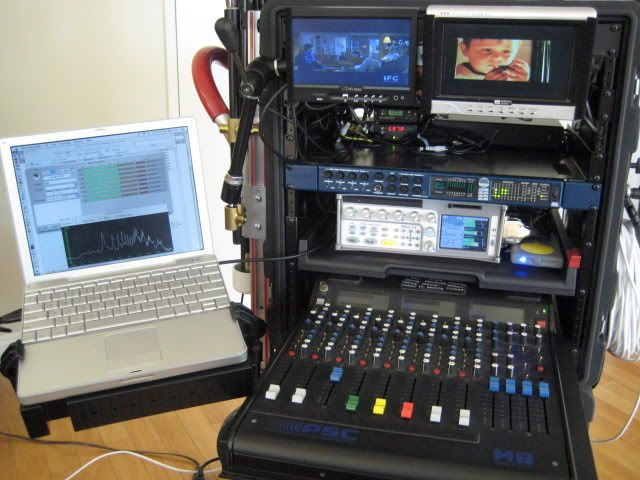
Here's a "Hollywood" sound cart (no, it's not mine):

IMG_0881.jpg


BTW, I moved from touring musician to recording engineer to audio post. I also do a little production sound, but not one of my favorite gigs...
 
One of the fundamental differences that I find between music and film sound, is that in music you're in an environment where you can listen to everything in a control room and know if a mic sounds good, placement's solid, ect....

In film you'll record the audio, and then 2 months later you'll get a call telling you about the issues with the production sound when they're playing it back on a mixing stage.

Which is to say, imho film production sound is more about reliability and consistency as you're doing your work semi-deaf using only a set of cans to tell you what's working or not. Preamps and limiters are chosen for being silent and unobtrusive, mics are chosen for being rugged and natural, or rejecting a high amount of ambient sound (like shotguns are designed for). As compared to music where those components are mostly chosen to add unique elements to the recording to get the "sound" that the artist and/or engineer is looking for.

And many studio mics I've worked with would take Superman as the boom op to not die by lunch. (i.e. many are heavy)
 
One of the fundamental differences that I find between music and film sound, is that ....

i"ll add to this and say

.... in music recording it is all about the "audio".
Mic's go exactly where you want, you get the time to adjust and make it perfect.

Film production sound is secondary to picture.
You dont get to put the mic exactly where you want most of the time
nor do you have the luxury of stopping production more than a few times
to "adjust" (without not being asked back next time)
It really is all about being the invisible dept as much as possible on set.
 
I have a MXL 990 condensor microphone that I use for home recording, as I said eariler a US-122 Tascam interface (its usb) that has 2 XLR inputs... I love it, never had any problems with it.

I thought about using the tascam in conjunction with a small laptop, on a small rolling cart, and run my mics into it and use reaper to record all my audio. Could I then resync it back up in post with vegas? I want to record it seperate in case I need to fix anything afterwards. I heard someone say USB may not be the way to go, but I haven't had any issues with it. I guess the way to find out is to test.
 
The MXL 990 is probably not a good choice for production sound, although you could test it and see; don't wait until you're on a set to find out that it won't work well, experiment in advance. You mentioned "tons of sound equipment including... condensor mics... several Studio quality condensor microphones." What else do you have in your mic closet?

Sync should not be a problem as long as a clapper board is used. I've only had problems with extremely long takes. Again, do some testing in advance.

Production sound requires very different equipment as opposed to music production. As Gohanto mentioned, music production gear is all about "personality"; production sound gear is just the opposite.
 
Azmyth

• You need a good Shotgun for outdoor use. They don't react will to indoor reflections off walls unless you are in a very dead, or roomy room. Sennheiser 416, or a Rode NTG-3 are good places to start.

• A good Hypercardioyd for boom work indoors. Hypers, like shotguns reject off axis sound,so you are more focused on the voice only. I have a Rode NT3 that I like, but you can go a lot higher quality/price.

• A good wireless lav. Lectrosonics is awesome, but Sennheiser G2 is the best bang or the buck.

• A portable mixer. Check out the Sound Devices MixPre. It's a 2 channel wonder. Very clean, has limiters on the input and output. Phantom power. 2 levels of bass roll off. You can send a nice clean line level to the camera, or a portable recorder, or both. 665.00. The next step up is the 3 channel version for 1,200.00.

• Portable recorder. 2 channel - Maybe Zoom H4n at 350.00, Sony D50 - 500.00. 4 channel - Edirol R-44 for 900.00 (that's the cheap way out. If you are serious then expect to pay thousands for something from Sound Devices)

• Sony 7506 headphones. Industry standard, 100.00

• Boom pole. Many brands from 100.00 to 1,500.00

• Blimp. Check out Rode - again best bang for the buck. 300.00 with a fuzzy and handle.


Keep that mic within 2 feet of the talent's mouth.


Chadfish
 
I loaned all my mics to a friend, so I can't list them all right no.. some of them are just dynamics.

like sure SM57
I have a pair of behringer C-2's which are what I call "lipstick condensors" very skinny tube shaped mics.

I also have a fostex MR8... I was wondering how that would work as a portable recorder.. It will run on 6 AA batteries, and has built in phantom power and records to compact flash.

fostexmr8.gif
 
How many inputs does the MR8 have? 2? Chances are it's noisy. I can't say. If you like the way it sounds - great. Keep in mind that with location audio you aren't always able to have the voice up close on the mic. So you get a quieter signal recorded. Then you need to turn up those tracks a lot in post. It's at that time that you really hear if the recorder's preamps are noisy.


I am interested in a new Zoom 8 simultaneous track recorder.
http://www.bhphotovideo.com/c/product/600773-REG/Zoom_R16_R16_Multi_Track_Recorder.html

zmr16.jpg


If this thing records clean then it would be tempting at such a cheap price. All you need is something to capture audio cleanly - the rest you deal with on your DAW.

I am thinking about picking up an Edirol R-44. I have used the R-4Pro ( a more expensive hard drive based unit) and feel it's preamps are fairly quiet. The R-44 is SDHC card recordable, smaller, and less than half as much:

http://www.bhphotovideo.com/c/product/542280-REG/Edirol_Roland_R_44_R_44_Solid_State_Four_Channel_Portable.html

Edirol-R-44_alt.jpg


Half the inputs (4) at twice the price - means they put more money into each XLR/preamp.

Anyone use the R-44?
 
The MR8, I'm pretty sure, will only record cd-quality (16-bit/44.1kHz). You'll want something that'll do at least 48kHz for production work.

(On Edit: The R16 Chad links to is sadly only 44.1 unless you're using it as an audio interface with a computer. Really too bad, as that looked really promising before the specs got out.)

Those C-2s are actually not terrible little mics for a completely inexperienced boom op on a zero-budget shoot. They're also not bad for dangerous recording situations.

You'll want to get something with a tighter pickup pattern (hyper or super-cardioid for interriors, shotgun for exterriors).

Oktava's 012 is a common low-budget hyper (only buy from soundroom to be safe), but it requires wind protection, even inside. AKG's blueline is a modular system, so you could pick up one power module and then swap between the shotgun and hyper capsules as needed.
 
(On Edit: The R16 Chad links to is sadly only 44.1 unless you're using it as an audio interface with a computer. Really too bad, as that looked really promising before the specs got out.)

Are you sure Jordan?

B&H says this about the R16 in the specs:

"44.1 kHz 16/24-bit WAV when recording to SD Card

96 kHz 24-bit when recording into a computer "

24bit / 44.1 ain't too shabby. I put 44.1 final mix' in projects all the time. the difference (sonically) is about impossible to disern with the human ear.

What is really important is the quality of the preamps. Even at 16 bit you can get great audio if the signal chain is clean.
 
How many inputs does the MR8 have? 2? Chances are it's noisy. I can't say. If you like the way it sounds - great. Keep in mind that with location audio you aren't always able to have the voice up close on the mic. So you get a quieter signal recorded. Then you need to turn up those tracks a lot in post. It's at that time that you really hear if the recorder's preamps are noisy.


I am interested in a new Zoom 8 simultaneous track recorder.
http://www.bhphotovideo.com/c/product/600773-REG/Zoom_R16_R16_Multi_Track_Recorder.html

zmr16.jpg


If this thing records clean then it would be tempting at such a cheap price. All you need is something to capture audio cleanly - the rest you deal with on your DAW.

I am thinking about picking up an Edirol R-44. I have used the R-4Pro ( a more expensive hard drive based unit) and feel it's preamps are fairly quiet. The R-44 is SDHC card recordable, smaller, and less than half as much:

http://www.bhphotovideo.com/c/produ...4_R_44_Solid_State_Four_Channel_Portable.html

Edirol-R-44_alt.jpg


Half the inputs (4) at twice the price - means they put more money into each XLR/preamp.

Anyone use the R-44?

there's always a seperate preamp.. of course thats more crap to carry around.

I may just record the audio straight the the camera since It will have XLR inputs.
 
what if I ran the mic into a small mixer (thus using its preamps instead of the cameras and thus being able to adjust the sound better.)

The only thing I was trying to avoid was actually having the sound guy attached to the camera.
 
So what exactly are you shooting?

FYI a preamp that ouputs line level signal will sound better than going into the camera's XLR straight. But some cam's have pretty clean preamps. What camera are you using?
 
So what exactly are you shooting?

FYI a preamp that ouputs line level signal will sound better than going into the camera's XLR straight. But some cam's have pretty clean preamps. What camera are you using?


Shooting a low budget horror film.

Will have both inside and outside locales (field, several houses, parking lot so far that we have secured)

Shooting on a DVX100A or B (whichever I nab fairly soon)

I'm trying to preplan everything I will need, to see what I already have I can use and what will have to be bought.

my original plan was to use a rolling cart, and set up a yamaha mixer into a computer interface into a laptop, and record directly to the computers hard drive. For power I'd use a UPS or some sort. But, dunno how well that would work.
 
There isn't a discernable difference to our ears between 44.1/48, Theres a greater impact in the 16bit/24bit jump, for sure.

However, 48k is 'standard' in sound for picture.
 
Actually you'd be hard pressed to hear a difference between 16/24 bit. 16 bit recorded at a strong level, filling all the bits sounds the same as 24 bit. The main benefit of 24 bit is headroom. You can record at a lower level with less noise. It gives you more options in post. This has been discussed ad nausium on the Recording Review forums.
 
Yeah, I'm not saying you hear the difference in 16 vs 24, just that it has more impact than the difference between 44.1/48 as it gives you that headroom to work with.
 
Back
Top