top secret crucial screenwriting technique pros know that you likely dont

As a writer, a director or an actor you should ask yourself the same questions: What is the function of what I do in the "flow" of the tale. Does what I do really deliver something to it, make it clear to the audience where the story and the character is at a given point. As a writer you all the time are in danger to over-state things so you can get in a situation to lay out too rigid on paper how a scene, a shot, an actors movements should be. "Puppeteering on paper" can become both a nuisance when it is overdone and probably (and worse) a bad read because your script may swell to a convolut that is not yet Russian or French high-literature but clearly may drown "the flow" in a sea of words.

Is it important for the script to describe the tapestry of a room in detail? Yes, if this tapestry will have a function in the drama - now or later on. Maybe, if this is your tool to create a perception you think is important for a reader to understand the background and the emotional (or in this case scenic) atmosphere the story needs. Clearly no if it is only a sign that a writer is too much in love with his style (a sin we all commit at times) or unsure where the story goes too and/or feels the need to micro-manage from behind. Control-freaking on paper. Not advisable. And all of that can become even more so when we discuss the description of the actors / characters behaviour.

On the other hand it's the darn job of a writer to make comprehensible what HAPPENS in a scene and the job of a director or an actor to find out why this is so and how to make it "actable". The latter may then decide to do it differently than written if they have really good reasons for doing that -because the solution they find is in their view the better one ( time for writers to bring out the paper tissues and cry). But objecting against "direction on paper" in principal would be outright silly. A good director and an able actor may find different ways to express what is needed in the scene, maybe they will skip dialogue or use other tools for convey a certain dramatic function, an information or an emotion - but all starts with a propositon, an simulation of a future movie on paper. And this needs to be different to stage writing where the room for interpretation will be more open for principal reasons.

Having said this I have to confess that I do hate parentheticals. Parentheticals for me are like fat bad tempered nannys standing behind me telling me to eat my spinach and how. But thats probably just me........
 
Well hey, if that's standard scriptwriting and everyone knew about it, then good for them. Took me five years to figure out, and I have the same standard big fat library of screenwriting books on my shelf as everyone else, and I'm pretty sure I read them darn thorougly.

Glad everyone knows about this

As others have said in the thread, there's a difference between defining a shot (camera angle, closeness, etc.) or telling an actor how to deliver a line (which is what many parentheticals do -- especially "(beat)"), and simply describing what the character is doing. You have to tell what the character does.

It's not so much appropriate to describe what the character is thinking; you should demonstrate it with the character's action. But you surely can/should describe a character's emotional action.
 
Beat is a holdover from the stage like sotto. They both can be useful but are more risk than reward. If your a known playwright writing for the screen no one is going to fault you for using beat. All others use at your own peril.
 
Ill keep it simple:

most screenwritng texts emphasize, emphatically, that the delivery of a line and the staging of the scene are up to the actors and the director.

This is (largely) not true.

To write a clear piece of visual (and verbal/dialog) storytelling, you must know exactly what the emotional state of each character is at all times, and communicate this in the script, with notes on body language, facial expressions, and yes, notes on how a line is delivered, and yes, even notes sometimes on what characters are thinking, (since these come across visually in body language and facial expression). These are all things that screenwriting texts, more often than not, ask you to avoid.

Ignore every bit of advice to "not direct on the page" and study scripts to see these techniques in action, used unobtrusively and artfully.

"nycineaste flashes a winning smile"

that is all
 
Last edited:
Ignore every bit of advice to "not direct on the page" and study scripts to see these techniques in action, used unobtrusively and artfully.
As has been pointed out to you earlier in this thread, the vast majority of scripts of great or popular films that you are able to get your hands on are transcriptions of the produced films. What you are interpreting as directions by the writer are actually descriptions of choices made by actors and directors that help the reader envision the film. Your basic premise is flawed.
Capable writers will add a bit of direction in their scripts to help the less imaginative get the picture, knowing that good directors and actors will take what they need to realize the script and discard the rest. But what your advocating is actually deadly when you have to get a script up on it's feet and breath life into it.
 
Last edited:
I picked a screenplay totally at random. I'm quite sure this is not a transcription but the actual screenplay.

=======


7. MOVING ANGLE FAVORING NANCY. She's a pretty girl in a letter 7. sweater, with an easy, athletic stride and the look of a natural leader. GLEN, holding her hand, wears one of the school's football jerseys; a good-natured, bright kid. Tina's in mid-conversation. TINA (referring to kids' song) That's what it reminded me of -- that old jump rope song. (shudders) Worst nightmare I ever had. You wouldn't believe it. Nancy nods. NANCY Matter of fact I had a bad dream last night myself... TINA turns to NANCY, but before either can say more, ROD LANE, a lean, Richard Gere sort in black leather and New Wave studs joins up with them and interupts. ROD (to Tina) Had a hardon this morning when I woke up, Tina. Had your name written all over it. Tina cracks her gum with a look of withering indifference. TINA There's four letters in my name, Rod. How could there be room on your joint for four letters? The guy's stopped in his tracks. ROD Hey, up yours with a twirling lawn mower! He cuts off across the lawn. TINA Rod says the sweetest things. NANCY He's nuts about you. TINA Yeah, nuts. TINA makes a face and rakes her fingernails across a tree as she passes. TINA (CONTD) (yawns) Anyway, I'm too tired to worry about the creep. Couldn't get back to sleep at all. (beat) So what you dream? NANCY Forget it, the point is, every- body has nightmares once in a while. No biggy. GLEN Next time you have one, just tell yourself that's just all it is, right while you're having it, y'know? That's the trick. Once you do that, you wake right up. At least it works for me. TINA looks at GLEN sharply. He kisses NANCY and darts off for class. TINA Hey! You have a nightmare too? But GLEN's gone. TINA (CONTD) Maybe we're gonna have the Big Earthquake. They say things get weird just before that... BELLS ARE RINGING, and STUDENTS crowding; TINA and NANCY are drawn into the crush.
=============

Anyways, my interest is pnly in sharing the importance of this to others who may be struggling.
Dan Decekr calls them VEC's (visual emotional cues), Gotham Screenwriting calls them
"Physical Accompaniment" and , I have never seen them mentioned ANYWHERE ELSE, despite in my opinion being as important to screenwriting as wood and nails are to carpentry.

enjoy:


-Nancy nods.


-Tina cracks her gum with a look of withering indifference.
-The guy's stopped in his tracks.
-TINA makes a face and rakes her fingernails across a tree as she passes.

-TINA looks at GLEN sharply. He kisses NANCY and darts off for class.

-
TINA turns to NANCY, but before either can say more, ROD LANE, a lean, Richard Gere sort in black leather and New Wave studs joins up with them and interupts.

======

Ill stop now, this is reaching the point of diminishing returns. Im sure at least one person was helped out by this.

have fun
 
-Nancy nods.

-Tina cracks her gum with a look of withering indifference.

-TINA makes a face

-TINA looks at GLEN sharply.
This is exactly what I'm talking about. This isn't the kind of information a director or actor needs to bring this scene to life. It's for the less imaginative reader.

As a side note, As an actor my job is to inhabit the role as believable as I can in a way that fulfills the author's intentions. I'm not interested in rewriting the story. Give me circumstance, actions and dialogue that can lead me to the heart of the role as you intend it. If you can do that, then you are doing your job.
 
Last edited:
Avoid these tools and youll likely write more on-the-nose and/or wooden dialog cause your forcing the dialog (and not moving images of people doing things with their face and body) to do the heavy lifting of the storytelling. In other words, you'll be avoiding visual storytelling.

Spot them:

http://sfy.ru/?script=thelma_and_louise

dont trust me. learn from great writers.

=================== SCREENWRITING THROWDOWN RIGHT HERE======================

I challenge rsbush and anyone else on this thread that has disagreed with me, to a screenwriting competition to settle the matter.

The rules:

You must write a scene using ONLY DIALOG. ABSOLUTELY NO indications of facial expression, body language, tone of voice, or staging. Absolutely nothing that can be mistaken for "directing" or "pupetteering" the actor. ONLY DIALOG.

I will use the fundamental tool(s) I continue to mention (Dan Decker refers to it a "VEC" visual emotional cue).

The others reading this thread will vote to see which one is more interesting/dramatic/less on-the-nose/more subtext (ie better).


heres the scene:

Christmas Eve. A business man has arrived home, having just won an important client. His wife has decorated the christmas tree on her own (remember, no notes on staging/body language- you can mention the tree, but cannot POSITION OR MOVE THE ACTOR AROUND IN RELATION TO IT), and she argues that he spends too much time at work.

half to a whole page or so

whose up for the challenge
 
Last edited:
This isn't the kind of information a director or actor needs to bring this scene to life. It's for the less imaginative reader.

What if "the" less imaginative reader" is 4 producers and 12 financiers, a bunch of distributing people, marketing guys and the main producers cleaning lady who reads all scripts for him because he likes to have a different angle of view..... and .... and... and...

Director/Actor may agree and can work on a different and less over-wrought description of (possible) actions of the characters. If they are good enough, the may need only a lean description like in a stage play. But: A lot of others essential for the production of a film may need more. So you need to have a script able to convince those people too.

Direction on page is a proposition, recommendation and exemplification. Not a dogma. But, yes, often it's overdone. Less may be more at times.
 
What if "the" less imaginative reader" is 4 producers and 12 financiers, a bunch of distributing people, marketing guys and the main producers cleaning lady who reads all scripts for him because he likes to have a different angle of view..... and .... and... and...
These are exactly the people I'm talking about. As we all know reading a script is a bit more challenging than prose and some people need help. And you want to help the people who can help you. I'm with you on that point.
I'm not advocating having "No Directions", I'm pointing out that facial expressions and attitudes are not going to be of any help to an actor and will very likely be detrimental if they chose to lock in on them. As I interpret nycineaste's posts, he seems to believe that actors won't know what to do if you don't have those kind of directions present. Which is, simply put, ridiculous.

what about my challenge sir?

it will settle the matter

write a scene with ONLY DIALOG and we will see how well it communicates emotion and carries some form of subtext. Use no indication of body language/staging (no positioning or moving the actor around the set), facial expression, attitudes, etc.


PS I work with four-five year trained actors from a prestigious new york acting school. They are brilliant at inventing what they call "behavior", but can only do so if they know what the emotional state of the character is, no? If, as writer, you don't invent (well keep calling it) BEHAVIOR into the script, then the dialog you wrote will obviously be more on-the-nose (ie it carries an obvious emotion- "Im angry with you, Joe!".) You will have diifficulty creating a scene with subtext unless you write (usually contrasting) behavior into the script. Subtext very often comes from the DIFFERENCE between the words and the behavior; its a prime way you create subtext, by making the words different from a physical action that reveals the true nature (subtext) of the scene. Since, in drama as in life, actions speak louder than words.

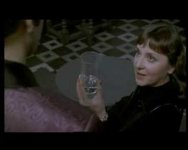
The still below is from the "glass of water" scene of Pinters "Homecoming". A prime example of a scene brimming with subtext, the glass of water and all that is done with it is in the manuscript, thats not something an actor can just invent for the scene.

but yes, my challenge stands for you or anyone else-- write a 30 second scene (use my christmas tree idea or invent anything you like) post below, then I will rewrite the scene for more subtext/interest/less on the nose/just better.

Use ONLY DIALOG.
 

Attachments

  • at_home.jpg
    at_home.jpg
    26.3 KB · Views: 0
Last edited:
nycineaste,
You may want to reread my posts as you seem to believe I'm advocating something I'm not. Nowhere do I suggest that a script should contain only dialogue or that dialogue is all an actor needs to inform their performance. I say "Give me circumstance, actions and dialogue that can lead me to the heart of the role as you intend it". What I point out as useless to an actor are: 'makes a face', 'with a look of withering indifference' (whatever that's supposed to be) etc. If you want someone to play your games, you'll need to find someone who wants to defend the artificial argument you've created.

And by the way, take a closer look at Pinter to see what I'm talking about.
 
What I point out as useless to an actor are: 'makes a face', 'with a look of withering indifference' (whatever that's supposed to be) etc.

again, to anyone else that is watching this thread, DONT TRUST ME, just spot THE FOLLOWING in screenplays by PROFESSIONALS ---"looks", facial expressions, notes on body language, often even notes on what a character is thinking as shorthand for a look or facial expression or bodily attitude, and notice how these things work to make the overriding emotional state of the characters as clear as day so that the dialog and the thrust of the scene can be interpreted correctly. Or rather, these things (VECS?) CREATE the emotional thrust of the scene in tandem with the dialog.

Heres an excerpt from "Sideways":

======================

Jack looks at Miles in a mute appeal for sympathy.

CHRISTINE (ON THE PHONE)
So what do you think? With the Feldmans?

Jack hasn't even really heard the question.

JACK
Yeah. The Feldmans.

======================

They are RIGHT THERE.

To anyone struggling with "on the nose" or "wooden" dialog or wondering how-in-the-hell you get the mystical thing called "subtext" in your screenplay, THIS IS (one of the major ways) HOW.

Spot more of them, often, so you can build up a "lexicon" and know how to use them:

I'm quite sure this is the original screenplay, and not a transcript:

http://www.imsdb.com/scripts/Sideways.html

Books that teach this (sadly, not many):

"VEC"

http://www.amazon.com/Anatomy-Scree...85745&sr=8-1&keywords=anatomy+of+a+screenplay

'Physical Accompaniment"

http://www.amazon.com/Writing-Movie...91985796&sr=8-1&keywords=gotham+screenwriting

So YES, put facial expressions in your screenplay, study screenplays by professionals to learn how.

CRUCIAL tool.

Oh yeah, I leave you with a quote from Harold Pinter:

"Before, I thought theatre was about the spoken; after, I understood the eloquence of the unspoken. The position of a chair, the length of a pause, the choice of a gesture, I realized, could convey volumes."
 
Last edited:
Rule number one is - there are a lot of rules for scriptwriting. Rule number two is - after you have learned about them, you need to forget them again. Rule number three - a lot of different people in different positions and with different tasks have to work with a script, so throw them a bone so they have something to chew on especially if those people are intellectually a tad clumsy. Rule number four - if you throw too much bones you do not get a living script but a carcasse. Rule number five - forget what I have written and start working your keyboard ...... :-)
 
Excellent post Rolf.

Oh yeah, I leave you with a quote from Harold Pinter:

"Before, I thought theatre was about the spoken; after, I understood the eloquence of the unspoken. The position of a chair, the length of a pause, the choice of a gesture, I realized, could convey volumes."
If you want to trade Pinter quotes here you go:
Quite often I have a compelling sense of how a role should be played. And I'm proved—equally as often—quite wrong. HAROLD PINTER, The Paris Review, fall 1966

I made a terrible mistake when I was young, I think, from which I've never really recovered. I wrote the word "pause" into my first play.
HAROLD PINTER, interview, Oct. 1989
[SIZE=-1]

[/SIZE]

​
 
nycineaste gives a sour look:

True, "pause" isn't always the greatest "VEC" (kinda vague) and beginners overuse it. Using a glass of water in a complex display of sexual tension and dominance is ten times more creative. Its clear Pinter grew as an artist, no?

Any technique can be done well or poorly.

Heres an excerpt from FARGO (number 32 on WGA' greatest screenplays). "Beat" works very well below to note that these guys arent really talking to each other and its awkward. The "sour look" is a great "beat" with a clear purpose, and a great example of what I keep harping on.

============-----------------------------

Carl Showalter is driving.

Gaear Grimsrud stares blankly out.

After a long beat:

GRIMSRUD
Where is Pancakes Hause? '

CARL
What?

GRIMSRUD
We stop at Pancakes Hause.

CARL
What're you, nuts? We had pancakes for breakfast. I gotta go somewhere I can get a shot and a beer - and a steak maybe. Not more poo pooin' pancakes. Come on.

Grimsrud gives him a sour look.

CARL
Come on, man. Okay, here's an idea. We'll stop outside of Brainerd. I know a place there we can get laid. Wuddya think?

GRIMSRUD
I'm poo pooin' hungry now, you know.

========================================


Again, folks:

GO HERE:

http://www.wga.org/subpage_newsevents.aspx?id=1807

Find the screenplays online, SPOT what I'm talking about, build up a "lexicon" of them, use them in your scripts. Ignore goofy "theoretical" discussions and learn from actual great screenplays. Dont trust me, dont trust this other guy, trust the guys who...erm...er.... geez...er...WROTE FARGO. A facial expression ("sour look"), right there, in the screenplay, used as a crucial visual storytelling tool. The screenplay is online for free (amazing!) study it, spot them, keep learning how to use whats been called "visual emotional cues".

Crucial (and sadly undermentioned) tool.
 
Last edited:
NOBODY argues that a script should contain only dialog. NOBODY.

In fact, what EVERYBODY argues is "show, don't tell."
 
nycineaste gives a sour look:

True, "pause" isn't always the greatest "VEC" (kinda vague) and beginners overuse it. Using a glass of water in a complex display of sexual tension and dominance is ten times more creative. Its clear Pinter grew as an artist, no?

Any technique can be done well or poorly.

Heres an excerpt from FARGO (number 32 on WGA' greatest screenplays). "Beat" works very well below to note that these guys arent really talking to each other and its awkward. The "sour look" is a great "beat" with a clear purpose, and a great example of what I keep harping on.

============-----------------------------

Carl Showalter is driving.

Gaear Grimsrud stares blankly out.

After a long beat:

GRIMSRUD
Where is Pancakes Hause? '

CARL
What?

GRIMSRUD
We stop at Pancakes Hause.

CARL
What're you, nuts? We had pancakes for breakfast. I gotta go somewhere I can get a shot and a beer - and a steak maybe. Not more poo pooin' pancakes. Come on.

Grimsrud gives him a sour look.

CARL
Come on, man. Okay, here's an idea. We'll stop outside of Brainerd. I know a place there we can get laid. Wuddya think?

GRIMSRUD
I'm poo pooin' hungry now, you know.

========================================


Again, folks:

GO HERE:

http://www.wga.org/subpage_newsevents.aspx?id=1807

Find the screenplays online, SPOT what I'm talking about, build up a "lexicon" of them, use them in your scripts. Ignore goofy "theoretical" discussions and learn from actual great screenplays. Dont trust me, dont trust this other guy, trust the guys who...erm...er.... geez...er...WROTE FARGO. A facial expression ("sour look"), right there, in the screenplay, used as a crucial visual storytelling tool. The screenplay is online for free (amazing!) study it, spot them, keep learning how to use whats been called "visual emotional cues".

Crucial (and sadly undermentioned) tool.

"Gives him a sour look" is NOT "directing on the page." It's simply saying what the character does.

It does not describe anything internal. It says exactly what happens on the screen. It is showing, not telling.
 
I threw around the term "directing on the page" just to make a point, but yeah, "gives a sour look" is clearly a facial expression and my friend rsbush believes that facial expressions don't belong in a screenplay.

"internals" are an extremely useful thing (dont overdo of course) as a way of noting that the feeling or thought ois clearly reflected in the characters facial expression and.or body language:


Here's an excerpt from "Sideways" (also on WGA list of greatest screenplays):

==========================================================

This makes Maya laugh a big throaty laugh. Jack joins in.

Nervous about Jack's aggressive flirtatiousness, Miles musters a tight courtesy smile.

MAYA
(winding down)
Oh. I needed that. Thank you.

They all take a drink of wine.

MAYA

So what are you guys up to tonight?

Before Jack has a chance to speak --

MILES
We're pretty wiped. Probably go back to the hotel and crash.

This makes Maya slightly embarrassed at her apparent availability, but she recovers quickly, remains breezy.

===============================

Internals, right there (as a shorthand for a visual emotional cue)

another crucial tool, and yeah, of course, dont overdo them.
 
Back
Top