To letterbox or not?

iamWZA

Active member
I just can't decide to shoot my film so I can letterbox it in post or to just shoot it normally. What's the point of letterboxing nowadays? Is it really just a matter of taste?
It's quite a big decision to make because once you've shot everything with the correct framing you can't go back on it, right?

What do you think? This can be just a general letterboxing thread.
 
What are you shooting it in? If you're shooting with a camera that you have to crop in later (i.e. you're not using anamorphic lenses, which is the ideal way in my opinion), then you'll have options in post. Hell, there are movies that have been distributed in a variety of different aspect ratios, all from the same source.

The safest way, if you will be cropping, is to make sure you're not using the letterboxing to hide unsightly elements, i.e. a boom. I would also say to utilize the widest lenses you can get a hold of. When shooting this project:


I picked up a Tokina 11-16mm f/2.8 and shot the fast majority of it with it on a APS-C sized sensor (with the exception of my Sigma 30mm f/1.4 for the closeups because the Tokina was simply too wide). I've seen some material that was shot conventionally and then cropped and it just ends up feeling really cramped. The Tokina was never wider than 16mm, so 10-12mm would be ideal on smaller sensors like m4/3 (which you can't go much lower...8mm fisheyes).

Do make use of any tools you can use to give you a guide, though you can always adjust up or down in post if you need to.

Ultimately, it is just a matter of taste. I find nothing wrong at all with the 16x9 aspect ratio (which is incredibly close to the Academy standard of 1.85:1).
 
It'll be shot in 16:9. I want to know before I start shooting whether or not I'm going to letterbox it, that way I can frame everything accordingly and not have to worry. I definitely don't want to be limited to wide shots either - I plan to use plenty of close ups. David - I'd hope it will be shows at festivals.
 
It'll be shot in 16:9. I want to know before I start shooting whether or not I'm going to letterbox it, that way I can frame everything accordingly and not have to worry. I definitely don't want to be limited to wide shots either - I plan to use plenty of close ups. David - I'd hope it will be shows at festivals.
Take it with the director and the person in charge of post. I once had the director coming up to me half way through a two week shoot telling me "Oh, by the way, we'll be letterboxing the movie." --- And of course I held a big speech on how I'd now framed the entire shizzle without taking account the letterbox crop.

The saddest thing (besides from poor audio) is when a movie is letterbox cropped and you can tell that it wasn't framed for it - Other than that it's an artistic choice, I guess.
 
The saddest thing (besides from poor audio) is when a movie is letterbox cropped and you can tell that it wasn't framed for it - Other than that it's an artistic choice, I guess.

I absolutely agree. The 2.40:1 aspect ratio, when properly planned for and shot correctly, looks amazing. But, for the most part, crops look like crops, and in the case of using really tight framing, comes off as a ridiculous choice.

Cinemascope, where it all began, was developed because the whole point was to show wide vistas (hence why there was also a competiting technology called VistaVision). It was that era's 3D. So, I would also say, that your subject matter needs to be appropriate for that framing. You wouldn't shoot a mumblecore drama indie in 3D, and, likewise, it would be odd to shoot something like Hitchcock's Rope in 2.40:1.
 
I love the 2:35:1 aspect ratio but without the black bars, Even if not shot anamorphic it still gives some room to play with in post as far as framing goes, Of course it's ideal to block and frame for it, but.
 
I just can't decide to shoot my film so I can letterbox it in post or to just shoot it normally. What's the point of letterboxing nowadays? Is it really just a matter of taste?
It's quite a big decision to make because once you've shot everything with the correct framing you can't go back on it, right?

What do you think? This can be just a general letterboxing thread.

What you actually need to do is decide which aspect ratio best suits your artistic needs.

THEN, and only then, worry about letterboxing as appropriate.

Letterboxing is 100% a by-product of aspect ratio. You don't choose black bars because they look cool. You put up with black bars because it's the only way to achieve your aspect ratio with standard equipment.

Hr.. maybe it's because I'm a newb but can you expound? Although I only get to shoot with my dslr, I have ML's cinescope frame on when i shoot so i can frame my material in camera and letterbox in post, but I thought letterboxing nowadays was just an artistic choice. What do you mean by 'achieving your aspect ratio'?
 
Letterboxing is 100% a by-product of aspect ratio. You don't choose black bars because they look cool. You put up with black bars because it's the only way to achieve your aspect ratio with standard equipment.

Is that the case with modern Hollywood films? Surely they're capable of getting whatever aspect ratio they want, but often some will have letterboxing anyway. I think people do choose to put up the black bars because they look cool, but I may be wrong.
 
You will have letterboxing displaying an aspect ratio other than 16:9 on practically everything except a theater screen.
 
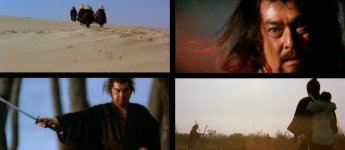
yeah, dude BIG, BIG +1 on Mr David Jimerson's post here.. the only reason letterboxing (should) exist(s) is when rectangular movies are being shown on square tvs. Its goofy, dumb, and ARTISTICALLY PHONY to put black bars on something cause the black bars look "cool or "cinematic"". You dont want people LOOKING AT THE BLACK BARS, you want them looking AT YOUR MOVIE!!!

or better put:

Whats SUPPOSED TO LOOK COOL IS NOT THE BLACK BARS, BUT THE -----WIDESCREEN COMPOSITION------ INSIDE THE SCREEN that you created with the wider aspect ratio!!!!!!!!!!!!!!!!

WTF!?!??

take a look see:


http://thelucidnightmare.blogspot.com/2012/04/review-shogun-assassin.html
 

Attachments

  • ShogunAssassin_GROUP2.jpg
    ShogunAssassin_GROUP2.jpg
    38 KB · Views: 0
Last edited:
I agree with the statements that the film should dictate the aspect ratio. Action, Epic, Adventure and Fantasy will typically benefit from 2.40. One of the biggest signs of a newb/amateur is a drama or comedy that does it just for looks.
 
Hr.. maybe it's because I'm a newb but can you expound? Although I only get to shoot with my dslr, I have ML's cinescope frame on when i shoot so i can frame my material in camera and letterbox in post, but I thought letterboxing nowadays was just an artistic choice. What do you mean by 'achieving your aspect ratio'?

Letterboxing in post is fine to give you the aspect ratio you want IF you need to do it. If you're doing anything wider than 16:9, then you'll need to in order for it to be on Blu-ray or DVD. If you're just going to keep it on the computer, you may not need to letterbox at all; you can crop and create a file which is actually your aspect ratio. No letterboxing, just an image the shape you want.
 
Is that the case with modern Hollywood films? Surely they're capable of getting whatever aspect ratio they want, but often some will have letterboxing anyway. I think people do choose to put up the black bars because they look cool, but I may be wrong.

Depends on what it's shot with, and how "modern" you mean.

On film, there are several ways to do it; film frames are 4:3, but an anamorphic lens will squeeze a wider image into it. Then, to project it properly, it needs to be projected through an appropriate lens to stretch it back out.

Or, it's just shot on the 4:3 frame, and then it's projected, the top and bottom are matted off using a gate on the projector.

With (Hollywood) digital, it's kind of similar; lenses will get you your image squeezed into a narrower frame if possible, or cropping or letterboxing can be done to the image. Some cameras will actually shoot multiple aspect ratios natively.

But, with anything available to you, it's most likely going to be shoot 16:9, then crop or matte in post. Again, IF appropriate, and if you think an aspect ratio other than 16:9 is artistically right. Remember -- choose that first, THEN worry about cropping or letterboxing.

The important thing is to IGNORE the black bars. The black bars are not part of your image. The black bars are an ugly compromise, a necessary evil. Learn to hate the bars. Learn to love what's between them.
 
I have never really understood the black bars in an artistic mindset except in one film. They were used in certain scenes in Scott Pilgrim Vs The World and it actually worked with the movie and its comic book style action
 
I do it a lot on stuff I shoot. But at the end I actually crop the bars out and make the video file contain no bars. Vimeo/Youtube and all that will just vertically center your content and add those pesky black bars automatically. Keep the black bars out of teh final output. Until its time to put on a DVD or whatever export format, THEn worry about adding black bars and scaling down your video to fit within THAT format. my 2 cents.
 
when I shoot with my DSLR with the magic lantern firmware, I use the cropmarks overlay (it doesn't record onto the file at all).

Then in FCP I add a layer on video channel 2 to place the bars over the video again at hte same aspect ratio. I'm not at all intending to keep the bars. But If i need to bump the content up or down because of a framing mistake I can right there.

at the end when I export I crop to get RID of the bars. They are NOT part of my movie, the bars are only there in FCP to guide me with what content I am deciding to show.
 
The "black bars" are nothing but a tool you can use to conform your non-standard (in consumer terms) aspect ratio to a consumer standard (like 16:9 or 4:3) so that it displays correctly on screen. Use it any other way and, in my opinion, you're missing the point.
 
Back
Top