Tiffen Ultracons

David Evans

Well-known member
Hey guys

I have a bmd Ursa Mini 4.6k and I was looking for a Ultracon filter to take the a bit of the edge off the camera (i don't want diffusion) and get a creamier look. I was looking specifically for the Ultracon 2, but I called Tiffen and they don't have that particular density, at least not europe. So they had to make it...

Anyway, i was considering buying either the Ultracon 1 or the 2. Anyone has any experience with these? Is the ultracon 3 too much?

Thanks!
 
These don't "take the edge off" they bump up the shadow areas to give you less overall contrast in your shot.

Actually, you described the Low Cons. UltraCons reduce contrast overall, by getting more detail in the shadows and highlights. And that's what I'm interested in. I know how they work and, in theory, it should render a more flexible image to work with. I'm thinking more milky blacks and a nice highlight rolloff, similar to what some filmmakers are trying to accomplish by underexposing the image (without the hassle of noise and dull looking shadows). I was just trying to figure out which density might be good to start with (since the Ultracon 2 seems to be impossible to find in europe)...

EDIT: I forgot to mention that I wanted to go for the Ultracon, instead of the Low Con, because I'm not interested in that fog filter kind of effect that the Low Con produces. It's beautiful in certain situations, but not my current need.
 
Last edited:
I used to use Ultracons with SD cameras back in the day, still own a set of 4x4's (I think in 1/2, 1, 2 and 3). Haven't used them in years. They were helpful to stretch the limited dynamic range of Beta and Digibeta.

One of the things you had to be careful of was panning through areas where the highlight values changed significantly, as you could see the contrast shift in response. And like all contrast and diffusion filters, you had to be careful to protect them via mattebox and eyebrow/siders.
 
These seem very intersting. I had also read about them in the bmcuser forum, and they also recommended the 2 (probably the same source you found, actually, since they were talking about the BM46). I'll check them out when my p4k arrives.
 
Like Charles I haven't used these in years, but the highest I used was 1, and mainly 1/4 to 1/2 when I was shooting with the SDX900.
 
If anyone is interested, I have my set of 4x4 Ultracons for sale (have to confirm strengths). I did find that one size does not fit all--each scene has its own level of contrast and you need to tailor the strength of the filter for best effect.
 
If anyone is interested, I have my set of 4x4 Ultracons for sale (have to confirm strengths). I did find that one size does not fit all--each scene has its own level of contrast and you need to tailor the strength of the filter for best effect.

Unfortunately, I need circular as I'm not using mattebox at the moment. Charles, from your experience with those filters, would they help achieve a nicer rolloff to shadows and highlights in digital cameras (even cameras with good DR such as the ursa mini)? I'm thinking mostly of achieving creamy skin tones, minimizing harsh rolloff to specular highlights.
 
BTW, what lenses are you using?

For example, Zeiss CP.2 are nice and contrasty when you might want them to be, but also when you don't. you can introduce a glass element, or something subtle, that will not cause as much halation or fog as a diffusion filter. May even push the colors torwards a prefered hue if you select the right glass.

I dislike how most filters can cause reflections and double imaging at the wrong angles. I'll be experimenting with two options: 1. Black Pro Mist 1/16 4x4 filter 2. cheaper glass element behind the lens.

But if you are really trying to introduce a natural way to take the edge off, you can also put a wide angle adapter on the front of your lens and that with introduce anomalies that will soften the light without murky halos. Again, this may also tint your image towards a favorable hue as well.


You can also attach plastic wrap directly to the surface of your lens front or rear element. will prevent reflections, but also may be too murky. this was more a trick in the Standard Definition days.
 
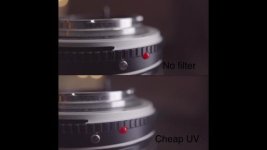
Here is a quick test putting a cheap UV filter on the rear of a Zeiss CP.2

Zeiss CP/ZF/ZE have the reputation for higher contrast than other cinema lenses. A cheap UV filter lowers contrast in the shadows and softens the highlights withough going so far as full on diffusion.

58AF72CE-E2DD-4606-8A35-997356414383.jpg

Maybe an Ultra Con or diffussion would be better, but i find even light diffusion to be noticeable.

Theoretically, with a lower quality piece of glass in the rear of the lens, it will soften highlights and lift the shadows. Even though the glass is "clear", it is in the more critical path of light between the lens and the sensor. It will add character to sharp contrasty glass, like the Lumix stuff for the M433 cameras, or Zeiss ZF stopped down. In the image i posted, the highlight in the shiny lens mount has a small amount of clipping, the clipping is smoother with the cheap UV filter added to the rear of the lens in part because of lower contrast and color shift, but also because of a slight sharpness reduction. Shadows are also lifted. I’ll have to test more types of glass and filters, but it feels promising so far. Being less optically pure, there is some sharpness loss in addition to the contrast reduction, so it does help smooth highlights in that way. The cheap UV filter I used had a slight haze to it. may have been defective, so this one has a stronger effect than the average cheap glass.So, I imagine this UV filter has the effect of very light diffusion.
 
Last edited:
Great info James. I've also read about using nets between the lens and the sensor, but never actually tried it. It's a common diffuser, nonetheless. I guess I'm just trying to find a way to get a smoother rolloff along the entire spectrum of the image, especially in the highlights. Underexposing has been a common practise to achieve this, but, sometimes, at the expense of crushed / noisy shadows.
 
James- Are you also using a lens adapter with the CP.2's? Or are you using the CP.2's mounted to a native mount, sans any mount adapter? I didn't know the CP.2's have threads on the rear element.
 
Magic Bullet has a fairly good approximation of a low com. Clicking it on and off will give you a rough idea of the Ultra Com. I use Ultra Cons in everything but corp. videos.
 
When I used to use Ultracons it was mostly to keep shadow areas from blocking up. We still have to crush the image back down in post to deliver proper blacks, but it did give the possiblity of pulling out some detail if required. There was usually a little bit of highlight improvement, a slight rounding off of clipping, but most of the effect was in the shadows.

With log at our disposal, I'm not sure that UltraCons represent much of an advantage as they do the same sort of thing less effectively and consistently. Would be interested in seeing examples that demo specific advantages of using Ultra Cons vs using a softer curve in post.
 
I'll use them on any camera if it suits the project and the image I'm looking for. It adds a little bit of something even if I'm grading a fair bit

Here its a 5d mark IV with an Ultracon 2 on a Zeiss 50mm

Screen Shot 2018-04-09 at 9.57.57 PM.jpg
 
A round ultracon is going to be a bit odd to use. They work much better in a mattbox since all of the incident light adds to the contrast reduction. They can also be a bit odd if you are shooting in a space with non balanced light. For example, a big green field is going to tint your image.

I really like the Black Satin filters for getting the effect I think you are trying to achieve. You might look into those.
 
Back
Top