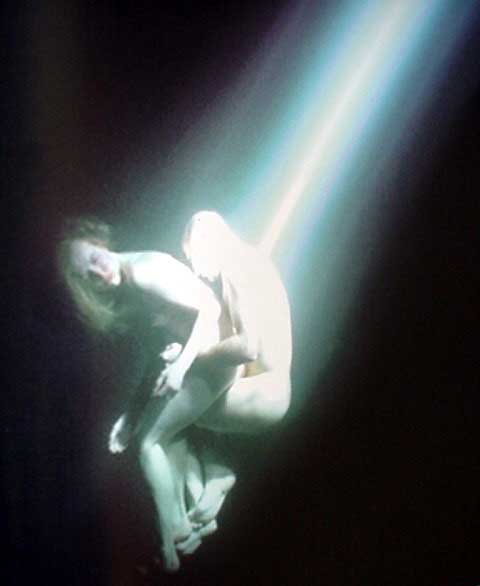
The Reverse Silouette.... what?

I want a properly exposed or slightly under set with a motivated silhouette of complete blown out nature. A true reverse silhouette, not over exposed. It might be completely wrong looking and unmotivated, but I'm hoping to get that pure white clean figure that darkened silhouettes get.

Thanks for everyone's input, and I'll be sure to post back when I do the experiment.

I've had a hard time visualizing what you are looking for. A silhouette is a high contrast image, where all the interior detail has been dropped, and only the shapes remain. Whether the 'central/significant' shape is white or black (or any other contrasting color combo...), mawx nix, given that it is contrasted with the surrounding area of the image.

Further I didn't interpret your terms to mean, 'rotoscoped' detailed image dropped into <whateverbackground>.

If, on the other hand, you are looking for something to 'pull' a figure out of a 'background', then perhaps something like the Woman In The Red Dress scene in "Matrix"(1999) is what you are thinking of.

I wouldn't calll that a 'reverse silhouette' though...
 
Last edited:
I see what you are talking about Ryan, but I don't think it will look all to good. In those situations like the deer in the headlights, spaceship landing, etc, the light over exposing the subject is motivated.

I am having a hard time thinking of a situation where I have seen (in real life) a person or object so brightly lit that I could pull no detail from their figure but the rest of the surrounding area is fine. I do see silhouettes everyday though, so that doesn't look strange on film. Do try it though, and please share the results.
 
'Chiaroscuro' is perhaps the term you're thinking of.

No, much more sublime than that.

As I remember the term was used because some film stocks were so bad that sometimes you could only get exposure on one plane (on the subject, or behind the subject), and there was a term for this.
 
Well, I’ve been racking my brains for a couple of days, and have managed to rustle up a couple of examples (…kinda). Both are from the same director…

Both clips herelink’d feature nudity and/or images that some might find disturbing.

Chris Cunningham’s RUBBER JOHNNY contains the odd frame featuring the ‘inverse silhouette’:


um_1032043-182571-RubberJohnnyChrisCun-1188956188_thumb27.jpg
105930.large.jpg


These aren’t achieved under continuous lighting, however. Rather, they appear to be the result of random strobe flashes (and they may well be further post-processed). In isolation, these grabs remind me of 1920-1930s photographs of spiritualists spewing ‘ectoplasm’ all over their levitating table-cloths!

The male figure in this tableau from Cunningham’s FLEX is rendered, more or less, as a ‘reverse silhouette’ (albeit in a void, as opposed to a real-life BG):

cunningham01a.jpg


I agree with William, though – outside of supernatural depictions, and the type of instances we’ve already mentioned, there aren’t too many situations in which a motivated source would produce the whole-enchilada effect.

On the other hand – f**k reality! I can’t wait to see the results of your experiments, and to hear about the techniques used – keep us posted!

Cheers,

DP
 
Ryan,

I watched "Stardust"(2007) last night. In the finale scene where the Lamia character (Michelle Pfeiffer) is just about to kill Yvaine the Star, (Clare Danes), she embraces Tristan (Charlie Cox), the young hero to protect him, and then she emits her 'star' quality, which is to shone. The pair become essentially a bright light which distroys Lamia, and saves the day.

Is this what you are thinking of?
 
When I think of the effect that you are talking about, I think about animation effects. The "Sin City" reference is spot on. I also remember seeing that effect during the late 70's in the works of Ralph Bakshi, especially stuff like "Fritz the Cat", "Heavy Traffic", and especially "Wizards". Man, oh man, I miss the Midnight movie days....

When I started I shot a lot of "Extreme" fashion shows (ok, fetish leather shows) and punk bands on Super 8 reversal, and the low luminance range of the reversal stocks gave us that, "Inverse" silhouette look on many occasions. What we usually did was set every camera to WFO, just to get an exposure across the stage, then when the talent moved into a follow spot, close to the camera, they would blow out, and the background would be under exposed by a few stops. We usually shot at a higher fps to get slo mo and then slowed most everything down in post, so these shots were pretty expressionistic and considered primo shots. We used them a lot. Of course these kind of shots in that environment, were just the artistic accidents of shooting a live event on film. Now that you got me thinking about it, I would like to experiment with this some more, in more controlled situations. Nice call.
 
Maybe if your subject was clothed in UltraBounce, including a facemask? And keep spill off the background, maybe silhouette some of the BG elements (trees, say) for context in the shot.
 
Yes. What I would *like* to do is get an amazing sunset/magic hour landscape shot, and have two actors in the foreground being hit by two 10 or 20k's each right next to camera on either side, to eliminate shadows. The magic hour lighting will allow for the background to be relatively less illuminated then during normal daytime hours... and still look nice. It's obviously going to be a surreal scene, as this would not be easily motivated. I'll see if I can do this one day, but the lighting rental and power issues will be... issues. Perhaps I'll wait to experiment when I'm on a set with such lights. Therefore I don't pay for it!
 
Does anyone remember Quantum Leap? As the main protagonist, Sam, 'leaps' into another body - and time - he phases a kind of all white, whilst the background remains normal. I think use of this technique on a human subject generally connotes a supernatural or fantasy theme. However, I'm sure you could use it elsewhere: a subject sitting near a window with late afternoon sun streaming through from a high level, high angle position, bleaching the subject entirely white, whilst the background remains untouched. I agree, Ryan, the background does not have to be black.
 
One of the few examples that I can think of like this is the scenes in Dexter where Harry (Dexter's dad) appears to him from the other side. Usually the background is extremely dark and a combination of filtration, shutter angle and white level is used to bloom out his highlights until he practically glowing. It's not exactly what you're talking about, but a practical application of that sort of vignette/camio lighting.
 
1282245372.jpg

From LA Confidential.

It's a flashbulb, and is only momentary. But this is a great example of the reverse silhouette, and it proves it to be possible, however uncomfortable for the actor.
 
One thing to remember is that if there's no outline it isn't a silhouette in the first place.

Defining a silhouette needs contrast difference and the object being silhouetted should also be smaller than the contrasting element.

It also depends if by opposite you mean overexposed instead of underexposed (some examples already posted) or background/ambient underexposed.

What could be a nice effect is a person lit normally and all the other elements 3 or 4 stops down. Difficult thing to get without compositing.

Band_of_Brothers%2C_101st_in_Iraq.jpg


Time for some photoshopping for the inverse of it.

:)
 
One thing to remember is that if there's no outline it isn't a silhouette in the first place.

Defining a silhouette needs contrast difference and the object being silhouetted should also be smaller than the contrasting element.

It also depends if by opposite you mean overexposed instead of underexposed (some examples already posted) or background/ambient underexposed.

What could be a nice effect is a person lit normally and all the other elements 3 or 4 stops down. Difficult thing to get without compositing.

Time for some photoshopping for the inverse of it.

:)

-What do you mean by "no outline"?

-My definition of a silhouette is a subject with an extreme lighting contrast with its background.

-By opposite, I mean an extremely over-exposed or blown out subject on a darker or properly exposed background.

-The photoshopped example is not what I mean. :( Perhaps the word 'reverse silhouette' is the issue. What I meant is like the still from LA Confidential
 
Yeah, the problem was with the definition, when I read reverse silhoutte all I could picture was a person exposed normally and the background pretty dark, however you wouldn't be able to see outlines from background elements anyway (my confusing explanation), only foreground elements, with stuff passing in front of the normally exposed actors.
 
Back
Top