The Practical Lighting Discussion Thread

Angry Leprechaun

Well-known member
So in honor of the Practicals king Roger Deakins winning his Oscar (but mostly out of my own curiousity) I wanted to hear some of your best advice on using practicals while using minimal to no "film lights". And I don't mean ghetto rigging some work lights or china balls, I mean using actual house lights that can be in the shot without being distracting.

I'm actually working on a documentary project where I'll be shooting at different people's houses and instead of setting up film lights for talking head interviews, I'd like to "dress the set" in a way by changing out light bulbs and adding practicals. That way I can follow my talent in any room of the house and not be tied down to one location.

So here are some questions I have about working with only or mostly practicals.

Assuming the talent doesn't mind what type of light fixtures you add to their home and they more or less go with the rest of the house, what are some light fixtures that would give off a nice soft light? Maybe if there are specific lamp shades that diffuse light more evenly than a more decorative lamp.

I'm wondering how something like this would work? Almost seems like a China ball on a stand.
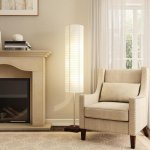
walnut-adesso-floor-lamps-4099-15-e1_1000.jpg

Sometimes I'll put one of these against a wall and bounce light from it and it does a pretty good job. I am trying to find a way to modify it with maybe a bigger cone and some diffusion on it.

https://www.walmart.com/ip/Mainstays-72-Combo-Floor-Lamp/12173433

Also what are some recommendations in terms of bulbs? I'm mostly shooting during the day so I'll mostly be using daylight balanced bulbs and if I'm shooting at night I might switch them out with tungsten, but I find most "daylight" bulbs ridiculously blue and it looks like I'm shooting a SAW movie. So what are some of the best color accurate bulbs for household lamps? They also need to work with a dimmer and preferably LED or CFL. I've seen Kino has 100w equivilent CFL bulbs that apparently have a good CRI and "produce soft light" but I'm not sure if they're dimmable or not (plus they're pretty pricey). Anyone know of other options?

And if anyone has any pictures of their practical lighting setup I'd love to see them!
 
Well... this looks quite nice:

http://erichelmin.com/serious/serious5.jpg

In other cases, fx. Prisoners, Deakins would hang an additional or two bulbs about his source, (like the scene in the old house where they are torturing Alex) so it isn't always just the practical.
But what camera are you using? Would it be at all possible for you to arrange your shots so you are basically using the window light as a source and the practicals are just.... practicals? Maybe with a little kick...
But again, I guess it's down to style, so if you are indeed going for that more "balanced" look, then the Serious Man example wouldn't fit ofcourse.

CFL's would give a decent amount of light. But you'd probably have to add some magenta filter to them.
 
Well - not sure where that still image came from on orig post - but that "china ball on a stand" is certainly not lighting the front & right side of that chair (or probably much of anything else in that scene). So much of this would depend upon your actual location & windows / time of day, etc. "Follow my talent in any room of the house and not be tied down to one location" - might require large, bright sources bounced off a ceiling / diffusion to put lots of soft light throughout a room. But perhaps if you were shooting at night - or windows didn't have to play - then lots of daylight "practicals" could at least supplement or help
 
I think describing Deakins as a user of practicals is way wide of the mark.

--

That Serious man shot for example.. If the ratios were wrong he we have called to his team to dim the practicals or ND the outside world or lift the outside world with some huge fixture(s).

Yes he uses practicals.. but not in the sense we know it!
 
Very often having a practical hot enough in a scene to be able to light an actor to anything near stop will mean that it will also blow out on camera. That may be part of the look, but if it isn't, you have to figure out a workaround. Traditionally that would mean an additional unit that would appear to be motivated from camera. These days tiny LED fixtures can more easily be hidden behind the practical (light ribbon or sticks that can be taped up).

Another approach if the practical has an accessible bulb is to knock down the side of the bulb that faces camera, with Streaks 'n Tips or other means. With cool running sources like fluorescent or lower voltage LED's you can use paper tape, or sometimes ND gel that is wrapped halfway around the bulb. If there is a linear shaped shade, you can sometimes mount ND or diffusion to the camera facing side.

I remember on West Wing the DP had requested special lampshades for the table practicals that had extra thick material on one half and we'd rotate those so that side always faced camera.
 
Guy and I go back some 25 years!! He is a font of knowledge.

Even since that post in 2013 (I think of that as not that long ago, but five years is five years) we have new options as I mentioned above. LED sticks/floppy panels/self-contained tubes are pretty prevalent now and I think often a better alternative than knocking down the practical bulbs as mentioned. Separating the sources means more control over both, especially if things change. And the light output from a practical is often a complex thing: a standard lampshade will have one value to camera at the shade, and also push a hotter level of light out the bottom and/or top, so regulating those together while still lighting the subject means juggling a lot of things. So as I said, I think it's smarter now to hide LED's against the backside of a practical if you have the means to do so. Of course this doesn't work if a single shot will come around and see 270 degrees of a fixture.
 
Very often having a practical hot enough in a scene to be able to light an actor to anything near stop will mean that it will also blow out on camera. That may be part of the look, but if it isn't, you have to figure out a workaround. Traditionally that would mean an additional unit that would appear to be motivated from camera. These days tiny LED fixtures can more easily be hidden behind the practical (light ribbon or sticks that can be taped up).

Another approach if the practical has an accessible bulb is to knock down the side of the bulb that faces camera, with Streaks 'n Tips or other means. With cool running sources like fluorescent or lower voltage LED's you can use paper tape, or sometimes ND gel that is wrapped halfway around the bulb. If there is a linear shaped shade, you can sometimes mount ND or diffusion to the camera facing side.

I remember on West Wing the DP had requested special lampshades for the table practicals that had extra thick material on one half and we'd rotate those so that side always faced camera.

Very cunning! I need to remember this for the future, seems so obvious yet never considered it when I've encountered it myself.
 
Thanks for all the great tips everyone (especially the links to the light bulbs! Been looking everywhere for something like these) I don't mind the lights being a bit overexposed, but I definitely like the ND gel idea so I'll have to play around with that. An idea I was thinking of instead of just relying on one higher wattage source, bringing in more sources to help light the room. Maybe keeping the brighter sources towards the middle of the space with having splashes of lower wattage bulbs closer to the walls and corners. That quote from Guy is great but also David Mullen's comment he was replying too.

It shouldn't be hard to light a house to 1000 ISO at T/2 -- just put some brighter wattage bulbs in the practicals, have plenty of practicals, and augment when possible with some hidden ceiling bounces or paper lanterns. The exposure doesn't have to hit key levels anyway, that would end up looking over-lit.

I am going to have to supplement I'm sure, but I think relying mostly on practicals will at least give me the flexibility I'm looking for. I might carry around an Ice Light or one of the knock offs on a small stand or tabletop stand to act as a supplemental key for quick interviews. Since I'm lighting for a documentary I don't think I'll have as much time and control I'd have shooting a narrative, but I at least have an idea of how I can work with the spaces I'm given.

Let's keep this discussion going though! Maybe it's just me, but I've always liked the work I've done with few lights better. Just seems more natural and less distracting.
 
Came across this blog with a lot of great tips for practical lighting.

https://www.owlbot.co/owlblog/practical-lighting/

I think I'm going to grab those Quasar Science bulbs (they have these soft A-LED lights also https://www.quasarscience.com/colle...edium-base-household-bulbs?variant=3582653635) And try to work with replacing bulbs and adding fixtures. Anyone else use the screw in A-LEDs before? I see a lot of people using the tubes to replace their fluorescent fixtures but not a lot of people talking about the bulbs.

I'm also thinking about making a batten light out of these lights, a 4 socket adapter, and a large white lampshade with muslin lined on half of the inside of the shade. Basically trying to make a china ball out of a normal looking lampshade. My reasoning is if the batten light is accidentally in frame it's just going to look like another lamp.

I've noticed this in quite a few documentaries, there will be an interview or something and since it's run and gun, I'll see a china ball or a Kino in the frame (happens in Icarus quite a bit), so I'm curious how modifying a household lampshade will work as a supplement light.
 
I know I mention this every so often... but Deakins' forum is also a big treassure. Even though his lighting is pretty simple at times, it's the way he uses it and the image it creates. From the vast setups in Blade Runner 2047 to Prisoners... I mean, fx. the bathroom scene where Hugh Jackman smashes the sink, was lit with the pratical, and then only added another practical just above the one in the shot. I love it! :)

And in the case you talk about, the same could be said with Deakins where in office scenes he would just shoot under the tubes already there, and emphasize with the same tubes, or replace them if there wasn't too many and then again emphasize.
 
Back
Top