The personality of a good director

Denialorcoped

Well-known member
To be honest, I've never directed an anything besides a micro-budget short in which my actors were also the crew and an animated web-series in which I communicated with my team via email. My end goal is to one day direct an indie-feature, but one thing that has been bothering me as of late is if being a good director requires a certain personality type. I'm definitely a more quiet and introverted type, I don't raise my voice ever. I'm a good listener and I like to keep a positive attitude with the teams I work on; it's just my style, but I fear that some may interpret my style has not being able to convey leadership. Do you think generally producers care about that sort of thing? Or do they mainly just judge you by your work and not your personality?
 
Judith Weston says that the director's primary role is that of a viewer, so that the actor doesn't need to watch himself as he's acting. He can trust you to say, "Print," or "Let's do it again." Actors who don't trust their director end up watching themselves as they perform, and so they cannot get as much in the moment, and in the end the performance is not as good.

So I would say being a good listener, courteous and gentle, are good qualities in a director that are also right in line with being an introvert. Secondly, being trustworthy simply comes with good judgment, again an equal possibility for introverts and extroverts.

Finally Judith says that actors want either clear, simple direction or nothing at all. Again, totally within reach of an introvert. An introvert may even be more predisposed than an extrovert to be short and to the point.

 
Last edited:
Judith Weston says that the director's primary role is that of a viewer, so that the actor doesn't need to watch himself as he's acting...

Having read Weston's books, I must say that that's a very interesting interpretation of what she says. I also find it hard to see the connection between the alleged director's primary role as a viewer (if one indeed is a viewer) and the need (or lack of it) for actors to watch himself or herself.

But talking about introverts, I'd concur that introverts can be excellent directors as the history of cinematography proved not once. And getting back to Judith Weston - if OP hasn't read her books, it'd be certainly beneficial to read them. My personal favorite is Directing Actors as IMO a more practical and less controversial reading.
 
Judith Weston says that the director's primary role is that of a viewer, so that the actor doesn't need to watch himself as he's acting.
Having read Weston's books, I must say that that's a very interesting interpretation of what she says. I also find it hard to see the connection between the alleged director's primary role as a viewer (if one indeed is a viewer) and the need (or lack of it) for actors to watch himself or herself.

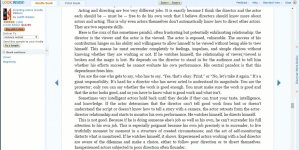
From the Introduction:

directing_actors.jpg
 
Last edited:
I think it takes all types for all types of films. I was given a cool little book of director's quotes, and it would often juxtapose different philosophies across two pages - so you can see a quote from Steven Soderbergh followed by a quote from David Fincher and they have the complete opposite approach to directing a set, yet both achieve great results (in this case, Fincher needing a tense set where Soderbergh likes things relaxed).
 
To really be in control of your success as a director you have to know at LEAST half a dozen ways to direct actors because what works, what connects, with one actor will often not work with another.

Having directed live theater, short films, live events, music videos, and the related task of producing about 20 albums for different types of musical acts, I can say FOR CERTAIN that I still learn new and IMPORTANT ways to interact with artists EVERY single time I work.
 

I don't see the word "primary". In the context of the original post to talk about the primary role as a viewer is very misleading IMO. The primary role of a director is that of a leader, and as other responses pointed, that requires to be able to play many roles (including being a viewer) and have many skills. Also, Weston's books are not even meant to cover and teach all aspects of directors job. She is focusing on what she knows best - directing actors.
 
Back
Top