The new Mac Pro coming later this year (take a look).

I'm worried about Johny Ive's influence. Yes Love his aluminum Macs but he introduced some really crap products that looked great. The PLASTIC imacs. monitors and ibooks spring to mind. I sure hope he can explain WHY this new MacPro is cylindrical. On my 'bookself' every book has flat side so they can play well together. A cylinder makes no sense for a CPU from a HW integration POV.
 
Here's my 2c: the idea is strong. Lotsa (aggregate-able) Thunderbolt is great. The basic architecture is great. I'm scared about buying New Mac Pro Version 1 though because it seems it might possibly be a bit expensive to upgrade down the line. Particularly those proprietary GPU circuit boards.

Depends on your own ROI situation of course. For lots of people it will make perfect sense.

Expansion options, even back in the day the old macpro was criticised for lack of expansion having only 3 slots (PC were not much better some having 4). once you had installed two graphics cards and say an eSata card that was it.
I love this new design, for me it's offers much more versatility. Say for example in 4 yrs time a new super graphics card emerges, you buy perhaps 2 or 4 of these which will already be housed in a stand alone case with PSU and simply connect via thunderbolt, for real data flow perhaps use 2 or 4 thunderbolt ports in parallel.

The thing is: back in the old days, the inability to stick 4 GPUs in a Mac Pro wasn't a huge problem because GPUs weren't ready to tackle general purpose computing tasks yet so it made little point to have 4 of them.

I do fear that in less than 4 years' time, GPUs will be so powerful so powerful that Thunderbolt 2 will be a botteneck (depending on whether the task is throughput-limited or compute-limited, of course). Especially if you want to plug in several of those guys.

And wait until the fibre option of thunderbolt come on line, can't wait to see those speeds. It's a great modular design that can be configured anyway you want. They are going with this external bus theme.

I do like fibre... however please realize that the fibre option of Thunderbolt 2 will be the same speed as existing Thunderbolt 2.

Maybe they'll have Thunderbolt 3 with faster speeds. But you will have to buy a new Mac Pro to get that.

Bruce Allen
www.boacinema.com
 
Here's my 2c: the idea is strong. Lotsa (aggregate-able) Thunderbolt is great. The basic architecture is great. I'm scared about buying New Mac Pro Version 1 though because it seems it might possibly be a bit expensive to upgrade down the line. Particularly those proprietary GPU circuit boards.

Depends on your own ROI situation of course. For lots of people it will make perfect sense.


The thing is: back in the old days, the inability to stick 4 GPUs in a Mac Pro wasn't a huge problem because GPUs weren't ready to tackle general purpose computing tasks yet so it made little point to have 4 of them.

I do fear that in less than 4 years' time, GPUs will be so powerful so powerful that Thunderbolt 2 will be a botteneck (depending on whether the task is throughput-limited or compute-limited, of course). Especially if you want to plug in several of those guys.


I do like fibre... however please realize that the fibre option of Thunderbolt 2 will be the same speed as existing Thunderbolt 2.

Maybe they'll have Thunderbolt 3 with faster speeds. But you will have to buy a new Mac Pro to get that.

Bruce Allen
www.boacinema.com

You're worried about a computer 4 years from now? If thats the case, stop buying computers. With tech moving so fast I think the turnover rate is 2 years max. Buy, make money with it, buy again. Budget the next computer in chunks into contracts and set aside money for the next move.
 
Personally, the new design is a disappointment to me. I was really hoping for something a bit less exotic, and with internal hard disk drive bays for storage (2 or preferably 3). Please don't tell me that you can just add external drives, I know that, but that option is more expensive, and always seems to be slower and less reliable when it comes to real world speed. Internal drives are also more tidy, and they use less electricity as they share a power supply.

To me, this is just like the Cube, it's an iMac on steroids with no screen, but the real iMac will probably have the same performance in a year or two anyhow, and will no doubt have a 4k screen built in. The cube did not sell well, and I don't think this will either. It's only worthwhile to people who need massive performance and don't care about expandability.

My Mac Pro 2008 is still a very good computer after 5 years, I don't see this new machine being more than a door stop after that amount of time.
 
Please don't tell me that you can just add external drives, I know that, but that option is more expensive, and always seems to be slower and less reliable when it comes to real world speed

Thunderbolt 2 is a bi-directional 20 Gbps data conduit, which could easily be 5 - 10 times faster than any built-in SATA drive.

This new Mac is not going to be cheap, so anyone buying it should be able to afford high performance external drives.

The biggest problem I've found with built-in drives is that they fill up very quickly, and then you are forced to used external drives because you need 12+ GB of drive space for production work.

Overall I quite like this new design, especially as it's small enough to be considered portable, so you could take this to your client's office for on the spot edits, or just ferry it between home and the studio.
 
Last edited:
My Mac Pro 2008 is still a very good computer after 5 years, I don't see this new machine being more than a door stop after that amount of time.

I agree with that (still using a 1st gen Mac Pro regularly), and it's certainly a testament to the old Mac Pro's longevity, but doesn't that statement apply to the entire computer industry? Is there any PC workstation today that will be more than a doorstop in 5 years? If you build one yourself you can upgrade it piecemeal, but over a 5-year span you've still essentially gutted the computer and ended up with a new one (albeit gradually).

The old Mac Pro didn't deliver anything particularly different than a similarly-specced PC, other than a well-designed enclosure. Every new model was criticized (and not without merit) for being overpriced relative to similar PCs, and forcing people to pay the "Apple Tax" to run OS X.

The new Mac Pro on the other hand is an Apple product through and through. It's their clean-slate take on a pro workstation, using their engineering wherewithal to fit as much computing power as possible into as small and efficient a device as possible. Any peripheral functionality can be added; Thunderbolt may need to play some catch-up for certain uses, but I think it's hard to make the case that six 20Gbit expansion ports equals no expandability.

I think the implicit statement with this design is, if you want a PC workstation, get one. But if you want an Apple workstation, then you should be getting Apple's idea of a workstation, not just a PC that runs their OS.
 
You're worried about a computer 4 years from now? If thats the case, stop buying computers. With tech moving so fast I think the turnover rate is 2 years max. Buy, make money with it, buy again. Budget the next computer in chunks into contracts and set aside money for the next move.
I think computer speeds have come to a grinding halt since AMD stopped being a player. They are so far behind Intel now that Intel can slow down and still be ahead in the speed race.

I bought a CPU 3 years ago (AMD) for about 250$, I just bought another computer today, while spending about 30% more on the CPU this time, the CPU in itself is only twice as fast (not in clock speed, but real world usage). It used to be doubling in speed every 18 months, now it hasn't really doubled in 3 years. And the 3 year old is still fine for doing RED 4.5k (edit 2k, and export pretty fast in 4.5k), and I will keep it for another 2-3 years just as a render machine.

The computers today and last couple of years are so fast/competent that you can have them around for a long time, you might not be able to play newer games on high quality, or run the new 6K dragon in full res, but you can still edit in 2k of Full HD, etc... 10-15 years ago the computer got obsolete in 3-4 years, making it impossible to install new programs or games. Now, I can use my old computer and let it render frames in Maya, instead of taking 1 hour per frame like my new computer, it might do it for 2 hours per frame but the thing is that it can do it, it doesn't get obsolete, just slower.
 
Last edited:
Quote- "do like fibre... however please realize that the fibre option of Thunderbolt 2 will be the same speed as existing Thunderbolt 2.

Maybe they'll have Thunderbolt 3 with faster speeds. But you will have to buy a new Mac Pro to get that."


Hi Bruce I am aware that in the near future if they go fibre it wont be much faster that the existing copper thunderbolt, indeed I believe the choice to go copper was a last minute one to speed the launch of Thunderbolt 1 and 2, but I'll bet the next gen chipset for optical thunderbolt will scream, once Intel/Apple have cracked the issues regarding speeding up the optical/electron interface it will fly.

And yes Optical thunderbolt will probably mean a new motherboard/mac


How do they plan on having power in the optical version? And you are right that the copper version was just to get it out there in time to compete with USB3.
 
How do they plan on having power in the optical version? And you are right that the copper version was just to get it out there in time to compete with USB3.

Some info from the Wikipedia article. No power initially, but current connectors will be forward-compatibile with optical cables:

Intel and industry partners are still developing optical Thunderbolt hardware and cables. The optical fiber cables are to run "tens of meters" but will not supply power, at least not initially. ... The conversion of electrical signal to optical will be embedded into the cable itself, allowing the current MDP connector to be forward compatible, but eventually Intel hopes for a purely optical transceiver assembly embedded in the PC.
 
You're worried about a computer 4 years from now? If thats the case, stop buying computers. With tech moving so fast I think the turnover rate is 2 years max. Buy, make money with it, buy again. Budget the next computer in chunks into contracts and set aside money for the next move.

CPUs don't progress that quickly anymore. Sandy Bridge -> Ivy Bridge -> Haswell has been really disappointing. It's not like years ago when they would go out of date quickly.

We have a bunch of 2009 Mac Pros that just helped render a ton of stuff for the Iron Man 3 trailer. Sure they were slower than our 12-cores for Maya... but After Effects is so poorly multithreaded anyway that I think they might have been faster for AE, actually.

The only things that go out of date these days are GPU and SSD.

Which is why it sucks that the GPU isn't on a standard, upgradeable card on this Mac Pro.

I think computer speeds have come to a grinding halt since AMD stopped being a player. They are so far behind Intel now that Intel can slow down and still be ahead in the speed race.

Agree sadly.

Hi Bruce I am aware that in the near future if they go fibre it wont be much faster that the existing copper thunderbolt, indeed I believe the choice to go copper was a last minute one to speed the launch of Thunderbolt 1 and 2, but I'll bet the next gen chipset for optical thunderbolt will scream, once Intel/Apple have cracked the issues regarding speeding up the optical/electron interface it will fly.

And yes Optical thunderbolt will probably mean a new motherboard/mac


Agree 100%. I think the current plan for optical in Thunderbolt 1 / 2 is to have a little converter built into each end of the cable. EG it converts the electrical signal into optical, sends it down the cable, then converts the optical back to electrical.

So it is unlikely optical can be faster than electrical for this iteration. Also the cables will be expensive as hell and also you'll have to buy new ones (and a new Mac Pro motherboard) for Thunderbolt 3. Sadly!

Bruce Allen
www.boacinema.com
 
Seems like the plan for optical Thunderbolt is really just to allow longer cables, at least in the near future. So you can keep using the same copper cables for short (≤ 2m) runs or use the more expensive optical cables if you need longer runs.
 
Again the articles I have been reading suggest the next step will be a optical cable with the optical/electrical converter at each end to maintain compatibility with existing thunderbolt hardware, not a huge leap but a step none the less.

The big leap or next generation will be 100% optical, perhaps even a optical interface right into the processor or its supporting bus interface.

Current commercial fibre speeds

Quote"Fujitsu UK has announced the expansion of its 100G Dark Fibre network to cover an additional 2,500km of fibre optic cable, which supports “true” 100Gbps (Gigabits per second) data capacity across its carrier-grade Managed Wavelength Service (MWS) network."

and lifted off Wiki - the top speeds
[TABLE="class: wikitable, width: 1"]
[TR]
[TH="bgcolor: #F2F2F2, align: center"]Year[/TH]
[TH="bgcolor: #F2F2F2, align: center"]Organization[/TH]
[TH="bgcolor: #F2F2F2, align: center"]Effective speed[/TH]
[TH="bgcolor: #F2F2F2, align: center"]WDM channels[/TH]
[TH="bgcolor: #F2F2F2, align: center"]Per channel speed[/TH]
[TH="bgcolor: #F2F2F2, align: center"]Distance[/TH]
[/TR]
[TR]
[TD]2009[/TD]
[TD]Alcatel-Lucent[SUP][7][/SUP][/TD]
[TD]15 Tbit/s[/TD]
[TD]155[/TD]
[TD]100 Gbit/s[/TD]
[TD]90 km[/TD]
[/TR]
[TR]
[TD]2010[/TD]
[TD]NTT[SUP][8][/SUP][/TD]
[TD]69.1 Tbit/s[/TD]
[TD]432[/TD]
[TD]171 Gbit/s[/TD]
[TD]240 km[/TD]
[/TR]
[TR]
[TD]2011[/TD]
[TD]KIT[SUP][9][/SUP][/TD]
[TD]26 Tbit/s[/TD]
[TD]1[/TD]
[TD]26 Tbit/s[/TD]
[TD]50 km[/TD]
[/TR]
[TR]
[TD]2011[/TD]
[TD]NEC[SUP][10][/SUP][/TD]
[TD]101 Tbit/s[/TD]
[TD]370[/TD]
[TD]273 Gbit/s[/TD]
[TD]165 km[/TD]
[/TR]
[TR]
[TD]2012[/TD]
[TD]NEC, Corning[SUP][11][/SUP][/TD]
[TD]1.05 Petabit/s[/TD]
[TD]12 core fiber[/TD]
[TD][/TD]
[TD]52.4 km[/TD]
[/TR]
[/TABLE]


My point being (Fujitsu UK) this technology already exits and is in use, its only a matter of Intel/Apple or who ever making it cost effective to be built into their range of products allowing a hyper bus between computer modules.
 
Thunderbolt 2 is a bi-directional 20 Gbps data conduit, which could easily be 5 - 10 times faster than any built-in SATA drive.

This new Mac is not going to be cheap, so anyone buying it should be able to afford high performance external drives.

The biggest problem I've found with built-in drives is that they fill up very quickly, and then you are forced to used external drives because you need 12+ GB of drive space for production work.

Overall I quite like this new design, especially as it's small enough to be considered portable, so you could take this to your client's office for on the spot edits, or just ferry it between home and the studio.

The thunderbolt drives usually contain sata disks anyway, and not the fastest ones by any means. Having a thunderbolt interface between the enclosure and the computer simply slows it down even more. Having a high performance internal drive is better all round. A SSD TB drive may be a different case of course. With 3 TB drives I can have 12TB in my old mac pro which is plenty for me (I use external drives for backup).

As for the portability, if you have to take some huge TB raid with you, it's no more portable than the current Mac Pro. A laptop is a better solution in any case if portability is a requirement.

Sorry, but this new mac pro is a terrible design from a pro users POV. Maybe it will appeal to people who just like the idea of an overly expensive unusual looking computer, I'm not sure that's a big market though.

I think my next computer will have to be an iMac, at least they still have a single hard drive, but I'll wait until they get retina displays.
 
I think computer speeds have come to a grinding halt since AMD stopped being a player. They are so far behind Intel now that Intel can slow down and still be ahead in the speed race.

I bought a CPU 3 years ago (AMD) for about 250$, I just bought another computer today, while spending about 30% more on the CPU this time, the CPU in itself is only twice as fast (not in clock speed, but real world usage). It used to be doubling in speed every 18 months, now it hasn't really doubled in 3 years. And the 3 year old is still fine for doing RED 4.5k (edit 2k, and export pretty fast in 4.5k), and I will keep it for another 2-3 years just as a render machine.

The computers today and last couple of years are so fast/competent that you can have them around for a long time, you might not be able to play newer games on high quality, or run the new 6K dragon in full res, but you can still edit in 2k of Full HD, etc... 10-15 years ago the computer got obsolete in 3-4 years, making it impossible to install new programs or games. Now, I can use my old computer and let it render frames in Maya, instead of taking 1 hour per frame like my new computer, it might do it for 2 hours per frame but the thing is that it can do it, it doesn't get obsolete, just slower.
AMD CPUs are a better buy in mid-range systems.

http://www.cpubenchmark.net/cpu.php?cpu=AMD+FX-8350+Eight-Core

http://www.anandtech.com/show/7066/amd-announces-fx9590-and-fx9370-return-of-the-ghz-race
 
Last edited:
The thunderbolt drives usually contain sata disks anyway, and not the fastest ones by any means

You can buy whatever you like, so if you want speed a dual SSD in a compact portable Thunderbolt RAID box should rock your world if you can live with the price and the current size limitation of SSD drives.

Otherwise you're going to have to buy bigger SATA RAID boxes which can easily give you 400 - 600 MB/sec throughput and most of these are dedicated external RAID boxes.


Having a thunderbolt interface between the enclosure and the computer simply slows it down even more. Having a high performance internal drive is better all round.

This makes no sense, as you can buy small dual SSD RAID Thunderbolt drives that are about the same size as single 5.25 inch SATA drive, and it will stomp all over the SATA drive when it comes to raw speed.

Here's one from LaCie... LaCie Little Big Disk

And if you are willing to do a little work, there was an article at AnandTech where they ripped open a $200 Buffalo Thunderbolt MiniStation drive, removed the slow 5,400 rpm drive and replaced it with an SSD and saw 350+ MB/sec on a single SSD drive. ( a more up to date SSD would be pushing 500+ MB/sec )

As for the portability, if you have to take some huge TB raid with you, it's no more portable than the current Mac Pro. A laptop is a better solution in any case if portability is a requirement.

If you're in to any serious editing a laptop won't have enough room or drive speed, so you are going to be dragging along an external drive anyway, so why not bring a computer that can take full advantage of the external drive. I've had gigs where I end up working at the client's offices for almost 2 weeks, and I would rather work on a more powerful desktop than a more convenient laptop. ( I do love laptops, but most of them don't have the raw speed of an equivalent desktop computer )

Sorry, but this new mac pro is a terrible design from a pro users POV. Maybe it will appeal to people who just like the idea of an overly expensive unusual looking computer, I'm not sure that's a big market though.

I fully expect this new Mac Pro will be a rocket when benchmarked against any of the previous Macs it's replacing, especially when connected to a RAID that can make full use of Thunderbolt 2 speed.
 
The thunderbolt drives usually contain sata disks anyway, and not the fastest ones by any means. Having a thunderbolt interface between the enclosure and the computer simply slows it down even more. Having a high performance internal drive is better all round. A SSD TB drive may be a different case of course. With 3 TB drives I can have 12TB in my old mac pro which is plenty for me (I use external drives for backup).

As for the portability, if you have to take some huge TB raid with you, it's no more portable than the current Mac Pro. A laptop is a better solution in any case if portability is a requirement.

Sorry, but this new mac pro is a terrible design from a pro users POV. Maybe it will appeal to people who just like the idea of an overly expensive unusual looking computer, I'm not sure that's a big market though.

I think my next computer will have to be an iMac, at least they still have a single hard drive, but I'll wait until they get retina displays.

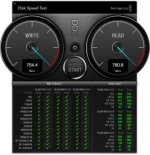
My TB enclosure is quite fast.
DiskSpeedTest.jpg

And I'll bet these enclosures will be built faster when the MacPro lands.

About the portability? What is currently as portable as the new MacPro that packs that speed? Even with a laptop you need to take your external drives with you. Taking the old MacPro was a pain as the computer is just too large and far too heavy. This new Mac Pro will be a dream to travel with.
 
So that's where they keep Darth Vader's ashes.

I bet third party manufacturers are already working on R2D2 mods.

ROFL.

I was thinking of the old SNL skit...
It's a super computer, it's a chamber pot, yes, it's both a super computer and a chamber pot.
 
You can buy whatever you like, so if you want speed a dual SSD in a compact portable Thunderbolt RAID box should rock your world if you can live with the price and the current size limitation of SSD drives.

Otherwise you're going to have to buy bigger SATA RAID boxes which can easily give you 400 - 600 MB/sec throughput and most of these are dedicated external RAID boxes.


This makes no sense, as you can buy small dual SSD RAID Thunderbolt drives that are about the same size as single 5.25 inch SATA drive, and it will stomp all over the SATA drive when it comes to raw speed.

Here's one from LaCie... LaCie Little Big Disk

And if you are willing to do a little work, there was an article at AnandTech where they ripped open a $200 Buffalo Thunderbolt MiniStation drive, removed the slow 5,400 rpm drive and replaced it with an SSD and saw 350+ MB/sec on a single SSD drive. ( a more up to date SSD would be pushing 500+ MB/sec )


If you're in to any serious editing a laptop won't have enough room or drive speed, so you are going to be dragging along an external drive anyway, so why not bring a computer that can take full advantage of the external drive. I've had gigs where I end up working at the client's offices for almost 2 weeks, and I would rather work on a more powerful desktop than a more convenient laptop. ( I do love laptops, but most of them don't have the raw speed of an equivalent desktop computer )


I fully expect this new Mac Pro will be a rocket when benchmarked against any of the previous Macs it's replacing, especially when connected to a RAID that can make full use of Thunderbolt 2 speed.

You're really missing the point that I was making. I don't doubt that the new Mac Pro will be faster and more powerful, that is not Apple's achievement so much as that of intel and the Graphics card manufacturers. Apple could have kept the old case, put in a new Mother Board with the latest tech and the machine would have been fantastic, just as fast, and much more upgradable. The only drawback would be aesthetic, and portability (although that would be arguable).

Alternatively, they could have made a smaller cheaper tower, with consumer grade (but powerful ) components and given us an expandable computer with performance better than an iMac (due to desktop graphics cards) at lower cost.

But what they chose was to put style ahead of function, and design a computer that is both expensive and unupgradable.

Regarding the specific point about external TBolt Hard Drives. I was talking about spinning discs here. They are usually slow 5400 models and have a SATA interface within the enclosure that is then converted to TBolt. Having the TBolt connection will not increase the speed of the disc or the SATA interface, it just makes one more step in the chain, which can only make things slower, never faster. An internal 7200rpm drive will be much faster and much cheaper and probably use less power. It is also very easy to swap for a larger drive when required.

Now, if you replace the drives with SSDs, you'll get a speed increase of course, but the same does for internal drives. In any case, SSDs are too small and too expensive for me to use as scratch drives for the foreseeable future.
 
Back
Top